

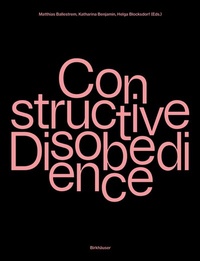
Constructive Disobedience
Description

How can we apply constructive experiments in architecture as an innovative response to the climate crisis? The conference 'Constructive Disobedience' was dedicated to addressing this question. This book compiles various projects and positions presented there, drawn from a wide range of practice, teaching and research cases. International projects include a prestressed rammed earth structure, studies on heterogeneous constructions, and the rediscovery of natural materials such as hemp and lime. Together, they form a methodological foundation that highlights the knowledge gained from experimental architecture for the coming era of building transformation.
- International contributions and new approaches in the field of experimental architecture
- Focus on bio-based and regenerative building methods: wood constructions, hemp lime, bacteria, reed, straw, earth
- A great variety of construction drawings
More details
Other editions
Additional editions

Persons
Editors
Helga Blocksdorf is an architect who runs the architecture office Helga Blocksdorf / Architektur. In 2021, she was appointed as professor and head of the Institute for Construction at the TU Braunschweig. Prior to this, she was a guest professor of constructive design at the Bauhaus-Universität Weimar and worked as a research assistant in the team headed by Prof. Ute Frank at the TU Berlin from 2007 to 2012. She is a doctoral candidate at the Programme for Design-Based Doctorates (PEP).
Matthias Ballestrem is an architect and Professor of Fundamentals of Architecture at the Technische Universität Dortmund. He was founding program director of the Bauhaus Earth Fellowship Program at Bauhaus Earth and co-managing director of Experimental. His is peer at the Programme for Design-Based Doctorates (PEP) and his research focuses on the methodologies of practice- and design-based research, experimental design, spatial perception, and spatial complexity.
Katharina Benjamin studied architecture at the Bauhaus-Universität Weimar. She worked for Peter Zumthor at Atelier Zumthor in Haldenstein (CH), as project coordinator for the XIV. International Bauhaus-Colloquium at the Bauhaus-Universität Weimar and from 2019 to 2022 as research assistant at the Chair of Architectural Design and Construction I at TU Dresden. Since 2021 she is working as research assistant at the Institute for Construction at the TU Braunschweig. In 2017 she founded the digital architecture platform Kontextur .
Contributing Authors
Aaron Forrest; Albor Arquitectos; Anne Beim; Anne Femmer; BLAF architecten; Brett Schneider; Christoph Richter; David Jenny; Delphine Schmid; Felix Hilgert; Florian Summa; Henriette Ejstrup; Jan Meier; Jan Musikowski; Lena Unger; Ludwig Wappner; Lykke Arnfred; MAPA; Monica Tu?inean; Nico Ros; Niklas Fanelsa; Oda Pälmke; Pelle Munch-Petersen; Peter Hoffmann; Remo Thalmann; Roger Boltshauser; Ruth Morrow; Saikal Zhunushova; Summer Islam; Susanne Brorson; Thorbjørn Lønberg Petersen; Yasmin Vobis
