

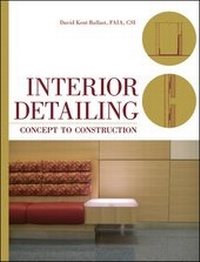
Interior Detailing
Concept to Construction
Published on 9. September 2010
304 pages
978-0-470-91642-1 (ISBN)
Description

The all-in-one interior detailing guide that unites creative andtechnical aspects
A well-executed interior space requires the successfulcombination of the creative and the technical. InteriorDetailing bridges the gap between design and construction, andshows how to develop and transform design concepts into detailsthat meet the constraints, functional requirements, andconstructability issues that are part of any interior designelement. It offers guidance on how design professionals can combineimaginative thinking and the application of technical resources tocreate interiors that are aesthetically pleasing, functionallysuperior, and environmentally sound. Interior Detailing:
* Includes 150 easy-to-understand details showing how to logicallythink through the design and development of an assembly so that itconforms to the designer's intent and meets the practicalrequirements of good construction
* Describes how to solve any detailing design problem in arational way
* Contains conceptual and practical approaches to designing anddetailing construction components thatform interior spaces
* Shows how a small number of principles can be used to solvenearly any detailing problem
This guide covers the subject of interior spaces comprehensivelyby balancing the contributions of physical beauty and structuralintegrity in one complete volume. By following the principles laidout in this book, interior designers and architects can plan forthe construction of a unique interior environment more thoughtfullyand with a clearer, better-defined purpose.
More details
Other editions
Additional editions
DK Ballast
Interior Detailing - Concept to Construction
Software
12/2011
Wiley
€127.14
Shipment within 15-20 days
Book
10/2010
Wiley
€92.00
Article not available at the moment
Person
DAVID KENT BALLAST, FAIA, CSI, a registered architect, has owned Architectural Research Consulting since 1981. The consulting firm provides applied research, technical advice, specifications, and information management services to architects, interior designers, and others in the construction industry. From 1987 to 2008, Ballast was an instructor in interior construction, CAD, and basic drafting at Arapahoe Community College. He is the author of a number of books on construction technology, including Handbook of Construction Tolerances, Second Edition, and Architect's Handbook of Construction Detailing, Second Edition, both published by Wiley.
Content
- INTERIOR DETAILING: CONCEPT TO CONSTRUCTION
- CONTENTS
- LIST OF TABLES
- LIST OF ILLUSTRATIONS
- PREFACE
- INTRODUCTION
- HOW SI UNITS ARE USED IN THIS BOOK
- PART 1: ROADMAP TO SOLVING DETAILING PROBLEMS
- CHAPTER 1: THE DESIGN/DETAILING PROCESS
- 1-1 INTRODUCTION
- 1-2 WHAT IS DETAILING?
- 1-3 THE DRAWING-THINKING-DRAWING CYCLE
- 1-4 PROCESS TOOLS AND TECHNIQUES
- 1-5 DETAILING COMPONENTS AND PROCESS
- 1-6 THREE PURPOSES OF A DETAIL
- 1-7 PROGRAMMATIC CONCEPTS VERSUS DESIGN CONCEPTS
- CHAPTER 2: CONSTRAINTS
- 2-1 INTRODUCTION
- 2-2 SUBSTRATES AND ADJACENT CONSTRUCTION
- 2-3 REGULATORY REQUIREMENTS
- 2-4 BUDGET
- 2-5 TIME
- 2-6 CLIMATE
- 2-7 LOCAL LABOR CONDITIONS AND TRADE PRACTICES
- 2-8 INDUSTRY STANDARDS
- 2-9 MATERIALS
- CHAPTER 3: FUNCTION
- 3-1 INTRODUCTION
- 3-2 CONCEALMENT AND FINISH
- 3-3 HUMAN FIT/OBJECT FIT
- 3-4 SAFETY: PROTECTION FROM ACCIDENTAL HARM
- 3-5 SECURITY: PROTECTION FROM INTENTIONAL HARM
- 3-6 SUSTAINABILITY
- 3-7 CHANGE AND RELOCATABILITY
- 3-8 FIRE RESISTANCE
- 3-9 ACOUSTICAL CONTROL
- 3-10 MOISTURE/WATER RESISTANCE
- CHAPTER 4: CONSTRUCTABILITY
- 4-1 INTRODUCTION
- 4-2 STRUCTURAL REQUIREMENTS
- 4-3 CONNECTIONS
- 4-4 MOVEMENT
- 4-5 TOLERANCES
- 4-6 CLEARANCES
- 4-7 DURABILITY
- 4-8 MAINTAINABILITY
- 4-9 CONSTRUCTION PROCESS
- PART 2: ELEMENTS
- CHAPTER 5: DIVIDING AND CREATING SPACE WITH PERMANENT BARRIERS
- 5-1 INTRODUCTION
- 5-2 ELEMENT CONCEPTS
- 5-3 FUNCTION
- 5-4 CONSTRAINTS
- 5-5 COORDINATION
- 5-6 METHODS
- CHAPTER 6: DIVIDING AND CREATING SPACE WITH TEMPORARY BARRIERS
- 6-1 INTRODUCTION
- 6-2 ELEMENT CONCEPTS
- 6-3 FUNCTION
- 6-4 CONSTRAINTS
- 6-5 COORDINATION
- 6-6 METHODS
- CHAPTER 7: OVERHEAD LIMITS-CEILINGS
- 7-1 INTRODUCTION
- 7-2 ELEMENT CONCEPTS
- 7-3 FUNCTION
- 7-4 CONSTRAINTS
- 7-5 COORDINATION
- 7-6 METHODS
- CHAPTER 8: THE GROUND PLANE-FLOORS, STAIRS, AND RAMPS
- 8-1 INTRODUCTION
- 8-2 ELEMENT CONCEPTS
- 8-3 FUNCTION
- 8-4 CONSTRAINTS
- 8-5 COORDINATION
- 8-6 METHODS
- CHAPTER 9: SPATIAL CONNECTION-OPENINGS, DOORS, AND GLAZING
- 9-1 INTRODUCTION
- 9-2 ELEMENT CONCEPTS
- 9-3 FUNCTION
- 9-4 CONSTRAINTS
- 9-5 COORDINATION
- 9-6 METHODS
- PART 3: TRANSITIONS
- CHAPTER 10: WALL TRANSITIONS
- 10-1 INTRODUCTION
- 10-2 CONNECTIONS OF MAJOR ELEMENTS
- 10-3 WALL TO FLOOR
- 10-4 WALL TO CEILING
- CHAPTER 11: PLANAR TRANSITIONS
- 11-1 PARTITION TO PARTITION
- 11-2 FLOOR TO FLOOR
- 11-3 CEILING TO CEILING
- CHAPTER 12: STRUCTURAL TRANSITIONS
- 12-1 INTRODUCTION
- 12-2 COLUMNS
- 12-3 BEAMS
- 12-4 SUSPENDED OBJECTS
- APPENDIX A: Resources
- APPENDIX B: Industry Standards for Interior Materials and Products
- INDEX
