

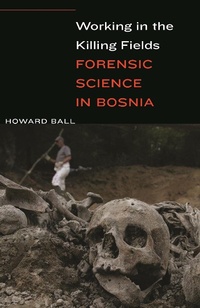
Working in the Killing Fields
Forensic Science in Bosnia
Published on 15. April 2015
232 pages
978-1-61234-730-1 (ISBN)
Description

While the specifics of individual wars vary, they share a common epilogue: the task of finding and identifying the "disappeared." The Bosnian war of the early 1990s, which destroyed the sovereign state of Yugoslavia, is no exception. In Working in the Killing Fields, Howard Ball focuses on recent developments in the technology of forensic science and on the work of forensic professionals in Bosnia following that conflict. Ball balances the examination of complex features of new forensic technology with insights into the lives of the men and women from around the globe who are tasked with finding and excavating bodies and conducting pathological examinations. Having found the disappeared, however, these same pathologists must then also explain the cause of death to international-court criminal prosecutors and surviving families of the victims. Ball considers the physical dangers these professionals regularly confront while performing their site excavations, as well as the emotional pain, including post-traumatic stress disorder, they contend with while in Bosnia and after they leave the killing fields.
Working in the Killing Fields integrates discussion of cutting-edge forensic technology into a wider view of what these searches mean, the damage they do to people, and the healing and good they bring to those in search of answers. Even though the Balkan wars took place two decades ago, the fields where so many men, women, and children died still have gruesome and disturbing stories to tell. Ball puts the spotlight on the forensic professionals tasked with telling that story and on what their work means to them as individuals and to the wider world's understanding of genocide and war.
Working in the Killing Fields integrates discussion of cutting-edge forensic technology into a wider view of what these searches mean, the damage they do to people, and the healing and good they bring to those in search of answers. Even though the Balkan wars took place two decades ago, the fields where so many men, women, and children died still have gruesome and disturbing stories to tell. Ball puts the spotlight on the forensic professionals tasked with telling that story and on what their work means to them as individuals and to the wider world's understanding of genocide and war.
Reviews / Votes
"Highly recommended for students of human rights politics and forensic sciences."-P. G. Conway, CHOICE "An excellent and accurate book that tells the story about the role of forensic scientists in the recovery and identification effort in the former Yugoslavia. It is well researched and thorough."-Eric Bartelink, associate professor of physical anthropology and director of the California State University-Chico Human Identification Laboratory "Howard Ball's erudite overview of the history behind [the Balkans] conflict and the responses of the forensic and psychosocial communities . . . are fascinating and in some ways diverse. . . . It behooves us all to look at the lessons and issues set out in works such as this and to try and slow down, and ultimately halt, what would seem to be the consequences of the worst of humankind."-Margaret Cox, president of Inforce Foundation and a former professor at the Cranfield Forensic Centre, Cranfield UniversityMore details
Language
English
Place of publication
Dulles
United States
Illustrations
1 illustration, 1 chart
File size
2,63 MB
ISBN-13
978-1-61234-730-1 (9781612347301)
Copyright in bibliographic data and cover images is held by Nielsen Book Services Limited or by the publishers or by their respective licensors: all rights reserved.
Schweitzer Classification
Other editions
Additional editions
Book
04/2015
Potomac Books Inc
€27.00
Shipment within 3-4 weeks
Person
Howard Ball is a professor emeritus of political science at the University of Vermont. He is the author of more than thirty books, including At Liberty to Die; Genocide; and Bush, the Detainees, and the Constitution.
Content
Acknowledgments
Introduction: On the Bank of the River Drina, May 10, 2003
Abbreviations
Chapter 1. The "Disappeared" in War and the Need to Find and Identify Them
Chapter 2. Balkan Nationalism, the Creation and the Collapse of Yugoslavia, and "Ethnic Cleansing"
Chapter 3. Finding, Exhuming, and Identifying the Human Remains in Bosnia
Chapter 4. The Forensic Scientists at Work in Bosnia's "Killing Fields"
Chapter 5. The Stark Realities Confronting the Searchers and the Survivors in Bosnia
Notes
Bibliography
Index
Introduction: On the Bank of the River Drina, May 10, 2003
Abbreviations
Chapter 1. The "Disappeared" in War and the Need to Find and Identify Them
Chapter 2. Balkan Nationalism, the Creation and the Collapse of Yugoslavia, and "Ethnic Cleansing"
Chapter 3. Finding, Exhuming, and Identifying the Human Remains in Bosnia
Chapter 4. The Forensic Scientists at Work in Bosnia's "Killing Fields"
Chapter 5. The Stark Realities Confronting the Searchers and the Survivors in Bosnia
Notes
Bibliography
Index
