

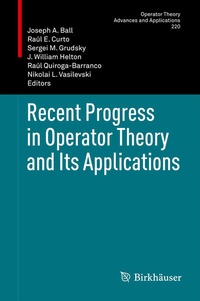
Recent Progress in Operator Theory and Its Applications
Description

This volume contains twenty-one solicited articles by speakers at the IWOTA 2009 workshop, ranging from expository surveys to original research papers, each carefully refereed. The contributions reflect recent developments in operator theory and its applications. Consistent with the topics of recent IWOTA meetings, IWOTA 2009 was designed as a comprehensive, inclusive conference covering all aspects of theoretical and applied operator theory, ranging from classical analysis, differential and integral equations, complex and harmonic analysis to mathematical physics, mathematical systems and control theory, signal processing and numerical analysis. The conference brought together international experts for a week-long stay at Hotel Real de Minas, in an atmosphere conducive to fruitful professional interactions. These Proceedings reflect the high quality of the papers presented at the conference.
More details
Other editions
Additional editions
Content
- Intro
- Recent Progress in Operator Theory and Its Applications
- Contents
- Introduction
- Exponential Decay of Semigroups for Second-order Non-selfadjoint Linear Differential Equations
- 1. Preliminary results
- 2. Main result
- 3. Related spectral problem
- Acknowledgement
- References
- Infinite Norm Decompositions of C*-algebras
- Introduction
- 1. Infinite norm decompositions
- 2. Applications
- References
- Canonical Transfer-function Realization for Schur-Agler-class Functions on Domains with Matrix Polynomial Defining Function in Cn
- 1. Introduction
- 2. Preliminaries
- 3. Weakly coisometric realizations
- 4. Weakly isometric realizations
- 5. Weakly unitary realizations
- References
- Generalized Lax Pair Operator Method and Nonautonomous Solitons
- 1. Introduction
- 2. Lax operator method formulation and exact integrability of nonautonomous nonlinear and dispersive models with external potentials
- 3. Generalized nonlinear Schr¨odinger equation and solitary waves in nonautonomous nonlinear and dispersive systems: nonautonomous solitons
- 4. Chirped optical solitons with moving spectra in nonautonomous systems: colored nonautonomous solitons
- 5. Bound states of colored nonautonomous optical solitons. Comparison of the Satsuma-Yajima canonical breather with nonautonomous "agitated" breather
- 6. Designable integrability of the variable coefficient nonlinear Schr¨odinger equation
- 7. Conclusions
- References
- Asymptotics of Individual Eigenvalues of a Class of Large Hessenberg Toeplitz Matrices
- 1. Introduction and main results
- 2. Toeplitz determinant
- 3. Contribution of ? to the asymptotic behavior of Dn
- 4. Contribution of 1 to the asymptotic behavior of Dn
- 5. Individual eigenvalues
- 6. An example
- References
- Real Berezin Transform and Asymptotic Expansion for Symmetric Spaces of Compact and Non-compact Type
- 1. Introduction
- 2. Berezin transform for hermitian symmetric spaces
- 3. Berezin transform for real symmetric spaces
- References
- On Nonlocal C*-algebras of Two-dimensional Singular Integral Operators
- 1. Introduction
- 2. The local-trajectory method
- 2.1. Starting assumptions
- 2.2. Trajectorial localization
- 3. C*-algebra of two-dimensional singular integral operators with constant coefficients on the space L2(II)
- 4. Quasiconformal shifts and their applications
- 5. C*-algebra of two-dimensional singular integral operators with continuous coefficients on the space L2(U)
- 5.1. The Allan-Douglas local principle and the C*-algebra u
- 5.2. Local algebras
- 6. C*-algebra of two-dimensional singular integral operators with shifts and continuous coefficients on the space L2(U)
- References
- The Riemann Boundary Value Problem on Non-rectifiable Curves and Fractal Dimensions
- Introduction
- 1. Approximation dimensions and integrations
- 2. The Cauchy transforms
- 3. Non-rectifiable arcs
- References
- Bloch Solutions of Periodic Dirac Equations in SPPS Form
- 1. Introduction
- 2. Schrödinger equations of Hill type
- 3. SPPS representation for solutions of the one-dimensional Dirac equation
- 3.1. Bloch solutions and Hill discriminant
- 4. Numerical calculation of eigenvalues based on the SPPS form of Hill's discriminant
- 5. Conclusions
- Acknowledgment
- References
- An Estimate for the Number of Solutions of a homogeneous Generalized Riemann Boundary Value Problem with Shift
- 1. Introduction
- 2. Main result
- 3. A special case with analytic coefficients
- References
- On the Hyperderivatives of Dirac-hyperholomorphic Functions of Clifford Analysis
- 1. Introduction
- 1.1. Algebraic preliminaries
- 1.2. Complex and hypercomplex antecedents
- 2. The left-e1-Dirac-hyperderivative
- 2.1.
- 2.2.
- 2.3.
- 2.4. Proposition.
- 2.5.
- 2.6. Definition.
- 2.7. Theorem.
- 2.8.
- 2.9. Theorem.
- 3. The left-e1-Dirac-hyperderivative as the limit of a quotient of increments
- 3.1.
- 3.2. Theorem.
- 4. The directional left-e1-Dirac-hyperderivative
- 4.1. Definition
- 4.2.
- 4.3.
- 4.4.
- 4.5. Theorem.
- 4.6. Corollary.
- 5. The left-e1-Dirac-hyperderivative and the Clifford-Cauchy-type integral
- 5.1.
- 5.2. The right-hand side operators
- 5.3. Definition.
- 5.4. Theorem.
- 5.5.
- 5.6.
- 5.7.
- 5.8. Theorem.
- 5.9. Corollary.
- 6. The left el-hyperderivatives
- 7. Comparison with one complex variable case
- References
- On the Discrete Cosine Transform of Weakly Stationary Signals
- 1. Introduction
- 2. Stationary random processes
- 2.1. First and second moments of stationary signals
- 2.2. Correlation and covariance matrices
- 3. The discrete cosine transform
- 4. Zeros on the diagonals
- 4.1. Nomenclature and fundamental identities
- 4.2. Diagonals of a DCT-II-transformed symmetric Toeplitz matrix
- 5. Conclusion
- Acknowledgment
- References
- Scattering of a Plane Wave by "Hard-Soft" Wedges
- 1. Introduction
- 2. Definitions and main theorems
- 3. Difference equation
- 3.1. Reduction to stationary problem
- 3.2. Reduction to the problem in a plane
- 3.3. Fourier Transform
- 3.4. Riemann surface
- 3.5. Connection equation and elimination of two Cauchy data
- 3.6. Automorphisms
- 4. Uniqueness
- 5. Solution of the difference equation
- 5.1. Meromorphic solution
- 5.2. Analytic solution
- 6. Inverse Fourier transform in time
- 6.1. Sommerfeld representation for scattered wave
- 7. Existence
- 7.1. On Sommerfeld-Malyuzhinets integrals
- 7.2. Incident, reflected and diffracted stationary waves
- 7.3. The scattered wave
- 8. Limiting amplitude principle
- Acknowledgment
- References
- Behavior of a Class of Second-order Planar Elliptic Equations with Degeneracies
- 1. Introduction
- 2. Normalization near a curve of degeneracy
- 3. Normalization near an isolated singularity
- 4. The Laplace equation with a singular point
- 5. Properties of the equation Pu = 0 and Du = 0
- References
- Finite Sections of Band-dominated Operators on Discrete Groups
- 1. Introduction
- 2. The algebra of the band-dominated operators
- 3. The algebra of the finite sections method
- 4. Stability
- References
- Joint Defect Index of a Cyclic Tuple of Symmetric Operators
- 1. Introduction
- 2. Formulation and Notation
- 2.1. The multi-dimensional moment problem
- 2.2. A cyclic tuple
- 2.3. Continuation
- 3. Main result
- 4. Reproducing kernels
- References
- Commutative Algebras of Toeplitz Operators on the Super Upper Half-plane: Super Parabolic Case
- 1. Introduction
- 2. Toeplitz operators on the super-disk
- 3. Toeplitz operators on the super upper half-plane
- 4. The super group R1|1
- 5. Toeplitz operator with symbols invariants under the action of R1|1
- References
- Measure Characterization involving the Limiting Eigenvalue Distribution for Schr¨odinger Operators on S2
- 1. Introduction
- 2. Results
- 2.1. Singular continuous measure
- 3. Future work
- Acknowledgement
- References
- Relations Among Various Versions of the Segal-Bargmann Transform
- 1. A Brief Introduction
- 2. Coxeter group case
- 3. Lie group case
- 4. An interesting counterexample: SU(2)
- 5. Concluding remarks
- Acknowledgment
- References
- Nonlinear Scattering in the LambSystem
- 1. Introduction
- 2. Problem formulation and description
- 2.1. Notations and definitions
- 3. Existence of dynamics
- 4. Scattering in the Lamb system
- 4.1. Convergence to the global attractor
- 4.2. Scattering asymptotic
- 5. Expression of the asymptotic states
- 6. Inverse scattering problem in the Lamb system
- 6.1. Reconstruction of the initial data (surjection of the operator W+-1)
- 6.2. Characterization on the asymptotic states
- 6.2.1. The case m = 0 and finite scattering data.
- 6.2.2. The case m = 0 and arbitrary scattering data: one-dimensional oscillator.
- 7. Example: F(u) = -u
- Acknowledgment
- References
- Toeplitz Algebras in Quantum Hopf Fibrations
- 1. Introduction
- 2. Preliminaries
- 2.1. Coalgebras and Hopf algebras
- 2.2. Pullback diagrams and fibre products
- 2.3. Disc-type quantum 2-spheres
- 2.4. Quantum 3-spheres and quantum Hopf fibrations
- 3. Fibre product approach to quantum Hopf fibrations
- 3.1. C*-algebraic construction of a quantum Hopf fibration
- 3.2. Index computation for quantum line bundles
- 3.3. Equivalence to the generic Hopf fibration of quantum SU(2)
- Acknowledgment
- References
