

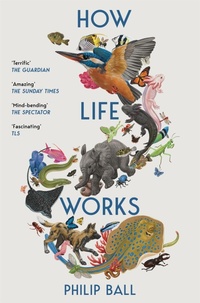
How Life Works
A User's Guide to the New Biology
Published on 9. November 2023
560 pages
978-1-5290-9601-9 (ISBN)
Description

'An essential primer on humanity's ongoing quest to understand the secrets of life . . . Excellent . . . Ball is a terrific writer.' - Adam Rutherford, The Guardian
'Ball is a ferociously gifted science writer . . . There is so much [here] that is amazing . . . urgent . . . astonishing.' - The Sunday Times
A cutting-edge new vision of biology that proposes to revise our concept of what life is - from Science Book Prize winner Philip Ball.
Biology is undergoing a quiet but profound transformation. Several aspects of the standard picture of how life works have been exposed as incomplete, misleading, or wrong.
In How Life Works, Philip Ball explores the new biology, revealing life to be a far richer, more ingenious affair than we had guessed. With this knowledge come new possibilities. Today we can redesign and reconfigure living systems, tissues, and organisms. We can reprogram cells, for instance, to carry out new tasks and grow into structures not seen in the natural world. Some researchers believe that ultimately we will be able to regenerate limbs and organs, and perhaps even create new life forms that evolution has never imagined.
Incorporating the latest research and insights, How Life Works is a sweeping journey into this new frontier of the nature of life, a realm that will reshape our understanding of life as we know it.
'Ball is a ferociously gifted science writer . . . There is so much [here] that is amazing . . . urgent . . . astonishing.' - The Sunday Times
A cutting-edge new vision of biology that proposes to revise our concept of what life is - from Science Book Prize winner Philip Ball.
Biology is undergoing a quiet but profound transformation. Several aspects of the standard picture of how life works have been exposed as incomplete, misleading, or wrong.
In How Life Works, Philip Ball explores the new biology, revealing life to be a far richer, more ingenious affair than we had guessed. With this knowledge come new possibilities. Today we can redesign and reconfigure living systems, tissues, and organisms. We can reprogram cells, for instance, to carry out new tasks and grow into structures not seen in the natural world. Some researchers believe that ultimately we will be able to regenerate limbs and organs, and perhaps even create new life forms that evolution has never imagined.
Incorporating the latest research and insights, How Life Works is a sweeping journey into this new frontier of the nature of life, a realm that will reshape our understanding of life as we know it.
Reviews / Votes
Ball is a terrific writer . . . An essential primer in our never-ending quest to understand life -- Adam Rutherford, <i>The Guardian</i> Ball is a ferociously gifted science writer . . . There is so much [here] that is amazing . . . urgent . . . astonishing * The Sunday Times * Ambitious and eye-opening * Financial Times * The best biology book I've ever read -- Brian Clegg, <i>Popular Science</i> A mind-stretching book . . . Ball is a clarifier supreme. It is hard to imagine a more concise, coherent, if also challenging, single volume written on the discoveries made in the life sciences over the past 70 years * The Spectator * Full of fascinating information . . . The dedicated reader will come away with many novel insights and a new perspective on what makes life special * The Times Literary Supplement * Lucid . . . suggests that before they can understand what really comprises life, biologists have first to unlearn a great deal of what they think they know * New Statesman * Well researched, interesting, and stimulating * Science * Ball deftly explains how it's possible to follow, in exquisite detail, how cells develop and specialise to form an organism. We are revising life constantly, and Ball's account of synthetic biology takes us to this exciting frontier * Prospect * A must-read user's guide for biologists and non-biologists alike . . . It's time to stop pretending that, give or take a few bits and pieces, we know how life works. Instead, we must let our ideas evolve as more discoveries are made in the coming decades -- Denis Noble, <i>Nature</i> Ball's marvelous book is both wide-ranging and deep . . . How Life Works has exciting implications for the future of the science of biology itself. I could not put it down -- Siddhartha Mukherjee, author of <i>The Emperor of All Maladies</i>, winner of the Pulitzer Prize for Non-Fiction Ball has the rare ability to explain scientific concepts across very diverse disciplines. . . . He explains the turn away from a purely mechanical view of life to one that embraces the inherently dynamic, complex, multilayered, interactive, and cognitive nature of the processes by which life sustains and regenerates itself -- James Shapiro, author of <i>Evolution</i> Offers a much-needed examination of exciting, cutting-edge findings in contemporary biology that is likely to dramatically transform our understanding of living systems -- Daniel J. Nicholson, coeditor of <i>Everything Flows</i> Ball takes glee in tearing down scientific shibboleths . . . and his penetrating analysis underscores the stakes of outdated assumptions. . . . Provocative and profound, this has the power to change how readers understand life's most basic mechanisms * Publishers Weekly * In showing that complex life is more 'emergent' than 'programmed,' Ball takes on many conventional notions about biology . . . Offers plenty of food for thought for scientists in disciplines from medicine to engineering -- <i>Kirkus Reviews</i>, starred reviewMore details
Language
English
Place of publication
London
United Kingdom
Publishing group
Pan Macmillan
Target group
Interest Age: From 18 years
File size
13,86 MB
ISBN-13
978-1-5290-9601-9 (9781529096019)
Copyright in bibliographic data and cover images is held by Nielsen Book Services Limited or by the publishers or by their respective licensors: all rights reserved.
Schweitzer Classification
Other editions
Additional editions
Book
03/2025
Picador
€19.00
Available immediately
Book
01/2024
Picador
€47.24
Article exhausted; check different version
Person
Philip Ball is a freelance writer and broadcaster, and was an editor at Nature for more than twenty years. He writes regularly in the scientific and popular media and has written many books on the interactions of the sciences, the arts, and wider culture. His book Critical Mass won the 2005 Aventis Prize for Science Books. Ball is also a presenter of Science Stories, the BBC Radio 4 series on the history of science. He trained as a chemist at the University of Oxford and as a physicist at the University of Bristol. He is the author of The Modern Myths, The Book of Minds, and How Life Works. He lives in London.
