

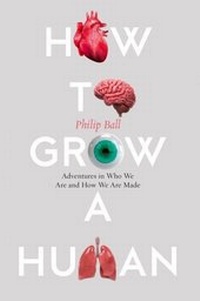
How to Grow a Human
Adventures in Who We are and How We are Made
1st Edition
Published on 30. May 2019
384 pages
978-0-00-833179-5 (ISBN)
Description

A cutting-edge examination of what it means to be human and to have a 'self' in the face of new scientific developments in genetic editing, cloning and neural downloading.
After seeing his own cells used to grow clumps of new neurons - essentially mini-brains - Philip Ball begins to examine the concepts of identity and consciousness. Delving into humanity's deep evolutionary past to look at how complex creatures like us emerged from single-celled life, he offers a new perspective on how humans think about ourselves.
In an age when we are increasingly encouraged to regard the 'self' as an abstract sequence of genetic information, or as a pattern of neural activity that might be 'downloaded' to a computer, he return us to the body - to flesh and blood - and anchors a conception of personhood in this unique and ephemeral mortal coil. How to Build a Human brings us back to ourselves - but in doing so, it challenges old preconceptions and values. It asks us to rethink how we exist in the world.
After seeing his own cells used to grow clumps of new neurons - essentially mini-brains - Philip Ball begins to examine the concepts of identity and consciousness. Delving into humanity's deep evolutionary past to look at how complex creatures like us emerged from single-celled life, he offers a new perspective on how humans think about ourselves.
In an age when we are increasingly encouraged to regard the 'self' as an abstract sequence of genetic information, or as a pattern of neural activity that might be 'downloaded' to a computer, he return us to the body - to flesh and blood - and anchors a conception of personhood in this unique and ephemeral mortal coil. How to Build a Human brings us back to ourselves - but in doing so, it challenges old preconceptions and values. It asks us to rethink how we exist in the world.
Reviews / Votes
Praise for How to Grow a Human'This is a deeply engaging crash course. Ball's description of cellular organelles and their functions, in particular, is an impressive feat. And his sense of wonder at biological processes is palpable: passages on the intricacies of cell plasticity had me (with my doctorate in molecular biology) exclaiming, "That is incredible!"'
Nature
'Philip Ball weaves a compelling story of bodily creation ... Highly readable and impeccably informed by research, How to Grow a Human revels in scientific possibility and confronts the social and ethical implications, while intelligently acknowledging what is as yet unknown' The Lancet
'[This] winding romp through advances in cell biology pushes readers to ponder the boundaries of life ... The book offers a provocative, meandering take on the progression of groundbreaking biotechnological capabilities ... absorbing ambitious and expansive ... Ball's look at the state of human-facing cutting edge bioscience is a thought-provoking read' Science
Praise for Philip Ball
'Ball's book towers above the competition with its erudition, balance, and attention to detail... This is the most accessible, comprehensive, and provocative investigation of the science of music - and its limits - yet to be written.'
Globe and Mail
'Excellent, smartly written'
Financial Times
'Ball is an exceptionally talented writer who manages to combine accessibility and thoroughness in razor-sharp prose' Physics World
'Lucid and impressive'
Prospect
More details
Language
English
Place of publication
London
United Kingdom
Publishing group
HarperCollins Publishers
Product notice
Reflowable
File size
3,35 MB
ISBN-13
978-0-00-833179-5 (9780008331795)
Copyright in bibliographic data and cover images is held by Nielsen Book Services Limited or by the publishers or by their respective licensors: all rights reserved.
Schweitzer Classification
Other editions
Additional editions
Book
04/2020
William Collins
€13.00
Shipment within 15-20 days
Book
05/2019
William Collins
€44.76
Article exhausted; check different version
Person
Philip Ball is widely recognised as a leading communicator of the relationships between science and the wider culture. For example, his book The Music Instinct (2010), a survey of the cognitive understanding of music, became a bestseller and was longlisted for the Samuel Johnson Prize for nonfiction. Philip's most recent book, The Water Kingdom (2016), was selected as a Book of the Year by the Times and the Economist. He received the Editorial Intelligence Comment Award for Best Science Commentator in 2015 and again in 2017.
Philip writes regularly on all areas of science in both popular and technical outlets. For many years he was an editor for Nature, to which he still contributes regularly. He has featured on many national and international radio and television programmes, and he is a presenter of the science history series Science Stories on BBC Radio 4.
Philip writes regularly on all areas of science in both popular and technical outlets. For many years he was an editor for Nature, to which he still contributes regularly. He has featured on many national and international radio and television programmes, and he is a presenter of the science history series Science Stories on BBC Radio 4.
