

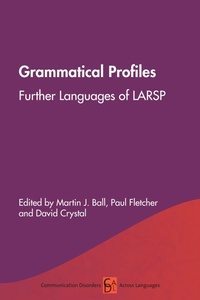
Grammatical Profiles
Further Languages of LARSP
Published on 15. July 2019
328 pages
978-1-78892-440-5 (ISBN)
Description

This book brings together 12 previously unpublished language profiles based on the original Language Assessment, Remediation and Screening Procedure (LARSP). The languages featured are: Bangla, Croatian, Colombian Spanish, Inuktitut, Norwegian, Portuguese, Russian, Slovak, Slovenian, Swahili, Tamil and Turkish. Some of these languages are included as they are likely to be encountered as home languages of clients by speech-language therapists and pathologists working in the UK, the US, Australia and elsewhere. Others are included because they are languages found where speech-language pathology services are provided, but where no grammatical profile already exists. The collection will be an invaluable resource book for speech-language pathologists who wish to analyse and assess the grammatical abilities of their clients who speak one of these languages. This new collection complements previous books in this series on the same theme and together they cover 34 languages of the world.
Reviews / Votes
LARSP is the gift that keeps on giving for those who want to perform linguistically informed language assessments. The third installment is a welcome addition to the already existing LARSP versions, covering languages from Russian to Swahili with a truly global reach, representing different continents, and including mother tongues from different linguistic branches. * Ferenc Bunta, The University of Houston, USA * This unique book forms a significant contribution to the literature and will be appreciated by a wide readership. It is a valuable resource to clinicians, researchers and students in the field of language development and disorders. It covers various languages and children with diverse linguistic profiles. The book provides much-needed information for clinical assessment and diagnosis. * Sari Kunnari, University of Oulu, Finland *More details
Series
Language
English
Place of publication
Bristol
United Kingdom
Target group
College/higher education
ISBN-13
978-1-78892-440-5 (9781788924405)
Copyright in bibliographic data and cover images is held by Nielsen Book Services Limited or by the publishers or by their respective licensors: all rights reserved.
Schweitzer Classification
Other editions
Additional editions
Book
07/2019
Multilingual Matters
€148.50
Shipment within 3-4 weeks
Persons
Martin J. Ball is Honorary Professor in the School of Languages, Literatures and Linguistics at Bangor University, UK. He is co-editor of the journal Clinical Linguistics and Phonetics (Taylor & Francis) and the book series Communication Disorders Across Languages (Multilingual Matters). His main research interests include clinical phonetics and linguistics, Welsh and sociolinguistics.
Paul Fletcher is Emeritus Professor of Speech and Hearing Sciences at University College Cork, Ireland. Since the 1970s he has published widely on language development and language impairment in children speaking English, Cantonese and Mandarin. His research focuses on grammatical and lexical development in typically developing children and in children with developmental disorders of language.
David Crystal is Honorary Professor of Linguistics at the University of Bangor, UK. He is a writer, editor, lecturer and broadcaster who has specialised for over 50 years on all aspects of the English language. His books include The Cambridge Encyclopedia of the English Language (2019) which is now in its third edition, as well as Sounds Appealing (2018) and We Are Not Amused (2017).
Paul Fletcher is Emeritus Professor of Speech and Hearing Sciences at University College Cork, Ireland. Since the 1970s he has published widely on language development and language impairment in children speaking English, Cantonese and Mandarin. His research focuses on grammatical and lexical development in typically developing children and in children with developmental disorders of language.
David Crystal is Honorary Professor of Linguistics at the University of Bangor, UK. He is a writer, editor, lecturer and broadcaster who has specialised for over 50 years on all aspects of the English language. His books include The Cambridge Encyclopedia of the English Language (2019) which is now in its third edition, as well as Sounds Appealing (2018) and We Are Not Amused (2017).
Content
Introduction: Martin J. Ball, Paul Fletcher and David Crystal
Chapter 1. Ingeborg Sophie Ribu, Hanne Gram Simonsen, Morten Aase Lover, Bror-Magnus Sviland Strand and Kristian Emil Kristoffersen: N-LARSP: A Developmental Language Profile for Norwegian
Chapter 2. N. Gabriela Moffatt and Nicole Mueller: Developing a Linguistic Profile for Russian
Chapter 3. Svetlana Kapalkova and Daniela Slancova: Language Assessment, Remediation, and Screening Procedure for Slovak-speaking Children
Chapter 4. Vesna Mildner, Vesna Stojanovik and Diana Tomic: Croatian LARSP
Chapter 5. Darija Skubic, Ana Praprotnik, Tamara Sevsek and Martina Ozbic, with Jerneja Novsak Brce and Damjana Kogovsek: Slovenian LARSP
Chapter 6. Ana Castro, Carolina Marques and Catarina Doro: LARSP-PE: A Developmental Language Profile for European Portuguese-speaking children
Chapter 7. Maryluz Camargo-Mendoza, Ana Isabel Codesido-Garcia and Elena Garayzabal- Heinze: CS-LARSP: Colombian Spanish Morphosyntactic Development Profile
Chapter 8. Asifa Sultana, Stephanie Stokes, Thomas Klee & Paul Fletcher: Towards a Micro-profile of Bangla Verb Inflection
Chapter 9. OEzlem Cangoekce Yasar and Seyhun Topbas: Adapting LARSP to Turkish: TR-LARSP Part II
Chapter 10. R. Lalitha Raja: T-LARSP: A Grammatical Profile for Tamil
Chapter 11. Kamil Ud Deen: The Assessment of the Acquisition of Swahili: Towards the S-LARSP
Chapter 12. Shanley E. M. Allen, Catherine B. Dench and Kerry Isakson: InuLARSP: An Adaptation of the Language Assessment, Remediation, and Screening Procedure for Inuktitut
Chapter 1. Ingeborg Sophie Ribu, Hanne Gram Simonsen, Morten Aase Lover, Bror-Magnus Sviland Strand and Kristian Emil Kristoffersen: N-LARSP: A Developmental Language Profile for Norwegian
Chapter 2. N. Gabriela Moffatt and Nicole Mueller: Developing a Linguistic Profile for Russian
Chapter 3. Svetlana Kapalkova and Daniela Slancova: Language Assessment, Remediation, and Screening Procedure for Slovak-speaking Children
Chapter 4. Vesna Mildner, Vesna Stojanovik and Diana Tomic: Croatian LARSP
Chapter 5. Darija Skubic, Ana Praprotnik, Tamara Sevsek and Martina Ozbic, with Jerneja Novsak Brce and Damjana Kogovsek: Slovenian LARSP
Chapter 6. Ana Castro, Carolina Marques and Catarina Doro: LARSP-PE: A Developmental Language Profile for European Portuguese-speaking children
Chapter 7. Maryluz Camargo-Mendoza, Ana Isabel Codesido-Garcia and Elena Garayzabal- Heinze: CS-LARSP: Colombian Spanish Morphosyntactic Development Profile
Chapter 8. Asifa Sultana, Stephanie Stokes, Thomas Klee & Paul Fletcher: Towards a Micro-profile of Bangla Verb Inflection
Chapter 9. OEzlem Cangoekce Yasar and Seyhun Topbas: Adapting LARSP to Turkish: TR-LARSP Part II
Chapter 10. R. Lalitha Raja: T-LARSP: A Grammatical Profile for Tamil
Chapter 11. Kamil Ud Deen: The Assessment of the Acquisition of Swahili: Towards the S-LARSP
Chapter 12. Shanley E. M. Allen, Catherine B. Dench and Kerry Isakson: InuLARSP: An Adaptation of the Language Assessment, Remediation, and Screening Procedure for Inuktitut
