

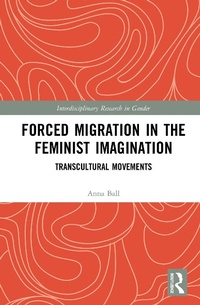
Forced Migration in the Feminist Imagination
Transcultural Movements
1st Edition
Published on 21. September 2021
222 pages
978-1-000-45910-4 (ISBN)
Description

Forced Migration in the Feminist Imagination explores how feminist acts of imaginative expression, community-building, scholarship, and activism create new possibilities for women experiencing forced migration in the twenty-first century.
Drawing on literature, film, and art from a range of transnational contexts including Europe, the Middle East, Central America, Australia, and the Caribbean, this volume reveals the hitherto unrecognised networks of feminist alliance being formulated across borders, while reflecting carefully on the complex politics of cross-cultural feminist solidarity. The book presents a variety of cultural case-studies that each reveal a different context in which the transcultural feminist imagination can be seen to operate - from the 'maternal feminism' of literary journalism confronting the European 'refugee crisis' to Iran's female film directors building creative collaborations with displaced Afghan women; and from artists employing sonic creativities in order to listen to women in U.K. and Australian detention, to LGBTQ+ poets and video artists articulating new forms of queer feminist community against the backdrop of the hostile environment.
This is an essential read for scholars in Women's and Gender Studies, Feminist and Postcolonial Literary and Cultural Studies, and Comparative Literary Studies, as well as for those operating in the fields of Gender and Development Studies and Forced Migration Studies.
Drawing on literature, film, and art from a range of transnational contexts including Europe, the Middle East, Central America, Australia, and the Caribbean, this volume reveals the hitherto unrecognised networks of feminist alliance being formulated across borders, while reflecting carefully on the complex politics of cross-cultural feminist solidarity. The book presents a variety of cultural case-studies that each reveal a different context in which the transcultural feminist imagination can be seen to operate - from the 'maternal feminism' of literary journalism confronting the European 'refugee crisis' to Iran's female film directors building creative collaborations with displaced Afghan women; and from artists employing sonic creativities in order to listen to women in U.K. and Australian detention, to LGBTQ+ poets and video artists articulating new forms of queer feminist community against the backdrop of the hostile environment.
This is an essential read for scholars in Women's and Gender Studies, Feminist and Postcolonial Literary and Cultural Studies, and Comparative Literary Studies, as well as for those operating in the fields of Gender and Development Studies and Forced Migration Studies.
Reviews / Votes
"This book provides a much needed critical engagement with an entire field of multi-media work that has appeared in order to specifically document, represent and facilitate an understanding of the experiences of forced migration. Anna Ball's intervention shows us how to construct creative and compassionate responses and as such it is a crucial book - a necessary book."Anastasia Valassopoulos, Senior Lecturer in World Literatures, University of Manchester, UK
"This powerful book examines the forced migration of women as a gendered experience. Its original transcultural approach demonstrates the migration of women not as single transnational experiences, but as part of larger global trends about the perception of women that are influenced not only by the particular migratory path, but also by attitudes and knowledge towards other migratory places and experiences. Dr Ball compellingly weaves together the primary reading of text with larger theoretical questions about author intentionality, political currents, patterns of female engagement, the significance of maternity in establishing women's 'acceptability' and 'need', and larger national and international questions about human rights crises, medical and political responsibility for refugees, and the politics of images in changing narratives about refugees from 'terrorists' to 'victims'. It is a 'must read' for scholars of women and gender studies, and those interested in labor and forced migration."
Rachel Sylvia Harris, Associate Professor of Comparative and World Literature, University of Illinois, USA
"This is a wonderful book! Deeply inspiring, essential reading and a major intervention in transcultural feminist approaches to forced migration. It will have resonance far beyond academia in reinvigorating feminist responses through the transcultural feminist imagination defined and practiced in the book."
Maggie O'Neill, Professor in Sociology and Criminology, University College Cork, Ireland
More details
Series
Edition
1. Auflage
Language
English
Place of publication
London
United Kingdom
Publishing group
Taylor & Francis Ltd
Target group
College/higher education
Illustrations
12 Halftones, black and white; 12 Illustrations, black and white
File size
4,39 MB
ISBN-13
978-1-000-45910-4 (9781000459104)
Copyright in bibliographic data and cover images is held by Nielsen Book Services Limited or by the publishers or by their respective licensors: all rights reserved.
Schweitzer Classification
Other editions
Additional editions
Book
05/2023
1st Edition
Routledge
€63.10
Shipment within 10-20 days
Book
09/2021
1st Edition
Routledge
€206.30
Shipment within 15-20 days
Person
Anna Ball is Associate Professor of Postcolonial Feminisms, Literatures, and Cultures at Nottingham Trent University, U.K. Working across literary, filmic, and artistic mediums, her research operates at the intersection of postcolonial feminist literary and cultural studies, and focusses primarily on the gendered politics of mobility, agency, and cultural expression at stake within sites of political instability in the Middle East and among its resulting global flows of forced migrants. She held a Leverhulme Research Fellowship in 2018-19 in support of this work. Firmly committed to transcultural feminist community-building, she also engages in collaborative cultural work that enables those within forced migrant communities to explore their creative agency.
Content
Preface: Walking with the River
1. Moving Women, Moving Stories: Forced Migration in the Transcultural Feminist Imagination
2. An Expectant Figure: Encountering the 'Refugee Crisis' through Literary Maternal Feminism
3. Feminisms in Conflict: Decolonising Afghan Women's Displacement through the Iranian Cinematic Gaze
4. Sounding Out Dissent: Learning to Listen to Women in Detention through Sonic Creativities
5. No Straightforward Journey: Traversing Queer Feminist Territories through a Poetics of Crossing
Conclusion: Creative Mobilisations
1. Moving Women, Moving Stories: Forced Migration in the Transcultural Feminist Imagination
2. An Expectant Figure: Encountering the 'Refugee Crisis' through Literary Maternal Feminism
3. Feminisms in Conflict: Decolonising Afghan Women's Displacement through the Iranian Cinematic Gaze
4. Sounding Out Dissent: Learning to Listen to Women in Detention through Sonic Creativities
5. No Straightforward Journey: Traversing Queer Feminist Territories through a Poetics of Crossing
Conclusion: Creative Mobilisations
