

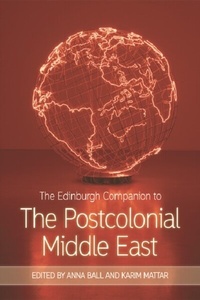
Edinburgh Companion to the Postcolonial Middle East
Description

Develops a new 'post/colonial' model of Middle Eastern literary and cultural modernity
This Edinburgh Companion seeks to develop a postcolonial framework for addressing the Middle East. The first collection of essays on this subject, it assembles some of the world's foremost postcolonialists to explore the critical, theoretical and disciplinary possibilities that inquiry into this region opens for postcolonial studies.
Throughout its twenty-four chapters, its focus is on literary and cultural critique. It draws on texts and contexts from the late nineteenth to the early twenty-first centuries as case studies, and deploys the concept of 'post/colonial modernity' to reveal the enduring impact of colonial and imperial power on the shaping of the region. And it covers a wide and significant range of political, social, and cultural issues in the Middle East during that period - including the heritage of Orientalism in the region; the roots and contemporary branches of the Israel-Palestine conflict; colonial history, state formation and cultures of resistance in Egypt, Turkey, the Maghreb and the wider Arab world; the clash of tradition and modernity in regional and transnational expressions of Islam; the politics of gender and sexuality in the Arab world; the ongoing crises in Libya, Iraq, Iran and Syria; the Arab Spring; and the Middle Eastern refugee crisis in Europe.
Key Features
- The first reference work to systematically investigate the relationship between postcolonial studies and the Middle East
- Brings together twenty-two of the world's foremost postcolonialists in a unique collaborative endeavour
- Addresses some of the most significant political, social and cultural issues in the Middle East from the late nineteenth to the early twenty-first centuries
- Covers a wide range of forms and genres, including fiction, poetry, life-writing, film, documentary, pictorial art, performance art, popular music, graffiti, the digital media and translation
Contributors
- Sadia Abbas, Rutgers University, Newark
- Sinan Antoon, New York University
- Anna Ball, Nottingham Trent University
- Réda Bensmaïa, Brown University
- Anna Bernard, King's College London
- Marilyn Booth, Oxford University
- Juan R. I. Cole, University of Michigan
- Miriam Cooke, Duke University
- Erdag Göknar, Duke University
- Salah D. Hassan, Michigan State University
- Waïl S. Hassan, University of Illinois at Urbana-Champaign
- Ikram Masmoudi, University of Delaware
- Karim Mattar, University of Colorado at Boulder
- Lindsey Moore, Lancaster University
- Stephen Morton, University of Southampton
- Laetitia Nanquette, University of New South Wales, Sydney
- Tahia Abdel Nasser, American University in Cairo
- Wen-Chin Ouyang, School of Oriental and African Studies, University of London
- Caroline Rooney, University of Kent
- Ella Shohat, New York University
- Ahdaf Soueif is a novelist, translator, and political and cultural commentator
- Anastasia Valassopoulos, University of Manchester
More details
Other editions
Additional editions
Content
- Intro
- Figures
- Acknowledgements
- Notes on the Contributors
- Note on Transliteration
- Preface
- Introduction
- Chapter 1 Dialectics of Post/Colonial Modernity in the Middle East: A Critical, Theoretical and Disciplinary Overview
- Chapter 2 Edward Said and the Institution of Postcolonial Studies
- Chapter 3 Postcolonialism and Modern Arabic Literature: Twenty-first-century Horizons
- Chapter 4 Interview with Ahdaf Soueif
- Chapter 5 Interview with Sinan Antoon
- Part I The Colonial Encounter: Discourses of Imperialism and Anti-imperialism
- Chapter 6 Between the Postcolonial and the Middle East: Writing the Subaltern in the Arab World
- Chapter 7 Orientalism and World Literature: A Re-reading of Cosmopolitanism in ?aha ?usayn's Literary World
- Chapter 8 On Orientalist Genealogies: The Split Arab/Jew Figure Revisited1
- Chapter 9 Colonial Violence, Law and Justice in Egypt
- Chapter 10 Peripheral Visions: Translational Polemics and Feminist Arguments in Colonial Egypt
- Chapter 11 Reimaging the Ottoman Legacy
- Part II States of Post/Coloniality: Politics, Religion, Gender, Sexuality
- Chapter 12 Postcolonial Nations: Political or Poetic Allegories? (On Tahar Djaout's L'Invention du désert)
- Chapter 13 Passing Away: Despair, Eulogies and Millennial Palestine
- Chapter 14 'They are in the right because I love them': Literature and Palestine Solidarity in the 1980s
- Chapter 15 Nikes in Nineveh: Daesh, the Ruin and the Global Logic of Eradication
- Chapter 16 There Was No 'Humble Task' in the Revolution: Anti-colonial Activity and Arab Women
- Chapter 17 The Queerness of Textuality and/as Translation: Ways of Reading Hoda Barakat's The Stone of Laughter
- Part III The Post/Colonial Present: Crisis and Engagement in Global Context
- Chapter 18 Anglophone Arab Autobiography and the Postcolonial Middle East: Najla Said and Hisham Matar
- Chapter 19 Bare Life in the 'New Iraq'
- Chapter 20 Towards a Globalisation of Contemporary Iranian Literature? Iranian Literary Blogs and the Evolution of the Literary Field
- Chapter 21 Popular Culture and the Arab Spring
- Chapter 22 The Syrian Revolution, Art and the End of Ideology
- Chapter 23 Biopolitical Landscapes of the 'Small Human': Figuring the Child in the Contemporary Middle Eastern Refugee Crisis in Europe
- Afterword: Critical Companionships, Urgent Affiliations
- Bibliography
- Index
