

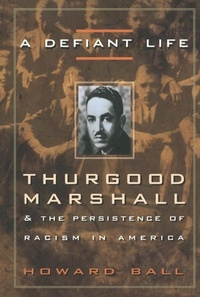
A Defiant Life
Thurgood Marshall and the Persistence of Racism in America
Published on 6. April 2011
464 pages
978-0-307-77798-0 (ISBN)
Description

Thurgood Marshall's extraordinary contribution to civil rights and overcoming racism is more topical than ever, as the national debate on race and the overturning of affirmative action policies make headlines nationwide. Howard Ball, author of eighteen books on the Supreme Court and the federal judiciary, has done copious research for this incisive biography to present an authoritative portrait of Marshall the jurist.
Born to a middle-class black family in "Jim Crow" Baltimore at the turn of the century, Marshall's race informed his worldview from an early age. He was rejected by the University of Maryland Law School because of the color of his skin. He then attended Howard University's Law School, where his racial consciousness was awakened by the brilliant lawyer and activist Charlie Houston. Marshall suddenly knew what he wanted to be: a civil rights lawyer, one of Houston's "social engineers." As the chief attorney for the NAACP, he developed the strategy for the legal challenge to racial discrimination. His soaring achievements and his lasting impact on the nation's legal system--as the NAACP's advocate, as a federal appeals court judge, as President Lyndon Johnson's solicitor general, and finally as the first African American Supreme Court Justice--are symbolized by Brown v. Board of Education, the landmark case that ended legal segregation in public schools.
Using race as the defining theme, Ball spotlights Marshall's genius in working within the legal system to further his lifelong commitment to racial equality. With the help of numerous, previously unpublished sources, Ball presents a lucid account of Marshall's illustrious career and his historic impact on American civil rights.
Born to a middle-class black family in "Jim Crow" Baltimore at the turn of the century, Marshall's race informed his worldview from an early age. He was rejected by the University of Maryland Law School because of the color of his skin. He then attended Howard University's Law School, where his racial consciousness was awakened by the brilliant lawyer and activist Charlie Houston. Marshall suddenly knew what he wanted to be: a civil rights lawyer, one of Houston's "social engineers." As the chief attorney for the NAACP, he developed the strategy for the legal challenge to racial discrimination. His soaring achievements and his lasting impact on the nation's legal system--as the NAACP's advocate, as a federal appeals court judge, as President Lyndon Johnson's solicitor general, and finally as the first African American Supreme Court Justice--are symbolized by Brown v. Board of Education, the landmark case that ended legal segregation in public schools.
Using race as the defining theme, Ball spotlights Marshall's genius in working within the legal system to further his lifelong commitment to racial equality. With the help of numerous, previously unpublished sources, Ball presents a lucid account of Marshall's illustrious career and his historic impact on American civil rights.
More details
Other editions
Additional editions
Book
04/2001
Random House USA Inc
€23.60
Shipment within 10-20 days

Book
01/1999
Crown Publishing Group (NY)
€47.80
Article exhausted; check different version
Person
Howard Ball, professor of political science and University Scholar at the University of Vermont, is a leading expert on the U.S. Supreme Court. He is the author of eighteen previous books and dozens of articles in leading political science journals and law reviews. He lives in Richmond, Vermont, with his wife, Carol, their dogs, Max and Casey, and a quarterhorse named Stormin' Norman. Their three daughters, Melissa, Sheryl, and Sue, visit on occasion.
Content
- Intro
- Other Books by This Author
- Title Page
- Copyright
- Dedication
- Contents
- Chronology Of "A Life Well Lived"
- Acknowledgments
- Foreword: Associate Justice William J. Brennan Jr.
- 1. Born into Racism and Segregation in America
- Slavery, Race, and Racism: The Historic Context
- Hooded Terror and the Civil War Amendments
- Redirecting Civil Rights: The U.S. Supreme Court Strikes Down Civil Rights Legislation, 1883-1896
- Plessy v. Ferguson: Legitimizing Jim Crow
- Race, Sex, and Lynching
- 1903: W. E. B. Du Bois's Souls of Black Folk
- 1908: Growing Up in Baltimore
- 2. The Rise of the NAACP and Charlie Houston's "Social Engineers"
- The Birth of the NAACP
- The NAACP's First Two Decades, 1910-1930
- Early Litigation Efforts, 1915-1936
- Charlie Houstons "Social Engineers"
- The Scottsboro Incident, 1931
- The Margold Report
- The Du Bois Crisis, 1934
- 3. Marshall Joins the NAACP
- "No Good Turkey"
- Thurgood Marshall, Esq.: Joining the NAACP's National Office, 1936
- The NAACP's 1936 Public Education Initiative: Beginning the Attack on Plessy v. Ferguson
- Marshall's Colleagues in the NAACP
- 4. "Thurgood's Coming": Mr. Civil Rights
- Creating the "Inc Fund," October 1939
- Adding Staff to the NAACP's Legal Office
- The Inc Fund's Legal Strategies, Rules, and Policies
- Marshall, the Communist Party, and the FBI
- Be Cool, Stay Cool
- Mr. Civil Rights: "Thurgood's Coming"
- The Inc Fund's Educational Equity Lawsuits
- Voting and Voter Registration Litigation
- The Criminal Justice Cases
- Segregated Transportation and Travel Cases
- Residential Discrimination and Restrictive Covenants Litigation
- The Politics of Race During the Roosevelt and Truman Administrations
- The "New Deal" and African Americans
- The World War II Race Riots
- The Vital Change: Harry S Truman
- The Assault on Public School Segregation and the Plessy Doctrine
- 5. Segregation in the Military: A Special Humiliation
- Military Segregation in World War I
- Segregation in the Armed Services in World War II
- World War II "Soldier Troubles"
- From War's End to the Korean War
- The Korean War
- 6. The Public Education Battles Begin: Brown V. Board
- Marshall's NAACP Strategy Implemented: The Public School Segregation Cases
- The U.S. Supreme Court Hears the School Segregation Cases
- Going Back to the Court
- The Supreme Court Overturns Plessy
- The Brown Implementation Decree
- Massive Resistance: The White Deep South's Response to Brown
- 7. The Segregation Battles Continue and the Civil Rights Movement Emerges
- The "New Wave" in Civil Rights
- The Alternatives to the NAACP: SCLC and SNCC
- The Little Rock Crisis
- The U.S. Supreme Court Reaffirms Brown: The Cooper v. Aaron Decision
- Eisenhower's Civil Rights View: "Make Haste Slowly"
- Ike's Ambivalent Support of the 1957 Civil Rights Act
- Marshall Leaves the NAACP
- 8. A New Life: Thurgood Marshall, Government Servant
- The "New Frontier" and Civil Rights
- Marshall's Appointment to the U.S. Court of Appeals, 1961
- Lyndon Johnson and Civil Rights
- Marshall's Appointment as U.S. Solicitor General, 1965
- Thurgood Marshall, "General"
- Marshall's Appointment to the U.S. Supreme Court, 1967
- 9. Mr. Justice Marshall
- The Outsider on the Court
- Friends, Colleagues, and Antagonists
- "My Knuckleheads": Justice Marshall and His Law Clerks
- Thurgood Marshall's Jurisprudence
- Photo Insert
- 10. The Meaning of Equality in the Fourteenth Amendment
- Equal-Protection Litigation
- Equality of Educational Opportunity After Brown
- 1970: Busing to End Segregated Schools (Swann)
- 1973: The Question of De Facto School Segregation (Keyes)
- 1974: Court Unanimity Disintegrates over the Question of Interdistrict Busing (Milliken)
- After Milliken: A Court Divided on How to Achieve School Desegregation
- Racially Discriminatory State Action
- Private Acts of Racial Discrimination and "State Action"
- Ending Nonracial Class and Caste Discrimination in America
- Gender-Based Discriminations
- Wealth, Poverty, Illegitimacy
- Resident and Illegal Aliens
- Age and Mental Retardation Discrimination
- Marshall's Concept of Genuine Equality
- 11. Bakke and the a Ffirmative Action Battles: "They Just Don't Get It!"
- 1964: Affirmative Action's Beginnings
- The Bakke Case: Defining Affirmative Action
- The Constitutionality of Court-Ordered Affirmative Action Programs
- Are "Voluntary" Affirmative Action Plans Constitutional?
- Government Contracting and Licensing and Affirmative Action Goals
- The Affirmative Action Battles
- 12. Procedural Fairness and Substantive Justice: Realities and Myths
- The Hugo, Oklahoma, Criminal Justice Horror: Lyons
- Marshall versus Rehnquist: The Uneven Battles
- Protection Against "Unreasonable" Searches and Seizures
- The Fifth Amendment and the Specter of Coerced Confessions
- The Right to Counsel and Other Sixth Amendment Protections
- Marshall's Views About the Death Penalty
- Marshall's Criminal Justice Jurisprudence
- 13. Marshall and First Amendment Freedoms
- The First Amendment: An Absolute Set of Freedoms?
- Freedom of Speech and Expression
- Protected Speech
- Unprotected Speech
- Peaceful Assembly and Association Rights
- The Predicament of the "Speech Plus Conduct" Cases
- Freedom of the Press and Clashes with Fair Trial Guarantees
- Freedom of the Press versus the Right to a Fair Trial
- The "No Establishment of Religion" and "Free Exercise" Clauses
- The "No Establishment of Religion" Clause
- The "Free Exercise of Religion" Clause
- Marshall and the First Amendment Freedoms
- 14. The Constitution as Evolving Guarantor of New Rights
- The Right to Privacy
- Abortion as a Woman's Personal-and Private-Choice
- Roe's Antecedents
- Roe v. Wade
- Roe's Progeny: The Woes of Roe
- 15. Justice Marshall: Always the Outsider, Always Defiant
- Marshall for the Defense
- Marshall's Epitaph
- Research Notes
- Bibliography
