

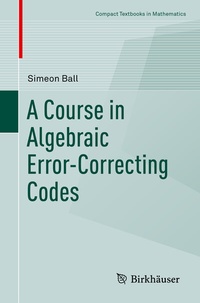
A Course in Algebraic Error-Correcting Codes
Description

This textbook provides a rigorous mathematical perspective on error-correcting codes, starting with the basics and progressing through to the state-of-the-art. Algebraic, combinatorial, and geometric approaches to coding theory are adopted with the aim of highlighting how coding can have an important real-world impact. Because it carefully balances both theory and applications, this book will be an indispensable resource for readers seeking a timely treatment of error-correcting codes.
Early chapters cover fundamental concepts, introducing Shannon's theorem, asymptotically good codes and linear codes. The book then goes on to cover other types of codes including chapters on cyclic codes, maximum distance separable codes, LDPC codes,
p
-adic codes, amongst others. Those undertaking independent study will appreciate the helpful exercises with selected solutions.
A Course in Algebraic Error-Correcting Codes
suits an interdisciplinary audience atthe Masters level, including students of mathematics, engineering, physics, and computer science. Advanced undergraduates will find this a useful resource as well. An understanding of linear algebra is assumed.
Reviews / Votes
"Merit of this book is its ability to bring together many topics, including current research, in a compact volume. Moreover, throughout the book, the author provides exercises that stimulate the interest of the reader. The style is clear and the topics are well presented, which makes the understanding of the subject approachable even for students coming from applied sciences. This is a remarkable textbook for a self-contained introduction to the theory of error-correcting codes and some of their modern topics." (Matteo Bonini, zbMATH 1454.94142, 2021)More details
Other editions
Additional editions
Person
Simeon Ball is Senior Lecturer of Mathematics at Universitat Politècnica de Catalunya in Barcelona, Spain. He has been invited speaker at many international conferences, as well as serving on the scientific and organising committee for the Fq series of conferences. His research interests include classical and quantum error-correcting codes, incidence problems in real and finite geometries, graphs and semifields, and is particularly focused on applying geometrical and algebraic methods to these combinatorial objects. He also serves on the editorial board of the Journal of Geometry, having previously served on the editorial board of Designs, Codes and Cryptography and Finite Fields and Their Applications.
