
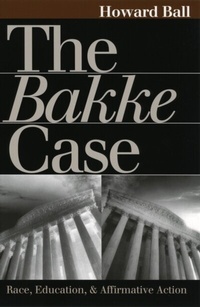
The Bakke Case
Description
Alles über E-Books | Antworten auf Fragen rund um E-Books, Kopierschutz und Dateiformate finden Sie in unserem Info- & Hilfebereich.
Twice denied admission to a California medical school despite better grades and test scores than successful minority applicants, Allan Bakke took his grievance to court and set off a major controversy over affirmative action. Bakke claimed that he was a victim of reverse discrimination, and his case has been considered by many as the most important civil rights decision since the end of segregation?and also one of the most difficult ever heard by the Supreme Court.
Howard Ball now reviews the many issues raised by this case that placed affirmative action on trial. He examines the law and politics surrounding Bakke in an even-handed manner, presenting both sides of the debate and discussing key arguments presented by pressure groups. He also offers a behind-the-scenes look at what transpired during the months between oral arguments before the Court and the justices' final decision, including secret conference sessions and judicial memos.
While four justices confirmed that Bakke had been the victim of reverse discrimination, four others agreed that the school's affirmative action plan was a logical application of the 1964 Civil Rights Act. Justice Lewis Powell sided with both viewpoints, resulting in Bakke's admission to the school and the upholding of affirmative action. The Court's unusual split decision invalidated UC-Davis's quota program for minorities but also struck down a California court's ruling that race could not be used as a factor in considering applicants.
In light of eroding public support for affirmative action today, Ball examines the impact of Bakke and its use as a precedent. He also reviews recent events such as California Proposition 209, Washington Initiative 200, the ?One Florida Initiative? program, and the Supreme Court's refusal to overturn Texas v. Hopwood?a decision that forced the University of Texas to eliminate affirmative action in its law school.
As affirmative action continues to divide judges, legislatures, and citizens, the fragile consensus forged by Justice Powell seems to be collapsing. This book offers essential background for anyone interested in the controversy, helping readers to better understand the dynamics of Supreme Court decision making in emotionally charged litigation and to arrive at a more informed opinion over this vexing issue.
All prices
More details
Other editions
Additional editions
Person
Content
Editors' Preface
Preface
1. Affirmative Action in Higher Education
2. Marco DeFunis Seeks Admission to the University
3. ?Let Me In!?: Allan Bakke's Plea to the University
4. Asking the U.S. Supreme Court to Review Bakke
5. ?Mr. Chief Justice and May It Please the Court?: The Oral Arguments in Bakke, 1977
6. Bakke and the Dynamics of Supreme Court Decision Making
7. Affirmative Action Public Policy in the Politically Turbulent 1990s
8. The Bakke Legacy: Hanging By A Thread?
Chronology
Relevant Cases
Bibliographic Essay
Index

System requirements
File format: ePUB
Copy protection: Adobe-DRM (Digital Rights Management)
System requirements:
- Computer (Windows; MacOS X; Linux): Install the free reader Adobe Digital Editions prior to download (see eBook Help).
- Tablet/smartphone (Android; iOS): Install the free app Adobe Digital Editions or the app PocketBook before downloading (see eBook Help).
- E-reader: Bookeen, Kobo, Pocketbook, Sony, Tolino and many more (not Kindle).
The file format ePub works well for novels and non-fiction books – i.e., „flowing” text without complex layout. On an e-reader or smartphone, line and page breaks automatically adjust to fit the small displays.
This eBook uses Adobe-DRM, a „hard” copy protection. If the necessary requirements are not met, unfortunately you will not be able to open the eBook. You will therefore need to prepare your reading hardware before downloading.
Please note: We strongly recommend that you authorise using your personal Adobe ID after installation of any reading software.
For more information, see our ebook Help page.
File format: PDF
Copy-Protection: Adobe-DRM (Digital Rights Management)
System requirements:
- Computer (Windows; MacOS X; Linux): Install the free reader Adobe Digital Editions prior to download (see eBook Help).
- Tablet/smartphone (Android; iOS): Install the free app Adobe Digital Editions or the app PocketBook before downloading (see eBook Help).
- E-reader: Bookeen, Kobo, Pocketbook, Sony, Tolino and many more (only limited: Kindle).
The file format PDF always displays a book page identically on any hardware. This makes PDF suitable for complex layouts such as those used in textbooks and reference books (images, tables, columns, footnotes). Unfortunately, on the small screens of e-readers or smartphones, PDFs are rather annoying, requiring too much scrolling.
This eBook uses Adobe-DRM, a „hard” copy protection. If the necessary requirements are not met, unfortunately you will not be able to open the eBook. You will therefore need to prepare your reading hardware before downloading.
Please note: We strongly recommend that you authorise using your personal Adobe ID after installation of any reading software.
For more information, see our eBook Help page.
File format: ePUB
Copy protection: Watermark-DRM (Digital Rights Management)
System requirements:
- Computer (Windows; MacOS X; Linux): Use a reading software that can process the file format ePUB: e.g., Adobe Digital Editions or FBReader – both free (see eBook Help).
- Tablet/Smartphone (Android; iOS): Before downloading, install the free app Adobe Digital Editions (see eBook Help).
- E-reader: Bookeen, Kobo, Pocketbook, Sony, Tolino and many more (not Kindle).
The file format ePUB works well for novels and non-fiction books – i.e., „flowing” text without complex layout. On an e-reader or smartphone, line and page breaks automatically adjust to fit the small displays.
This eBook uses Watermark-DRM, a „soft” copy protection. This means that there are no technical restrictions to prevent illegal distribution. However, there is a personalised watermark embedded in the eBook that can be used to identify the purchaser of the eBook in the event of misuse and to provide evidence for legal purposes.
For more information, see our eBook Help page.
