

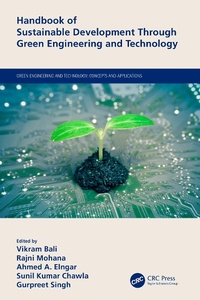
Handbook of Sustainable Development Through Green Engineering and Technology
1st Edition
Published on 27. September 2022
347 pages
978-1-000-44883-2 (ISBN)
Description

Green engineering involves the designing, innovation, and commercialization of products and processes which promote sustainability without eliminating both efficiency and economic viability. This handbook focuses on sustainable development through green engineering and technology. It is intended to address the applications and issues involved in their practical implementation.
A new range of renewable-energy technologies, modified to provide green engineering, will be described in this handbook. It will explore all green technologies required to provide green engineering for the future.These include, but are not limited to, green smart buildings, fuel-efficient transportation, paperless offices, and many more energy-efficient measures.
Handbook of Sustainable Development through Green Engineering and Technology acts as a comprehensive reference book to use when identifying development for programs and sustainable initiatives within the current legislative framework. It aims to be of great interest to researchers, faculty members, and students across the globe.
A new range of renewable-energy technologies, modified to provide green engineering, will be described in this handbook. It will explore all green technologies required to provide green engineering for the future.These include, but are not limited to, green smart buildings, fuel-efficient transportation, paperless offices, and many more energy-efficient measures.
Handbook of Sustainable Development through Green Engineering and Technology acts as a comprehensive reference book to use when identifying development for programs and sustainable initiatives within the current legislative framework. It aims to be of great interest to researchers, faculty members, and students across the globe.
More details
Series
Edition
1. Auflage
Language
English
Place of publication
London
United Kingdom
Publishing group
Taylor & Francis Ltd
Target group
College/higher education
Professional and scholarly
Illustrations
37 Tables, black and white; 79 Line drawings, black and white; 51 Halftones, black and white; 130 Illustrations, black and white
ISBN-13
978-1-000-44883-2 (9781000448832)
Copyright in bibliographic data and cover images is held by Nielsen Book Services Limited or by the publishers or by their respective licensors: all rights reserved.
Schweitzer Classification
Other editions
Additional editions
Vikram Bali | Rajni Mohana | Ahmed A. Elngar
Handbook of Sustainable Development Through Green Engineering and Technology
Book
03/2025
1st Edition
CRC Press
€83.70
Shipment within 15-20 days
Vikram Bali | Rajni Mohana | Ahmed A. Elngar
Handbook of Sustainable Development Through Green Engineering and Technology
Book
09/2022
1st Edition
CRC Press
€252.70
Shipment within 15-20 days
Persons
Dr. Vikram Bali is Director at IMS Engineering College, Ghaziabad, Uttar Pradesh, India. He graduated from REC, Kurukshetra - B.Tech. (CSE), Post-Graduation from NITTTR, Chandigarh - M.E (CSE) and Doctorate (Ph.D.) from Banasthali Vidyapith, Rajasthan. He has more than 20 years of rich academic and administrative experience. He has published more than 50 research papers in International Journals/Conferences and edited Books. He has authored Five text books. He has published 06 Patents. He is on the editorial board and on the review panel of many International Journals. He is SERIES EDITOR for three Book Series of CRC Press- Taylor & Francis Group. He is a lifetime member of IEEE, ISTE, CSI and IE. He was Awarded Green Thinker Z-Distinguished Educator Award 2018 for remarkable contribution in the field of Computer Science and Engineering at 3rd International Convention on Interdisciplinary Research for Sustainable Development (IRSD) at Confederation of Indian Industry (CII), Chandigarh. He has attended Faculty Enablement programs organized by Infosys and NASSCOM. He is member of board of studies of different Indian Universities and member of organizing committee for various National and International Seminars/Conferences. He is working on four sponsored research projects funded by TEQIP-3 and Unnat Bharat Abhiyaan. His research interests include Software Engineering, Cyber Security, Automata Theory, CBSS and ERP.
Dr. Rajni Mohana is currently working as Associate Professor in the Department of CSE, at Jaypee University of Information Technology (JUIT), Waknaghat, India. She has over 10 years of experience in Academia. Rajni has various national and international publications to her credit. She is also a reviewer for various renowned International journals and International conferences.She has completed her B.Tech(CSE) form MITS, Orissa, M.Tech(CSE) from DAVIET, Jalandhar and Ph.D (CSE) from Jaypee University of Information Technology, Wakhnaghat, Solan. Her interest areas are software engineering , information systems, service oriented architecture, aspect oriented programming, NLP, sentiment analysis, Text mining and opinion mining. She is currently pursuing research in Cloud Computing, NLP and Software Engineering. She has supervised various M.Tech Students and PhD Scholars.
Ahmed A. Elngar he is Assistant Professor of Computer Science at the Faculty of Computers and Artificial Intelligence, Beni-Suef University, Egypt. Dr. Elngar is the Founder and Head of Scientific Innovation Research Group (SIRG). Dr. Elngar is a Director of the Technological and Informatics Studies Center (TISC), Faculty of Computers and Artificial Intelligence, Beni-Suef University. Dr. Elngar has more than 55 scientific research papers published in prestigious international journals and over 25 books covering such diverse topics as data mining, intelligent systems, social networks and smart environment. Dr. Elngar is a collaborative researcher He is a member in Egyptian Mathematical Society (EMS) and International Rough Set Society (IRSS). His other research areas include Internet of Things (IoT), Network Security, Intrusion Detection, Machine Learning, Data Mining, Artificial Intelligence. Big Data, Authentication, Cryptology, Healthcare Systems, Automation Systems. He is an Editor and Reviewer of many international journals around the world. Dr. Elngar won several awards including the Young Researcher in Computer Science Engineering", from Global Outreach Education Summit and Awards 2019, on 31 January 2019 (Thursday) at Delhi, India. Also, he awards Best Young Researcher Award (Male) (Below 40 years)", Global Education and Corporate Leadership Awards (GECL-2018), Plot No-8, Shivaji Park, Alwar 301001, Rajasthan.
Sunil Kumar Chawla is working as an Assistant Professor in the Department of Computer Science and Engineering, Chandigarh University, Mohali, Punjab, India. He completed his B. Tech. from Kurukshetra University, M. Tech. from Maharishi Markandeshwar University, Mullana and his doctorate from IKG Punjab Technical University, Kapurthala. He is having teaching experience of more than 15 years. His research interests lie in Digital Image Processing, Biometrics, Image Segmentation, and Machine Learning. He is a member of IEEE and other professional societies like ISTE, CSTA, IAENG, and IETE. He has more than 30 Publications in International journals of repute indexed in Scopus, ESCI, Google Scholar and other eminent databases. He has been associated with many reputed international conferences in the capacity of Technical Programme Committee member. He is serving as a reviewer of several reputed journals. He has published a book entitled Segmentation and Normalization of Iris for Human Recognition with Lambert Academic Publishing, Germany. He has filed two patents. He is Guest Editor of two books under CRC Press, Taylor and Francis, USA and many special issues of reputed international journals.
Gurpreet Singh completed his B.Tech. from Punjabi University, Patiala and M.Tech. and PhD from IKG Punjab Technical University Kapurthala. His areas of interests are Cloud Computing, Green Computing, IOT, Next Generation Networks, Database and Data Mining. He has written more than 25 papers in various National and International referred Journals and conferences. Dr. Singh has also filed a patent on electronic payment system using Internet of Things in order to secure Direct Payments through Wi-Fi cards. He has written one book with International Publisher Lambert Publishers, Germany.
Dr. Rajni Mohana is currently working as Associate Professor in the Department of CSE, at Jaypee University of Information Technology (JUIT), Waknaghat, India. She has over 10 years of experience in Academia. Rajni has various national and international publications to her credit. She is also a reviewer for various renowned International journals and International conferences.She has completed her B.Tech(CSE) form MITS, Orissa, M.Tech(CSE) from DAVIET, Jalandhar and Ph.D (CSE) from Jaypee University of Information Technology, Wakhnaghat, Solan. Her interest areas are software engineering , information systems, service oriented architecture, aspect oriented programming, NLP, sentiment analysis, Text mining and opinion mining. She is currently pursuing research in Cloud Computing, NLP and Software Engineering. She has supervised various M.Tech Students and PhD Scholars.
Ahmed A. Elngar he is Assistant Professor of Computer Science at the Faculty of Computers and Artificial Intelligence, Beni-Suef University, Egypt. Dr. Elngar is the Founder and Head of Scientific Innovation Research Group (SIRG). Dr. Elngar is a Director of the Technological and Informatics Studies Center (TISC), Faculty of Computers and Artificial Intelligence, Beni-Suef University. Dr. Elngar has more than 55 scientific research papers published in prestigious international journals and over 25 books covering such diverse topics as data mining, intelligent systems, social networks and smart environment. Dr. Elngar is a collaborative researcher He is a member in Egyptian Mathematical Society (EMS) and International Rough Set Society (IRSS). His other research areas include Internet of Things (IoT), Network Security, Intrusion Detection, Machine Learning, Data Mining, Artificial Intelligence. Big Data, Authentication, Cryptology, Healthcare Systems, Automation Systems. He is an Editor and Reviewer of many international journals around the world. Dr. Elngar won several awards including the Young Researcher in Computer Science Engineering", from Global Outreach Education Summit and Awards 2019, on 31 January 2019 (Thursday) at Delhi, India. Also, he awards Best Young Researcher Award (Male) (Below 40 years)", Global Education and Corporate Leadership Awards (GECL-2018), Plot No-8, Shivaji Park, Alwar 301001, Rajasthan.
Sunil Kumar Chawla is working as an Assistant Professor in the Department of Computer Science and Engineering, Chandigarh University, Mohali, Punjab, India. He completed his B. Tech. from Kurukshetra University, M. Tech. from Maharishi Markandeshwar University, Mullana and his doctorate from IKG Punjab Technical University, Kapurthala. He is having teaching experience of more than 15 years. His research interests lie in Digital Image Processing, Biometrics, Image Segmentation, and Machine Learning. He is a member of IEEE and other professional societies like ISTE, CSTA, IAENG, and IETE. He has more than 30 Publications in International journals of repute indexed in Scopus, ESCI, Google Scholar and other eminent databases. He has been associated with many reputed international conferences in the capacity of Technical Programme Committee member. He is serving as a reviewer of several reputed journals. He has published a book entitled Segmentation and Normalization of Iris for Human Recognition with Lambert Academic Publishing, Germany. He has filed two patents. He is Guest Editor of two books under CRC Press, Taylor and Francis, USA and many special issues of reputed international journals.
Gurpreet Singh completed his B.Tech. from Punjabi University, Patiala and M.Tech. and PhD from IKG Punjab Technical University Kapurthala. His areas of interests are Cloud Computing, Green Computing, IOT, Next Generation Networks, Database and Data Mining. He has written more than 25 papers in various National and International referred Journals and conferences. Dr. Singh has also filed a patent on electronic payment system using Internet of Things in order to secure Direct Payments through Wi-Fi cards. He has written one book with International Publisher Lambert Publishers, Germany.
Content
1. Achieving Sustainable Development through Sustainable Entrepreneurship and Green Engineering. 2. Environmental Performance Index Score: A Driving Force towards Green Business Model and Process Innovations. 3. Precursors and Impediments of Green Consumer Behaviour: An Overview. 4. Green Smart Farming Techniques and Sustainable Agriculture: Research Roadmap towards Organic Farming for Imperishable Agricultural Products. 5. Toward Circular Product Lifecycle Management through Industry 4.0 Technologies. 6. A Taxonomy on Smart Grid Technology. 7. Towards Urban Sustainability: Impact of Blue and Green Infrastructure on Building Smart, Climate Resilient, and Livable Cities. 8. Smart Factories: A Green Engineering Perspective. 9. Electric Vehicle Research: Need, Opportunities, and Challenges. 10. Sustainable Developments through Energy-Efficient Buildings in Smart Cities: A Biomimicry Approach. 11. Biomass Derived Activated Biochar for Wastewater Treatment. 12. A Study on the Cause and Effects of Paddy Straw Burning by Farmers in Fields and Proposal of Using Rice Husk as a Novel Ingredient in Pottery Industry. 13. Clay and Ceramics as Sustainable and Green Materials to Remove Methylene Blue from Water: A Critical Analysis. 14. Metal Chalcogenides Based Nanocomposites for Sustainable Development with Environmental Protection Applications. 15. Renewable Energy in Smart Grid: Futuristic Power System. 16. Experimental Investigation on Different Supplementary Cementitious Materials as Smart Construction Materials to Produce Concrete: Toward Sustainable Development. 17. Solar Thermal Power Generation: Application of Internet of Things for Effective Control and Management.
