

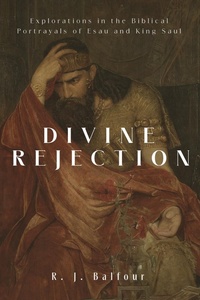
Divine Rejection
Description

Among the most enigmatic passages in the Bible are those featuring God's election of some and rejection of others. While many interpreters appeal to mystery or divine sovereignty as solutions to these difficult passages, intensive evaluation and sustained reflection on these passages and their implications can benefit both the church and the academy. In Divine Rejection, R. J. Balfour provides such evaluation and reflection on the notion of divine rejection in Christian theology through close readings of two paradigmatic biblical accounts of divine rejection, namely, the narratives of Esau and Saul.
Balfour contributes to the scholarly understanding of these narratives in their received form while providing extensive Christian theological reflection on the notion of divine rejection. Balfour's reading is carried out in conversation with significant historic and contemporary interpreters in order to exemplify what sustained theological interpretation might look like. By adopting this structure, Balfour seeks to model a retrieval of historic theological interpretations that is sensitive to the concerns and interests of the contemporary academy.
Balfour ultimately argues that these two narratives display differing accounts of divine decision-making. In the narrative of Saul's rejection, YHWH rejects Saul in an explicit fashion in response to his actions. By contrast, the grammatical ambiguity of the oracle at the outset of the Esau narrative (Gen 25:23), combined with the inversion of roles in the narrative's climax (Gen 32-33), prevents the reader from drawing strong conclusions as to the terms and nature of Esau's rejection. The book concludes with a series of reflections on how both aspects of divine decision-making have been incorporated into a Christian doctrine of election and how they might stimulate fresh Christian theological reflection on this important doctrine.
More details
Other editions
Additional editions
Person
R. J. Balfour is Lecturer in Old Testament at London School of Theology
Content
Introduction
I The Rejection of Esau1 Esau and John Calvin2 Esau and Jon D. Levenson3 Esau in Genesis4 Esau in Retrospect
II The Rejection of Saul5 Saul and Karl Barth6 Saul and Tragedy7 Saul in 1 Samuel8 Saul in Retrospect
Conclusion
