

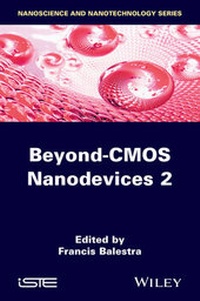
Beyond CMOS Nanodevices 2
Description

More details
Other editions
Additional editions
Content
General Introduction
Microelectronics, based on complementary metal–oxide semiconductor (CMOS) technology, is the essential hardware enabler for electronic product and service innovation in key growth markets, such as communications, computing, consumer electronics, automotives, avionics, automated manufacturing, health and the environment. The global semiconductor industry underpins 16% of the world’s total economy and is growing every year. The worldwide market for electronic products is estimated to be more than $1,800 billion, and the related electronics services market more than $6,500 billion. These product and service markets are made possible by a $310 billion market for semiconductor components and an associated $90 billion market for semiconductor equipment and materials. The new era of nanoelectronics, which started at the beginning of the current millennium with the smallest patterns in state-of-the-art silicon-based devices below 100 nm, is making an exponential increase in system complexity and functionality possible.
Nanoelectronics allows the development of smart electronic systems by switching, storing, monitoring, receiving and transmitting information. In respect to its societal relevance, the ubiquitous nanoelectronics is also closely linked to the notion of ambient intelligence, which is a vision of the future where people are surrounded by intelligent intuitive interfaces that are embedded in all kinds of objects and an environment that is capable of recognizing and responding to the presence of different individuals in a seamless way.
Since the invention of the transistor in 1947 at Bell Labs, followed by the first silicon transistor in 1954 and the concept of integrated circuits in 1958 at Texas Instruments, progress in the field of microelectronics has been tremendous, which has revolutionized society. In these last 50 years, dramatic advances have been achieved in the packing density of transistors. This has resulted in the density of transistors on an integrated chip (IC) doubling every two years (Moore’s law) since the 1970s. At the beginning of the 1970s, the first microprocessor had only about 2,000 transistors (10 μm gate length), the world’s first two-billion transistor processor was reported in 2008 in 65 nm CMOS technology.
The same trend can be observed for memories. The dynamic random access memory (DRAM) capacity has been raised from 1 kb in 1970 to several Gb at present. Several billion transistor static random access memory (SRAM) chips have also been realized. For nonvolatile memories, 256 Gb have been demonstrated. This increase in transistor count and memory capacity has led to increased processing power, measured now in thousands of millions of instructions per second (MIPS).
Moore’s law also means decreasing cost per function, the transistor price has dropped at an average rate of about 1.5 per year (about 108 since the beginning of the semiconductor industry).
However, according to the International Technology Roadmap for Semiconductors and ENIAC Strategic Research Agenda, there are big challenges to overcome in order to continue progressing in the same direction.
The minimum critical feature size of the elementary nanoelectronic devices (physical gate length of the transistors) will drop into the sub-decananometer range in the next decade. In the sub-10 nm range, “beyond-CMOS” devices, based on nanowires, nanodots, carbon electronics or other nanodevices, will certainly play an important role and could be integrated onto CMOS platforms in order to pursue integration down to nanometer structures. Silicon (Si) will remain the main semiconductor material for the foreseeable future, but the required performance improvements for the end of the roadmap for high performance, low and ultra-low power applications will lead to a substantial enlargement of the number of new materials, technologies, device and circuit architectures.
Therefore, new generations of Nanoelectronic ICs present increasingly formidable multidisciplinary challenges at the most fundamental level (novel materials, new physical phenomena, ultimate technological processes, novel design techniques, etc.).
In this timeframe, performance will also derive from heterogeneity, referring to the increasing diversity of functions integrated onto CMOS platforms as envisaged in the “More than Moore (MtM)” approach.
This book, and the related book Beyond-CMOS Nanodevices 1 (Volume 1), also published by ISTE and Wiley offer a comprehensive review of the state-of-the-art in innovative Beyond-CMOS nanodevices for developing novel functionalities, logic and memories dedicated to researchers, engineers and students.
Volume 1 particularly focuses on the interest of nanostructures and nanodevices (nanowires, small slope switches, 2D layers, nanostructured materials, etc.) for advanced MtM (RF, nanosensors, energy harvesters, on-chip electronic cooling, etc.). This book focuses on beyond-CMOS logic and memory applications.
MtM functions allow the world of digital computing and data storage to interact with the real world. MtM devices typically provide conversion of non-digital as well as non-electronic information, such as mechanical, thermal, acoustic, chemical, optical and biomedical functions, to digital data and vice versa. Clearly MtM technologies and products provide essential functional enrichment to the digital CMOS-based mainstream semiconductors. MtM has become one of the major innovation drivers for a very broad spectrum of societally relevant applications.
There has been increased interest recently for using nanoscale beyond-CMOS devices in the More Moore and MtM domains:
– miniaturization remains a major enabler for price reduction, functionality multiplication and integration with electronics; – the CMOS technology is facing dramatic challenges for future low power, high performance and memory applications; – nanoscale beyond-CMOS structures can improve devices’ intrinsic performance and enable new functionalities.Nanotechnologies will also offer powerful ways to bring added value, in terms of cost, reproducibility, sensitivity, automation, analysis and new functionality in healthcare applications such as in vitro diagnostics or drug delivery, as well as in environment control (water, air, soil), agriculture and food, transport monitoring, ambient intelligence, defense or homeland security. A wide range of sensor types will be required, such as biochemical sensors, sensors for liquid and gas spectroscopy.
As a very good example, nanowires have received much attention from the R&D community as components for electrical circuits based on CMOS compatible processes. Although the R&D activities for nanowires were initiated to address the future need of IC technologies beyond the physical limits of CMOS, more and more R&D activity nowadays is devoted to using nanowires to create innovative MtM products.
Other fields in which nanostructured materials and nanodevices could be of great interest are in the domain of energy-autonomous systems using energy harvesting, for wireless sensor networks, in situ monitoring for mobile systems, body-area networks, biomedical devices or mobile electronics; these systems will become very important in the future for the development of “green/sustainable” applications.
The integration of many different types of devices will be needed – for example, bio-sensors, nanoelectro mechanical structure (NEMS) devices, nanocomponents for logic and memory, energy scavenging systems and RF interfaces, for the development of these future nanoelectronics systems.
This book, and Volume 1, are thus reviewing innovative nanoscale structures that can improve performance and/or enable new functionalities in future terascale ICs and nanosystems. The convergence of More Moore and beyond-CMOS, on one hand, and the merging of MtM and beyond-CMOS, on the other hand, have been extensively studied in scientific literature these last years. The two books are offering a detailed overview of the most recent advances in these fields which have gained strong momentum for many applications.
In the MtM field, very sensitive nanosensors for biological and chemical products, mechanical, solar, thermoelectric energy harvesters, localized cooling on a chip with management of heat transfer using nanostructures and high performance, small size, low cost RF passive components using nanodevices or nanostructured materials are highlighted.
In order to develop future autonomous nanosystems, which will be needed for many applications of high industrial and societal relevance (monitoring of health and environment, internet of things, etc.), the main challenges are the development of CMOS-compatible technologies and using mainly “green” materials, the reduction of the energy consumption of sensors, computing and RF communication, together with the increase in the energy harvested from the environment.
This book, and Volume 1, have been written by scientists from universities and research centers, strongly involved in teaching and research programs related to nanoelectronic devices and circuits. Because of their expertise and international commitment, they are very well informed on the state-of-the-art of the physics and technologies and the evolution of nanoelectronic materials, components, circuits and systems.
Part 1, Volume 1, reviews the nanosensing field, including Si nanowire: biochemical sensors, fabrication of nanowires, functionalization techniques, sensitivity, integration of SiNWs...
