

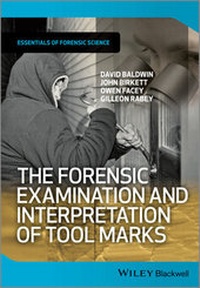
The Forensic Examination and Interpretation of Tool Marks
Description

Reviews / Votes
"An excellent resource that would find a prominent place in an organisation's library, a legal library and a forensic scientist's personal library." (The Chartered Society of Forensic Sciences, 1 January 2015)More details
Other editions
Additional editions
Persons
Content
About the Authors xi
Series Foreword: Essentials of Forensic Science xv
Foreword xvii
Preface xxi
About the Companion Website xxv
1 Introduction 1
1.1 Overview of contents 1
1.2 A brief history of tool marks 4
1.3 General aspects of marks' comparison 7
1.4 Training requirements for examiners 8
1.5 Good forensic practice 10
1.6 Examination and comparison strategy 11
1.6.1 Analysis 11
1.6.2 Comparison 12
1.6.3 Evaluation 12
1.6.4 Verification 12
1.7 Environment and equipment 13
1.7.1 Basic requirements 13
1.7.2 Examiner's 'toolbox' 14
1.7.3 Test mark and casting materials 14
1.7.4 Larger equipment 17
1.7.4.1 The comparator 18
1.8 Quality assurance 22
1.9 A brief summary 23
References 24
2 Tool Manufacture 25
2.1 Introduction 25
2.2 Working with metal 28
2.3 Creating a tool 'blank' 29
2.3.1 Forging 30
2.3.2 Blanking and shearing 31
2.3.3 Metal cutting operations 32
2.4 Finishing processes 34
2.5 Wear, corrosion and damage 45
References 51
3 Scene Examination 53
3.1 Examining and recording the scene 53
3.2 General preliminaries 54
3.2.1 Verifying the circumstances 54
3.2.2 Recording the scene 54
3.2.3 Scene to scene linking 55
3.2.4 Packaging 55
3.3 Forced entry marks-levering 56
3.3.1 Recovery of levering marks 58
3.4 Forced entry marks-other 63
3.4.1 Hammer-type attack 64
3.4.2 Gripping tool attacks 65
3.4.3 Motor vehicle entry 66
3.5 Entry by cutting 67
3.5.1 Padlock removal 68
3.5.2 Breached security systems 69
3.6 Theft of metal 72
3.7 Examination of machines 73
3.8 Pathology samples 74
3.9 Collecting suspect tools 77
References 79
4 Initial Laboratory Examination 81
4.1 General preliminaries 81
4.1.1 Receiving items 81
4.1.2 Planning the examination 82
4.1.3 Preparing for the examination 84
4.1.4 Collecting the items 84
4.1.5 Decontamination of item packaging 84
4.1.6 Operating procedures 84
4.1.7 Recording and opening the packaging 85
4.1.8 Description of the item 86
4.1.9 Examination of the item 86
4.2 Mainly impressed marks 86
4.2.1 Levering marks 87
4.2.2 Impact marks 89
4.2.3 Gripping marks 89
4.2.4 The tool(s) 90
4.3 Mainly dynamic marks 91
4.3.1 Levering marks with striations 92
4.3.2 Cutting and stabbing marks 92
4.4 Saw marks 99
4.5 Post-mortem samples 105
4.6 Alphanumeric punches 108
4.7 Using tool marks for intelligence purposes 111
4.7.1 Type and size of tool 111
4.7.2 Scene-to-scene linking without a tool 111
4.7.3 Scene-to-scene linking using a tool recovered from a scene 112
4.7.4 Linking suspect's tool(s) to previously unsuspected scenes 112
4.7.5 Setting up a database 112
References 113
5 Detailed Laboratory Examination 115
5.1 First considerations 115
5.2 Presentation of material to the comparator 116
5.3 Impressed marks 119
5.4 Marks with striations 123
5.4.1 Sliding marks 124
5.4.2 Double-bladed cutting tools 128
5.4.3 Stab marks (in tyres and bones) 131
5.5 Saw marks 136
5.5.1 Initial and final cuts 136
5.5.2 Sawn ends 137
5.6 Specialised marks 139
5.6.1 Alphanumeric punches 139
5.6.2 Drill marks 143
5.6.3 Slide hammers 144
5.6.4 Pipe cutters 146
5.7 Other considerations 147
5.7.1 Test marks made in situ 147
5.7.2 Amount of detail required for comparison 148
5.7.3 Use of a scanning electron microscope (SEM) 148
References 150
6 Interpretation and Evaluation 151
6.1 Introduction 151
6.1.1 Interpretation 151
6.1.2 Evaluation 153
6.1.3 Interpretation and evaluation 155
6.1.4 Scene-to-scene linking 157
6.2 Considerations as the laboratory examination progresses 157
6.2.1 Eliminations and inconclusive evidence 157
6.2.2 Identifications and levels of support 158
6.3 Other considerations 166
6.4 Verification 170
6.5 After the examination 171
6.6 Quality assurance 172
References 173
7 Manufacturing Marks: Involving Tool Mark Related Examinations 175
7.1 Introduction 175
7.2 Screws 176
7.3 Insulated cable 178
7.4 Copied coins 179
7.5 Security ties/tags 181
Reference 182
8 Physical Fits: Involving Tool Mark Related Examinations 183
8.1 Introduction 183
8.2 Scene examination 185
8.3 Categories of physical fit and laboratory examination 186
8.3.1 Jigsaw fits 186
8.3.1.1 Multiple broken pieces 187
8.3.2 Physical fits requiring tool mark skills 188
8.3.3 Physical fits requiring knowledge of manufacturing detail 190
8.3.3.1 Broken items 190
8.3.3.2 Cut items 191
8.3.4 Contact 'fits' 192
8.4 Evaluation 193
9 Plastic Film Examinations 197
9.1 Introduction 197
9.2 The 'blown film' process 199
9.2.1 Extrusion 199
9.2.2 Bag production and construction 201
9.2.2.1 Heat sealing, perforating and cutting 201
9.2.2.2 Gussets 203
9.2.2.3 Press seals 203
9.2.2.4 Printing 203
9.3 Laboratory considerations 205
9.3.1 Preliminaries 205
9.3.2 Equipment 206
9.4 Laboratory examination and evaluation 208
9.4.1 Pigmented bags 209
9.4.1.1 One unknown bag versus one known bag 209
9.4.1.2 Unknown bag(s) versus a roll/set of known bags 211
9.4.2 Self-seal bags 213
9.4.3 Wrapping film 214
9.4.4 Self-adhesive tape 215
References 217
10 Summary 219
References 220
Glossary 223
Index 237
