

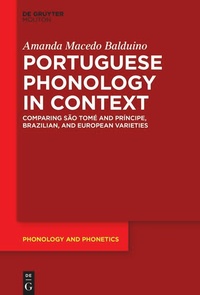
Portuguese Phonology in Context
Description

Portuguese Phonology in Context delivers a pioneering analysis of São Tomé and Príncipe Portuguese (PSTP), revealing unique phonological features of this African Portuguese variety. Through comparison with Brazilian and European Portuguese, it highlights distinct patterns and some similarities among different Portuguese varieties. This work deepens our understanding of language variation and phonological diversity, advocating for inclusive linguistic policies and establishing PSTP as an important reference in Portuguese phonetics and phonology studies.
More details
Other editions
Additional editions
Person
Amanda Macedo Balduino , Universidade Estadual de Campinas (Unicamp), Campinas, Brazil.
Content
- Intro
- Contents
- Introduction
- 1 The organization of this book
- 2 São Tomé and Príncipe
- 3 The Portuguese language of and in STP
- 4 Fieldwork, data collection, analysis, and dialogues
- 5 Why publish a phonology?
- 6 Conclusion and perspectives for future research
- 7 Acknowledgments
- Chapter 1 Consonants
- 1.1 Consonants overview
- 1.2 Plosives
- 1.2.1 Labial plosives
- 1.2.2 Coronal plosives
- 1.2.3 Dorsal plosives
- 1.3 Fricatives
- 1.3.1 Labial fricatives
- 1.3.2 Palatal fricatives
- 1.3.3 Coronal fricatives
- 1.4 Nasals
- 1.4.1 Labial nasal
- 1.4.2 Coronal nasal
- 1.4.3 Palatal nasal
- 1.5 Laterals
- 1.5.1 Coronal lateral
- 1.5.2 Palatal lateral
- 1.6 Rhotics
- 1.6.1 The issue of rhotics
- 1.6.2 Rhotics: Contact, changing, and other Portuguese varieties
- 1.6.3 Rhotics in PSTP: Features
- 1.6.3.1 The Rhotic group: [+sonorant] segments
- 1.6.3.2 The Rhotic group: [-sonorant] segments
- 1.7 Summary
- Chapter 2 Vowels
- 2.1 Oral vowels: An overview
- 2.2 Stressed vowels
- 2.2.1 Stressed vowels: Formants, duration, and acoustic dispersion
- 2.2.2 Stressed vowels in PSTP: Comparing with Brazilian and European Portuguese
- 2.3 Pretonic vowels: An overview
- 2.3.1 Pretonic vowels: Formants and duration
- 2.3.2 Raising, lowering, and vowel harmony in PSTP
- 2.3.2.1 Pretonic vowel raising
- 2.3.2.2 Pretonic vowel lowering: A vowel harmony case?
- 2.3.2.3 Pretonic [e] ~ [?]
- [o] ~ [?] alternations with -íssim and -inh suffixes
- 2.3.3 Pretonic vowels in PSTP: Comparing with Brazilian and European Portuguese
- 2.4 Non-final posttonic vowels: An overview
- 2.4.1 Posttonic vowels: Formants and duration
- 2.4.2 Non-final posttonic vowel raising
- 2.4.3 Non-final posttonic devoicing and syllable deletion
- 2.4.4 Non-final posttonic vowels in PSTP: Comparing with Brazilian and European Portuguese
- 2.5 Final unstressed vowels: An overview
- 2.5.1 Final unstressed vowels: Formants and duration
- 2.5.2 Final unstressed vowel raising and other phenomena
- 2.5.3 Final unstressed vowels in PSTP: Comparing with Brazilian and European Portuguese
- 2.6 Nasalized vowels and nasalization phenomena
- 2.6.1 Tautosyllabic nasality: A laboratory approach
- 2.6.2 Heterossyllabic nasality: A laboratory approach
- 2.7 Diphthongs
- 2.7.1 Rising diphthongs
- 2.7.2 Falling diphthongs
- 2.8 Summary
- Chapter 3 The syllable
- 3.1 Syllable structure in PSTP
- 3.1.1 Nucleus
- 3.1.2 Onset
- 3.1.2.1 Other clusters
- 3.1.3 Coda
- 3.1.3.1 Coda deletion
- 3.2 Ambisyllabicity
- 3.3 Conflicting patterns? CV syllables and new syllabic structures
- 3.4 Summary
- Chapter 4 Stress
- Chapter 5 The bigger picture: Establishing a standard norm of Portuguese for São Tomé and Príncipe
- References
- Index
