

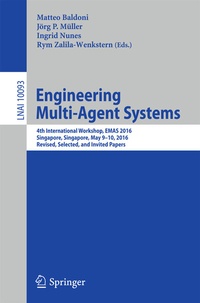
Engineering Multi-Agent Systems
Description

This book constitutes revised, selected, and invited papers from the 4th International Workshop on Engineering Multi-Agent Systems, EMAS 2016, held in Singapore, in May 2016, in conjunction with AAMAS.
The 10 full papers presented in this volume were carefully reviewed and selected from 14 submissions. The book also contains 2 invited papers; extended versions of AAMAS 2016 demonstration abstracts. EMAS deals with MAS software engineering processes, methodologies and techniques; Programming languages for MAS; Formal methods and declarative technologies for the specification, validation and verification of MAS; and development tools.
More details
Other editions
Additional editions
Content
- Intro
- Preface
- Organization
- Contents
- nDrites: Enabling Laboratory Resource Multi-agent Systems
- 1 Introduction
- 2 Previous Work
- 3 The Laboratory Resource Multi-agent System (LR-MAS) Framework
- 3.1 The Laboratory Resources Multi Agent System Model
- 3.2 nDrites
- 4 The Laboratory Resource Multi Agent System Implementation
- 4.1 Communications
- 4.2 Sending Messages to nDrites
- 4.3 Sending Messages to Agents
- 4.4 Definition of LR-MAS Agents
- 5 The Analytical Monitoring Case Study
- 6 The Instrument Failure Prediction Case Study
- 7 Conclusions
- References
- Towards Data- and Norm-Aware Multiagent Systems
- 1 Introduction
- 2 Meyer's Forces: Processor, Action and Object
- 3 From Functional Decomposition to MAS
- 4 Need of Data and Norm Awareness
- 5 Steps Towards Data and Norm Awareness
- 6 Final Remarks
- References
- Monitoring Patients with Hypoglycemia Using Self-adaptive Protocol-Driven Agents: A Case Study
- 1 Introduction and Motivation
- 2 Related Work
- 3 Self-adaptive Protocol-Driven Agents
- 4 Modeling Medical Protocols for Hypoglycemia in the Newborns
- 5 Conclusions and Future Work
- References
- Using Automatic Failure Detection for Cognitive Agents in Eclipse (AAMAS 2016 DEMONSTRATION)
- 1 Introduction
- 2 Automated Testing of Cognitive Agents
- 2.1 Modules as Basic Unit for Testing
- 2.2 Test Language
- 2.3 Test Templates
- 2.4 Test Approach
- 2.5 Debugging, Testing, and Fault Localisation
- 3 Debugging a Multi-agent System
- 3.1 Stepping an Agent
- 3.2 User-Defined Breakpoints
- 3.3 User-Selectable Breakpoints
- 3.4 State Inspection
- 3.5 Interactive Console
- 3.6 Watch Expressions
- 3.7 Logging
- 4 Testing GOAL Agents in the Eclipse IDE
- 5 Evaluation
- 6 Conclusion
- References
- PriGuardTool: A Web-Based Tool to Detect Privacy Violations Semantically
- 1 Introduction
- 2 Background: PriGuard Approach
- 3 PriGuardTool
- 4 Implementation
- 5 Evaluation
- 5.1 Experiments with Facebook Users
- 5.2 Variations on Example Scenarios
- 6 Discussion
- 6.1 Related Work
- 6.2 Limitations and Future Developments
- References
- Application Framework with Abstractions for Protocol and Agent Role
- Abstract
- 1 Introduction
- 2 Agent Model
- 3 Framework Overview
- 4 Application Framework: Agent System
- 5 Application Framework: Utility System
- 6 Test System
- 7 Evaluation
- 8 Discussion
- 9 Related Work
- 10 Summary
- Acknowledgments
- References
- A Namespace Approach for Modularity in BDI Programming Languages
- 1 Introduction
- 2 Related Work
- 3 Modules and Namespaces
- 3.1 Syntax
- 3.2 Loading Modules
- 4 Implementation
- 5 Example
- 6 Evaluation
- 7 Discussion
- 7.1 Module Relationships
- 8 Conclusion
- References
- ARGO: An Extended Jason Architecture that Facilitates Embedded Robotic Agents Programming
- 1 Introduction
- 2 Programming BDI Agents
- 2.1 Jason
- 2.2 Javino
- 2.3 Embedding Robotic Agents
- 3 Perception Filters
- 3.1 Filtering Perceptions
- 3.2 Perception Filters in Jason
- 4 ARGO
- 4.1 Overview of a Robot's Architecture Using Javino
- 4.2 ARGO Architecture
- 4.3 Internal Actions
- 4.4 Customizing Jason for ARGO
- 5 Experiments
- 5.1 Case Study
- 5.2 Experiment Design
- 5.3 Implementation
- 5.4 Results
- 6 Related Work
- 7 Conclusions and Further Work
- References
- A Multi-agent Solution for the Deployment of Distributed Applications in Ambient Systems
- 1 Deployment of Smart Applications
- 2 Related Work
- 3 Scenario
- 4 Multi-agent Architecture
- 4.1 Agents and Artifacts
- 4.2 Sharing Policies
- 4.3 Deployment
- 4.4 Scenario Illustration
- 4.5 Summary
- 5 Agents' Behaviour
- 5.1 User Agent
- 5.2 Application Agent
- 5.3 Infrastructure Agent
- 6 Implementation and Experimentations
- 7 Conclusion and Future Work
- References
- Reasoning About the Executability of Goal-Plan Trees
- 1 Introduction
- 2 Related Work
- 3 Goal-Plan Trees
- 3.1 Actions
- 3.2 Plans
- 3.3 Goals
- 4 Execution Conditions
- 4.1 Actions
- 4.2 Plans
- 4.3 Goals
- 4.4 Sets of Execution Paths
- 5 Conclusion and Future Work
- References
- Augmenting Agent Computational Environments with Quantitative Reasoning Modules and Customizable Bridge Rules
- 1 Introduction
- 2 Specification of the Case Study
- 3 Resource-Based Reasoning
- 4 Enhancing the ACE Framework
- 5 Case Study: Bridge Rules Customization and Application
- 6 Semantics
- 7 Case Study: RASP Implementation
- 8 Concluding Remarks
- References
- How Testable are BDI Agents? An Analysis of Branch Coverage
- 1 Introduction
- 2 Belief-Desire-Intention (BDI) Agents
- 3 All-Edge Coverage Analysis
- 3.1 Removing Failure Handling
- 3.2 Simplifying for Uniform Programs
- 4 All-edges vs. All-paths
- 5 BDI vs. Procedural
- 6 Conclusion
- References
- Author Index
