

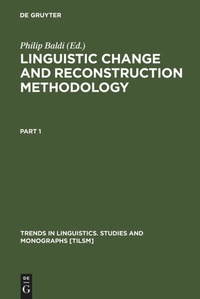
Linguistic Change and Reconstruction Methodology
1st Edition
Published on 1. June 2011
XII, 752 pages
978-3-11-088609-2 (ISBN)
Description

No detailed description available for "Linguistic Change and Reconstruction Methodology".
More details
Series
Edition
Reprint 2011
Language
English
Place of publication
Berlin/Boston
Germany
Publishing group
de Gruyter Mouton
Target group
Professional and scholarly
US School Grade: College Graduate Student
Illustrations
Num. figs. and tabs.
Num. figs. and tabs.
File size
19,56 MB
ISBN-13
978-3-11-088609-2 (9783110886092)
Schweitzer Classification
Other editions
Additional editions
Philip Baldi
Linguistic Change and Reconstruction Methodology
Book
04/1990
1st Edition
De Gruyter Mouton
€250.00
Shipment within 7-9 days
Philip Baldi
Linguistic Change and Reconstruction Methodology
Book
01/1990
1st Edition
De Gruyter Mouton
€339.00
Article exhausted; check different version
Content
- Intro
- Preface
- Contents
- List of Contributors
- Introduction: The comparative method
- 1. American Indian Languages
- Summary report: American Indian languages and principles of language change
- The role of typology in American Indian historical linguistics
- Morphosyntax and problems of reconstruction in Yuman and Hokan
- Tlingit: A portmanteau language family?
- Algonquian linguistic change and reconstruction
- Mayan languages and linguistic change
- 2. Austronesian Languages
- Summary report: Linguistic change and reconstruction methodology in the Austronesian language family
- The "aberrant" (vs. "exemplary") Melanesian languages
- The Austronesian monosyllabic root, radical or phonestheme
- Ergativity east and west
- Homomeric lexical classification
- Patterns of sound change in the Austronesian languages
- 3. Indo-European Languages
- Summary report of the Indo-European panel
- Phonology and morphology at the crossroads
- Etymologies, equations, and comparanda: Types and values, and criteria for judgment
- The historical grammar of Greek: A case study in the results of comparative linguistics
- A survey of the comparative phonology of the so-called "Nostratic" languages
- A few issues of contemporary Indo-European linguistics
- Is the "comparative" method general or family-specific?
- The homomeric argument for a Slavo-Germanic subgroup of Indo-European
- 4. Australian Languages
- Summary report: Linguistic change and reconstruction in the Australian language family
- Verbal inflexion and macro-subgroupings of Australian languages: The search for conjugation markers in non-Pama-Nyungan
- Social parameters of linguistic change in an unstratified Aboriginal society
- The significance of pronouns in the history of Australian languages
- Prenazalization in Pama-Nyungan
- 5. Altaic Languages
- Summary report of the Altaic panel
- Morphological clues to the relationships of Japanese and Korean
- A rule of medial *-r- loss in pre-Old-Japanese
- Japanese and what other Altaic languages
- 6. Afro-Asiatic Languages
- Summary report: Linguistic change and reconstruction in the Afro-Asiatic languages
- Dialectal variation in Proto-Afroasiatic
- Re-employment of grammatical morphemes in Chadic: Implications for language history
- Interpretation of orthographic forms
- The role of Egyptian within Afroasiatic (/Lislakh)
- A survey of Omotic grammemes
- The regularity of sound change: A Semitistic perspective
- Indexes
- Subject index
- Language index
- Author index
