

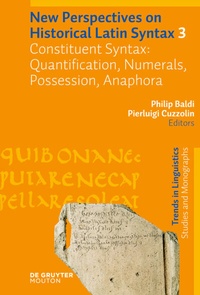
Constituent Syntax: Quantification, Numerals, Possession, Anaphora
Description

New Perspectives on Historical Latin Syntax: Constituent Syntax (Quantification, Numerals, Possession, Anaphora) is the third of four volumes dealing with the long-term evolution of Latin syntax, roughly from the 4th century BCE up to the 6th century CE. Essentially an extension of Volume 2, Volume 3 concentrates on additional subsentential syntactic phenomena and their long-term evolution from the earliest texts up to the Late Latin period. Included in Volume 3 are detailed treatments of quantification, numerals, possession, and deixis/anaphora. As in the other volumes, the non-technical style and extensive illustration with classical examples makes the content readable and immediately useful to the widest audience.
Key features
- first publication to investigates the long-term syntactic history of Latin
- generally accessible to linguists and non-linguists
- theoretically coherent, formulated in functional-typological terms
-
does not require reading fluency in Latin, since all examples are translated into English
More details
Other editions
Additional editions
Content
- Intro
- Acknowledgments
- Contents
- Detailed contents
- List of abbreviations
- Prolegomena
- 1. Background and methodology
- 2. Historical syntax and Latin
- 3. The Functional-typological Approach
- 4. The diachronic dimension
- 5. Audience
- 6. Volume 3
- Quantification
- 1. Indefinite pronouns
- 1.1. The derivation of indefinites
- 1.2. Indefinites and quantification
- 1.2.1. The relation between "existential quantifier" and "presupposition of existence"
- 1.2.2. The distinction "specific/nonspecific" and the presupposition of existence
- 1.3. Main functional types of indefinites
- 1.3.1. Specificity and nonspecificity
- 1.3.2. Knowledge of the speaker
- 1.3.3. Negation
- 1.3.4. Negative polarity
- 1.3.5. Free choice
- 2. Nonspecific/specific: quis/aliquis
- 2.1. Quis
- 2.1.1. The contexts of occurrence of quis
- 2.2. Aliquis
- 2.3. Interrogative clauses: ecquis, numquis
- 2.4. Conditional clauses: most cases of quis, some cases of aliquis
- 2.5. Indefinites in negative conditionals
- 2.6. Clauses introduced by ne
- 2.7. Some special uses of aliquis
- 2.7.1. Aliquis expresses a quantity
- 2.7.2. Aliquis is next to a free-choice pronoun
- 3. Quispiam
- 3.1. Quispiam in Early and Classical Latin
- 3.2. Quispiam in Late Latin
- 3.3. Quispiam in Gellius and Apuleius
- 4. Knowledge of the speaker
- 4.1. Semantic enrichment by implicature
- 4.2. The value of "hedge"
- 4.3. Plural uses
- 4.4. Later developments
- 5. Negation
- 5.1. Negative indefinite pronouns
- 5.2. Double negation
- 5.3. Diachronic change
- 5.4. Double negation: Different interpretations
- 5.5. Predicative use of nullus
- 5.6. Negative indefinites in Late Latin
- 6. Negative polarity: quisquam
- 6.1. Quisquam as a semantic negation
- 6.2. Quisquam as a pragmatic negation
- 6.3. Quisquam as a negative polarity item in nonnegative contexts
- 6.4. Quisquam in modal contexts: Problems of NEG-raising
- 6.5. Quisquam in Late Latin
- 7. Free choice
- 7.1. Quiuis, quilibet
- 7.2. The diachronic source of free-choice indefinites
- 7.3. Quisquis and quicumque
- 7.4. Quisquis
- 7.5. Quicumque
- 7.6. Quisquis and quicumque in Classical and Late Latin
- 7.7. The relationship between quisquis and quisque
- 8. Universal quantifiers
- 8.1. Totality quantifiers
- 8.2. The use of totus with pluralia tantum
- 8.2.1. Castra
- 8.2.2. Aedes
- 8.2.3. Moenia
- 8.3. Plural uses where toti means omnes
- 8.4. Universal quantifiers
- 8.5. Disambiguation in Latin
- 9. Distributive universal quantifiers
- 9.1. Quisque
- 9.2. Unusquisque and singuli
- 9.3. Singuli as a distributive-share quantifier
- 9.4. Quisque in Late Latin
- 10. Binary Quantification
- 10.1. Contrastive coordination: uterque and neuter
- 10.2. Distributive and collective reading: uterque and ambo
- 10.3. Disjunction: uteruis and alteruter
- 10.4. Alter in binary quantification
- 10.5. Non quantificational uses: alter/alius
- 10.6. Alter in enumerations
- 10.7. Some late uses of alter
- Numerals
- 1. The system of Latin numerals: categories and their semantics
- 1.1. Atoms, bases, and operations
- 1.2. The series of numerals
- 1.3. Historical changes
- 1.3.1. The structure of the sequence
- 1.3.1.1. From Indo-European to Latin
- 1.3.1.2. Evolution from historical times to Romance
- 1.3.2. The series of numerals
- 1.3.2.1. From Indo-European to Latin
- 1.3.2.2. Cross-patterns
- 1.3.2.3. The series in Vulgar and Late Latin
- 1.4. Preliminary conclusions on the semantics of numerals in Latin
- 2. External Syntax: Numerals as constituents of larger structures
- 2.1. Numerals and word classes
- 2.2. Numeral nouns
- 2.3. Numeral adverbs
- 2.4. Numeral adjectives
- 2.4.1. Adjectival numerals
- 2.4.2. Basic word order of adjectival numerals
- 2.4.3. Word order within noun phrases of more than two elements
- 2.4.4. Conclusion
- 2.5. Preliminary conclusions on the external syntax of numerals
- 3. The internal syntax of numbers
- 3.1. The system in pre-Classical and Classical Latin
- 3.1.1. Addition
- 3.1.1.1. Morphology
- 3.1.1.2. More than two additions
- 3.1.1.3. Non-grammaticalization
- 3.1.2. Multiplication
- 3.1.3. Subtraction
- 3.2. Patterns of development
- 3.3. Preliminary conclusions on the internal syntax of numerals
- 4. The evolution of unus into the indefinite article
- 4.1. The process
- 4.2. Stages of development
- 4.3. Causes of the development
- 4.4. Relationship to quidam and aliquis
- 5. Summary and conclusions
- Possession
- 1. Introduction
- 1.1. Relevant notions
- 1.2. Structures and functions: Attributive possession and predicative possession
- 1.3. Texts and parameters
- 2. Predicative possession: From the archaic period to Late Latin
- 2.1. Mihi est x and habeo x
- 2.1.1. Possessive relations and semantic content
- 2.1.1.1. [+Human] possessor & [+Human] possessum and kinship relations
- 2.1.1.2. Body part relations
- 2.1.1.3. Mental/emotional activities and experiencer
- 2.1.1.4. Other relations
- 2.1.2. Agentivity, stativity, and habeo as a "light verb"
- 2.1.3. Prototypical possession
- 2.1.4. Habeo x and mihi est x within the discourse
- 2.1.5. Topic continuity and discourse structure
- functional overload of the dative case
- 2.1.6. Existential constructions and definiteness of possessum
- 2.1.7. Mihi est x and habeo x: Conclusions
- 2.2. The genitive construction
- 2.2.1. The Marci/meus est x type: A general framework
- 2.2.2. Marci/meus est x versus mihi est x: A contrastive analysis
- 2.2.3. Conclusions
- 3. Attributive possession
- 3.1. A general frame of morphological features and formal structures
- 3.2. Function and semantics of the possessive noun phrase
- 3.2.1. Semantic and informational functions
- 3.2.2. Some remarks on definiteness
- 3.2.3. Conclusion
- 3.3. Variation in form and function
- 3.3.1. Dative marking
- 3.3.2. Zero-marking and implicit possessors
- 3.3.3. External possession
- 3.3.4. Adjectival marking
- 3.4. Tendencies in word order
- 4. Conclusions: Diachronic and typological implications
- 4.1. Predicative possession
- 4.2. Attributive possession
- Deixis and anaphora
- 1. Preliminaries
- 2. Person
- 2.1. Paradigmatic oppositions
- 2.2. The covert feature of person in the deictic system
- 2.2.1. Looking for the relevant feature of iste
- 2.2.1.1. Iste as a manifestation of the "emotive" function
- 2.2.2. Towards a paradigmatic description of the system: markedness and diachrony
- 2.3. Beyond person
- 3. Anaphora
- 3.1. Agreement
- 3.2. Zero anaphora?
- 3.3. Reflexive structures
- 3.3.1. The controller of the reflexive
- 3.3.2. Long distance reflexives
- 3.4. The determinative is, ea, id
- 3.5. Identity: idem, ipse
- 3.5.1. Interpretative differences as effects of the syntactic context where ipse occurs
- 3.5.2. The relationship of ipse with the subject function
- 3.5.3. Developments
- 4. Notes on the uses of hic/iste/ille/is, discourse organization and syntactic functions
- 5. Notes on the emergence of new categories
- 5.1. On the emergence of articles
- 5.2. On the emergence of clitics
- 6. Summary and concluding remarks
- Subject index
- Index of classical references
