

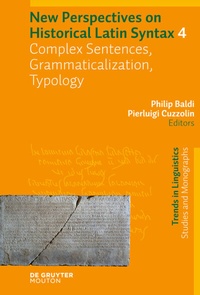
Complex Sentences, Grammaticalization, Typology
Volume 4: Complex Sentences, Grammaticalization, Typology
1st Edition
Published on 27. October 2011
XXXIII, 926 pages
978-3-11-025341-2 (ISBN)
Description

New Perspectives on Historical Latin Syntax: Complex Sentences, Grammaticalization, Typology is the fourth in a set of four volumes dealing with the long-term evolution of Latin syntax, roughly from the 4th century BCE up to the 6th century CE. As in the other volumes, the non-technical style and extensive illustration with classical examples makes the content readable and immediately useful to the widest audience.
More details
Series
Language
English
Place of publication
Berlin/Boston
Germany
Publishing group
de Gruyter Mouton
Target group
Professional and scholarly
US School Grade: College Graduate Student
Illustrations
27 s/w Tabellen, 5 Abbildungen
5 ill., 27 tbl.
File size
4,70 MB
ISBN-13
978-3-11-025341-2 (9783110253412)
DOI
http://www.degruyter.com/isbn/9783110253412
Schweitzer Classification
Other editions
Additional editions
Philip Baldi | Pierluigi Cuzzolin
New Perspectives on Historical Latin Syntax / Complex Sentences, Grammaticalization, Typology
Book
10/2011
1st Edition
De Gruyter Mouton
€289.00
Article exhausted; check different version
Philip Baldi | Pierluigi Cuzzolin
Complex Sentences, Grammaticalization, Typology
Volume 4: Complex Sentences, Grammaticalization, Typology
Book
10/2011
1st Edition
De Gruyter Mouton
€300.00
Shipment within 7-9 days
Persons
Philip Baldi, Pennsylvania State University, University Park, Pennsylvania,USA; Pierluigi Cuzzolin, Bergamo University, Italy.
Content
1 - Acknowledgments [Seite 5]
2 - List of abbreviations [Seite 29]
3 - Epilegomena [Seite 35]
3.1 - 1. Retrospective [Seite 35]
3.2 - 2. Volume 4 [Seite 39]
4 - Adverbial subordination: Introductory overview [Seite 45]
4.1 - 1. Introduction [Seite 45]
4.2 - 2. The concept of subordination: Adverbial phrases and studies of relations [Seite 45]
4.3 - 3. Treatment of adverbial clauses [Seite 46]
4.3.1 - 3.1. Purpose and result [Seite 47]
4.3.2 - 3.2. Conditionals and concessives [Seite 48]
4.3.3 - 3.3. Causals [Seite 49]
4.3.4 - 3.4. Temporals [Seite 50]
4.3.5 - 3.5. Comparatives [Seite 51]
5 - Purpose and result clauses [Seite 53]
5.1 - 1. Introduction: Clarification of previous concepts and methodologies [Seite 53]
5.2 - 2. Function and possible syntactic structures [Seite 55]
5.2.1 - 2.1. Vt + subjunctive [Seite 57]
5.2.2 - 2.2. Non-finite forms [Seite 60]
5.2.3 - 2.3. Relative connector-clause [Seite 64]
5.2.3.1 - 2.3.1. Generic relative in purpose clauses [Seite 64]
5.2.3.2 - 2.3.2. Quo [Seite 66]
5.2.3.3 - 2.3.3. The relative pronoun as an introductory element for result clauses [Seite 67]
5.3 - 3. The semantic level [Seite 69]
5.3.1 - 3.1. Characterizing semantic features [Seite 69]
5.3.2 - 3.2. Analysis of the characterizing features [Seite 70]
5.3.2.1 - 3.2.1. Possibility and Factuality [Seite 71]
5.3.2.2 - 3.2.2. Control, intentionality, animacy, and prospectivity [Seite 75]
5.3.2.3 - 3.2.3. The semantic value of the governing verb [Seite 80]
5.3.3 - 3.3. Some related semantic relations [Seite 83]
5.3.3.1 - 3.3.1. 'Conditionals' [Seite 83]
5.3.3.2 - 3.3.2. Comparative-Modal clauses [Seite 84]
5.3.3.3 - 3.3.3. Causal clauses [Seite 86]
5.3.4 - 3.4. Continuum in/between semantic relations [Seite 88]
5.3.5 - 3.5. Recapitulation of semantic features [Seite 89]
5.4 - 4. The syntactic level [Seite 90]
5.4.1 - 4.1. Syntactic status [Seite 91]
5.4.2 - 4.2. Analysis of (formal) features with syntactic implications [Seite 96]
5.4.2.1 - 4.2.1. Correlation [Seite 96]
5.4.2.2 - 4.2.2. First element of the correlation [Seite 98]
5.4.2.3 - 4.2.3. Introductory element [Seite 101]
5.4.2.4 - 4.2.4. Nominalization [Seite 107]
5.4.2.5 - 4.2.5. Polarity [Seite 108]
5.4.2.6 - 4.2.6. Verb tense [Seite 110]
5.4.3 - 4.3. The syntactic function and the level of integration [Seite 115]
5.5 - References [Seite 119]
6 - Conditionals and concessives [Seite 127]
6.1 - 1. Conditionals [Seite 127]
6.1.1 - 1.1. Preliminary remarks [Seite 127]
6.1.1.1 - 1.1.1. Paratactic conditionals [Seite 128]
6.1.1.2 - 1.1.2. The origin of conditional clauses [Seite 131]
6.1.1.3 - 1.1.3. Condensed conditions [Seite 133]
6.1.2 - 1.2. Types of conditional clauses [Seite 135]
6.1.2.1 - 1.2.1. The first type: Objectivity [Seite 135]
6.1.2.2 - 1.2.2. The second type: Possibility [Seite 138]
6.1.2.3 - 1.2.3. The third type: Unreality [Seite 139]
6.1.3 - 1.3. Some historical considerations [Seite 142]
6.1.4 - 1.4. Conditional perfection [Seite 145]
6.1.4.1 - 1.4.1. Necessary and sufficient conditions [Seite 146]
6.1.5 - 1.5. Exclusive nisi and exceptive nisi [Seite 148]
6.1.5.1 - 1.5.1. Exclusive nisi [Seite 149]
6.1.5.2 - 1.5.2. Exceptive nisi [Seite 149]
6.1.5.3 - 1.5.3. Nisi and si non [Seite 152]
6.1.5.4 - 1.5.4. Other negative conditional conjunctions: ni, si minus, sin [Seite 155]
6.1.6 - 1.6. Speech act conditions [Seite 159]
6.1.7 - 1.7. Complex conditional connectives [Seite 161]
6.1.7.1 - 1.7.1. Speech act conditions introduced by si modo [Seite 161]
6.1.7.2 - 1.7.2. Si modo as a true condition [Seite 162]
6.1.7.3 - 1.7.3. Si tamen [Seite 163]
6.1.7.4 - 1.7.4. Si quidem [Seite 167]
6.1.8 - 1.8. The relationship between condition and cause [Seite 169]
6.1.9 - 1.9. Epistemic conditionals [Seite 171]
6.2 - 2. Concessive clauses [Seite 173]
6.2.1 - 2.1. Preliminary remarks [Seite 173]
6.2.2 - 2.2. True concessives [Seite 177]
6.2.2.1 - 2.2.1. Quamquam [Seite 178]
6.2.2.2 - 2.2.2. Etsi [Seite 180]
6.2.2.3 - 2.2.3. Tametsi [Seite 184]
6.2.2.4 - 2.2.4. Tamenetsi [Seite 185]
6.2.3 - 2.3. The rectifying function of quamquam, etsi, and tametsi [Seite 187]
6.2.4 - 2.4. Concessive conditionals [Seite 190]
6.2.4.1 - 2.4.1. Quamuis [Seite 190]
6.2.4.2 - 2.4.2. Etiamsi (etiam si) [Seite 195]
6.2.5 - 2.5. Contextual concessivity [Seite 198]
6.2.5.1 - 2.5.1. Si-clauses [Seite 198]
6.2.5.2 - 2.5.2. The exclusive disjunction siue ... siue 'whether ... or not' [Seite 199]
6.2.5.3 - 2.5.3. The type quisquis est 'whoever it may be' [Seite 201]
6.2.5.4 - 2.5.4. Cum-clauses [Seite 202]
6.2.5.5 - 2.5.5. Vt-clauses [Seite 204]
6.2.6 - 2.6. Concession in paratactic and coordinate structures [Seite 206]
6.2.6.1 - 2.6.1. The correlative type quidem... sed (tamen) [Seite 207]
6.2.6.2 - 2.6.2. Concessive subjunctive [Seite 209]
6.2.7 - 2.7. Licet [Seite 212]
6.2.8 - 2.8. The concessive subordinators in Late Latin [Seite 215]
6.3 - References [Seite 217]
7 - Causal clauses [Seite 229]
7.1 - 1. Causality and adverbial clauses [Seite 229]
7.2 - 2. Two semantic types of causal clauses [Seite 231]
7.3 - 3. Types of causal conjunctions in Latin [Seite 235]
7.4 - 4. Processes of grammaticalization of the Latin causal conjunctions [Seite 238]
7.4.1 - 4.1. Primary causal conjunctions [Seite 238]
7.4.1.1 - 4.1.1. The conjunction quod [Seite 238]
7.4.1.2 - 4.1.2. The conjunctions quia, cur, quare [Seite 240]
7.4.2 - 4.2. Causal conjunctions with a temporal origin [Seite 242]
7.4.2.1 - 4.2.1. Quoniam, quando, dum [Seite 243]
7.4.2.2 - 4.2.2. Cum, ubi, postquam [Seite 245]
7.4.3 - 4.3. Causal conjunctions with origins in manner [Seite 246]
7.4.4 - 4.4. Causal conjunctions, finals, and quantifiers [Seite 248]
7.5 - 5. Distributional properties of quod-quia vs. quoniam [Seite 249]
7.5.1 - 5.1. Possibilities of coordination [Seite 250]
7.5.2 - 5.2. Answer to a causal interrogative [Seite 251]
7.5.3 - 5.3. Use of correlatives [Seite 251]
7.5.4 - 5.4. Quod and quia as complementizers [Seite 252]
7.5.5 - 5.5. Focalization [Seite 254]
7.5.6 - 5.6. Scope of illocutionary force and of negation [Seite 255]
7.5.7 - 5.7. Use of the subjunctive [Seite 256]
7.5.8 - 5.8. The consecutio temporum [Seite 257]
7.5.9 - 5.9. Word order [Seite 258]
7.6 - 6. Diachronic interferences and changes [Seite 260]
7.6.1 - 6.1. Quia instead of quoniam [Seite 260]
7.6.2 - 6.2. Quoniam instead of quia [Seite 261]
7.6.3 - 6.3. Quod and eo quod, pro eo quod, pro quod [Seite 262]
8 - Temporal clauses [Seite 269]
8.1 - 1. Time and the temporal clause [Seite 269]
8.1.1 - 1.1. The basic concept of time and the temporal clause [Seite 269]
8.1.2 - 1.2. Semantic and pragmatic extensions of temporal clauses [Seite 272]
8.1.3 - 1.3. Temporal clauses and clause-linking [Seite 275]
8.1.3.1 - 1.3.1. Hierarchization [Seite 275]
8.1.3.2 - 1.3.2. Desententialization and tense/mood [Seite 279]
8.1.3.3 - 1.3.3. Desententialization and aspect [Seite 282]
8.2 - 2. The time network in Latin [Seite 287]
8.3 - 3. Temporal subordinators [Seite 293]
8.3.1 - 3.1. Morphology and multifunctionality [Seite 294]
8.3.2 - 3.2. Categories of diachronic input [Seite 296]
8.3.2.1 - 3.2.1. Simple subordinators [Seite 297]
8.3.2.1.1 - 3.2.1.1. Subordinators that derive from the relative [Seite 297]
8.3.2.1.2 - 3.2.1.2. Dum [Seite 300]
8.3.2.1.3 - 3.2.1.3. Simplicity [Seite 302]
8.3.2.2 - 3.2.2. Complex subordinators [Seite 302]
8.3.2.2.1 - 3.2.2.1. Postquam [Seite 302]
8.3.2.2.2 - 3.2.2.2. Comparative constructions [Seite 303]
8.3.2.2.3 - 3.2.2.3. Ex quo [Seite 306]
8.3.3 - 3.3. Between Old Latin and Classical Latin: cum + subjunctive [Seite 307]
8.3.3.1 - 3.3.1. The subjunctive in the relative clause [Seite 309]
8.3.3.2 - 3.3.2. From relative clause to cum causale/historicum [Seite 315]
8.3.4 - 3.4. The subordinators in Late Latin [Seite 320]
8.4 - 4. Time location [Seite 328]
8.4.1 - 4.1. Simultaneity overlap, anteriority, immediate anteriority [Seite 328]
8.4.1.1 - 4.1.1. Semantics [Seite 328]
8.4.1.2 - 4.1.2. Expression formats [Seite 330]
8.4.1.2.1 - 4.1.2.1. SIOVER [Seite 331]
8.4.1.2.2 - 4.1.2.2. ANTE [Seite 334]
8.4.1.2.3 - 4.1.2.3. IMANTE [Seite 336]
8.4.1.2.4 - 4.1.2.4. Temporal distance [Seite 338]
8.4.2 - 4.2. Discourse functions [Seite 339]
8.4.2.1 - 4.2.1. The cum historicum [Seite 341]
8.4.2.2 - 4.2.2. Cum relativum and cum inversum [Seite 345]
8.4.3 - 4.3. The cum historicum as "general subordinator" [Seite 348]
8.4.4 - 4.4. Posteriority [Seite 353]
8.4.4.1 - 4.4.1. Semantics [Seite 353]
8.4.4.2 - 4.4.2. Expression formats [Seite 355]
8.4.4.2.1 - 4.4.2.1. Clause position [Seite 355]
8.4.4.2.2 - 4.4.2.2. Tense/aspect [Seite 356]
8.4.4.2.3 - 4.4.2.3. Modality [Seite 358]
8.5 - 5. Contingency [Seite 361]
8.5.1 - 5.1. Semantics [Seite 361]
8.5.1.1 - 5.1.1. Types of situational plurality [Seite 361]
8.5.1.2 - 5.1.2. CONTING as a special case of situational plurality [Seite 363]
8.5.1.3 - 5.1.3. The plurality continuum of iterative clauses [Seite 364]
8.5.2 - 5.2. Expression formats [Seite 365]
8.5.2.1 - 5.2.1. Subordinators [Seite 366]
8.5.2.2 - 5.2.2. Tense and aspect [Seite 368]
8.6 - 6. Time extent [Seite 371]
8.6.1 - 6.1. Co-extensiveness and terminus ad quem [Seite 371]
8.6.1.1 - 6.1.1. Semantics [Seite 372]
8.6.1.2 - 6.1.2. Expression formats [Seite 375]
8.6.1.2.1 - 6.1.2.1. Dum [Seite 378]
8.6.1.2.2 - 6.1.2.2. Donec [Seite 381]
8.6.1.2.3 - 6.1.2.3. Quoad [Seite 383]
8.6.2 - 6.2. Terminus a quo [Seite 385]
8.6.2.1 - 6.2.1. Semantics [Seite 385]
8.6.2.2 - 6.2.2. Expression formats [Seite 386]
8.7 - 7. Conclusion [Seite 390]
8.7.1 - 7.1. Network-external relations [Seite 390]
8.7.2 - 7.2. Temporal subordinators and network-internal relationships [Seite 391]
9 - Comparative clauses [Seite 407]
9.1 - 1. Introduction [Seite 407]
9.2 - 2. Comparative clauses of Degree [Seite 408]
9.2.1 - 2.1. Definition and constituent parts [Seite 408]
9.2.2 - 2.2. The comparee and the comparative predicate [Seite 410]
9.2.3 - 2.3. The standard [Seite 412]
9.2.4 - 2.4. The degree marker and the standard marker [Seite 416]
9.2.4.1 - 2.4.1. Comparatives of inequality: Superiority and inferiority [Seite 416]
9.2.4.2 - 2.4.2. Comparative constructions of equality, or equative constructions [Seite 422]
9.2.5 - 2.5. Lexical comparison [Seite 425]
9.2.6 - 2.6. Pseudo-comparative structures [Seite 426]
9.2.7 - 2.7. Syntactic, semantic, and pragmatic status of comparative clauses of Degree [Seite 429]
9.3 - 3. Comparative clauses of Manner [Seite 433]
9.3.1 - 3.1. Definition and constituent parts [Seite 433]
9.3.1.1 - 3.1.1. The comparee, the parameter, and the parameter marker [Seite 434]
9.3.1.2 - 3.1.2. The standard and the standard marker [Seite 436]
9.3.2 - 3.2. Functions of comparative clauses of Manner [Seite 442]
9.3.2.1 - 3.2.1. Representational level [Seite 443]
9.3.2.2 - 3.2.2. Interpersonal level [Seite 446]
9.3.3 - 3.3. Syntactic, semantic, and pragmatic status of comparative clauses of Manner [Seite 453]
9.4 - References [Seite 454]
10 - Relative clauses [Seite 461]
10.1 - 1. Definition and structure of the relative clause [Seite 461]
10.1.1 - 1.1. Status quaestionis [Seite 461]
10.1.2 - 1.2. Definition of relative clauses [Seite 462]
10.1.2.1 - 1.2.1. Typological definitions [Seite 462]
10.1.2.2 - 1.2.2. Structure of Latin relative clauses [Seite 463]
10.1.3 - 1.3. Relative pronouns and relative adverbs [Seite 463]
10.1.3.1 - 1.3.1. Types of relative pronouns and relative adverbs [Seite 463]
10.1.3.2 - 1.3.2. Functions of relative pronouns [Seite 464]
10.1.3.3 - 1.3.3. Etymology of relative pronouns [Seite 464]
10.1.4 - 1.4. Relative clauses with a finite verb [Seite 466]
10.1.4.1 - 1.4.1. Subjunctive by attractio modi [Seite 468]
10.1.4.2 - 1.4.2. Subjunctive with a nonspecific value [Seite 470]
10.1.4.3 - 1.4.3. The subjunctive in adverbial relative clauses [Seite 472]
10.1.5 - 1.5. Relative clauses without a finite verb [Seite 475]
10.1.5.1 - 1.5.1. Participles and relative clauses [Seite 477]
10.2 - 2. Phenomenology of the pivot in the matrix clause and semantics of the relative clauses [Seite 482]
10.2.1 - 2.1. Lexical head [Seite 486]
10.2.1.1 - 2.1.1. Semantics of external-headed relative clauses [Seite 487]
10.2.2 - 2.2. Pronominal and free relative clauses [Seite 489]
10.2.2.1 - 2.2.1. Pronominal relative clauses [Seite 491]
10.2.2.2 - 2.2.2. Free relative clauses [Seite 493]
10.2.2.3 - 2.2.3. Syntactic status of free relative clauses [Seite 494]
10.2.2.4 - 2.2.4. Semantics of free, pronominal, and internal-headed relative clauses [Seite 496]
10.2.3 - 2.3. Relation between the pivot and the relative pronoun [Seite 498]
10.2.3.1 - 2.3.1. Attractio inversa [Seite 502]
10.2.3.2 - 2.3.2. Attractio relativi [Seite 506]
10.3 - 3. Relative clause typology [Seite 507]
10.3.1 - 3.1. Relativization operations [Seite 508]
10.3.1.1 - 3.1.1. Subordination [Seite 508]
10.3.1.2 - 3.1.2. Attribution [Seite 511]
10.3.1.3 - 3.1.3. Empty-place formation [Seite 512]
10.3.2 - 3.2. Accessibility hierarchy [Seite 513]
10.3.2.1 - 3.2.1. The concept of an accessibility hierarchy [Seite 514]
10.3.2.2 - 3.2.2. The accessibility hierarchy and Latin relative clauses [Seite 515]
10.3.3 - 3.3. Relativization strategies [Seite 517]
10.3.3.1 - 3.3.1. Nonreduction Strategy [Seite 519]
10.3.3.2 - 3.3.2. Resumptive Pronoun Strategy [Seite 520]
10.3.3.3 - 3.3.3. Relative Pronoun Strategy [Seite 521]
10.3.3.4 - 3.3.4. Gap Strategy [Seite 522]
10.3.3.5 - 3.3.5. Concurrence of strategies [Seite 523]
10.3.3.6 - 3.3.6. Participle Strategy [Seite 523]
10.3.4 - 3.4. Position of relative clauses [Seite 526]
10.4 - 4. Relative clause typology in Latin [Seite 528]
10.4.1 - 4.1. Preposed relative clauses [Seite 528]
10.4.2 - 4.2. Prenominal relative clauses [Seite 533]
10.4.3 - 4.3. Postposed relative clauses [Seite 536]
10.4.3.1 - 4.3.1. Relative connection [Seite 539]
10.4.4 - 4.4. Postnominal relative clauses [Seite 543]
10.4.5 - 4.5. Circumnominal relative clauses [Seite 545]
10.5 - 5. Evolution of the relative clause [Seite 549]
10.5.1 - 5.1. An evolutionary hypothesis [Seite 552]
10.5.1.1 - 5.1.1. Genesis of the correlative clause [Seite 553]
10.5.1.2 - 5.1.2. Development of other types of relative clauses [Seite 556]
10.5.1.3 - 5.1.3. Development of free relative clauses and relative clauses with a pronominal head [Seite 560]
10.5.1.4 - 5.1.4. Genesis of different relativization strategies [Seite 561]
10.5.2 - 5.2. Early Latin [Seite 563]
10.5.3 - 5.3. Classical and post-Classical Latin [Seite 566]
10.5.4 - 5.4. Late Latin [Seite 569]
11 - Comparative and superlative [Seite 583]
11.1 - 1. Basic concepts [Seite 584]
11.1.1 - 1.1. The structure of the gradation patterns [Seite 584]
11.1.2 - 1.2. The structure of the basic comparative pattern [Seite 588]
11.1.2.1 - 1.2.1. The elements of comparison [Seite 588]
11.1.2.2 - 1.2.2. The interplay between morphology and syntax [Seite 593]
11.1.3 - 1.3. The various comparative patterns [Seite 594]
11.1.3.1 - 1.3.1. Sapir's analysis of gradation [Seite 596]
11.1.3.2 - 1.3.2. Comparison of majority [Seite 600]
11.1.3.3 - 1.3.3. Comparison of equality [Seite 601]
11.1.3.4 - 1.3.4. Comparison of minority [Seite 601]
11.1.4 - 1.4. Superlative [Seite 602]
11.1.5 - 1.5. Some terminological questions [Seite 608]
11.2 - 2. A typological survey of the comparative constructions [Seite 608]
11.2.1 - 2.1. The comparative [Seite 610]
11.2.2 - 2.2. The typological patterns [Seite 611]
11.2.3 - 2.3. The cognitive bases of the comparative patterns [Seite 613]
11.2.3.1 - 2.3.1. The separative comparative and the particle comparative: A contrastive analysis [Seite 614]
11.2.3.2 - 2.3.2. The conjoined comparative [Seite 617]
11.2.3.3 - 2.3.3. The surpass (exceed) comparative [Seite 618]
11.2.3.4 - 2.3.4. Concluding remarks on the typology of the comparatives [Seite 619]
11.2.3.5 - 2.3.5. Comparatives of equality and minority [Seite 621]
11.2.4 - 2.4. The typology of the superlative [Seite 621]
11.3 - 3. Historical syntax of comparison from Proto-Indo-European to Latin [Seite 623]
11.3.1 - 3.1. The scenario in Proto-Indo-European [Seite 623]
11.3.1.1 - 3.1.1. Comparative [Seite 623]
11.3.1.1.1 - 3.1.1.1. The morphological tools for comparison: Their form and function [Seite 626]
11.3.1.1.2 - 3.1.1.2. The lexical tools for comparison: Their form and function [Seite 631]
11.3.2 - 3.2. The syntax of comparison in Latin [Seite 635]
11.3.2.1 - 3.2.1. The various patterns of comparison in Latin [Seite 635]
11.3.2.2 - 3.2.2. Origin and function of the ablative of comparison [Seite 637]
11.3.2.3 - 3.2.3. Origin and function of quam as pivot [Seite 639]
11.3.2.4 - 3.2.4. Other minor prepositional patterns [Seite 640]
11.3.3 - 3.3. The patterns of comparison in Latin [Seite 641]
11.3.3.1 - 3.3.1. Conjoined comparative [Seite 641]
11.3.3.2 - 3.3.2. Separative comparative [Seite 642]
11.3.3.2.1 - 3.3.2.1. Genitive [Seite 645]
11.3.3.2.2 - 3.3.2.2. Dative [Seite 649]
11.3.3.2.3 - 3.3.2.3. Prepositional phrases [Seite 651]
11.3.3.3 - 3.3.3. Particle comparative [Seite 660]
11.3.3.4 - 3.3.4. Surpass comparative [Seite 662]
11.3.3.4.1 - 3.3.4.1. The decay of the surpass comparative [Seite 666]
11.3.4 - 3.4. Comparative of minority [Seite 667]
11.3.4.1 - 3.4.1. Comparative of minority encoded by sub- [Seite 671]
11.3.5 - 3.5. Comparative of equality [Seite 672]
11.3.6 - 3.6. Superlative [Seite 674]
11.3.6.1 - 3.6.1. The morphology of the superlative [Seite 674]
11.3.6.2 - 3.6.2. The absolute superlative [Seite 675]
11.3.6.2.1 - 3.6.2.1. Intensifiers with the superlative [Seite 676]
11.3.6.2.2 - 3.6.2.2. The absolute superlative encoded by prefixes: Per- and prae- [Seite 677]
11.3.6.2.3 - 3.6.2.3. The superlative reinforced by quam [Seite 680]
11.3.6.3 - 3.6.3. The encoding of the standard [Seite 680]
11.3.6.3.1 - 3.6.3.1. The standard in the genitive [Seite 680]
11.3.6.4 - 3.6.4. The standard with e, ex plus ablative [Seite 681]
11.3.6.4.1 - 3.6.4.1. The standard introduced by inter, ante, and praeter [Seite 683]
11.3.7 - 3.7. Superlative of minority [Seite 685]
11.4 - 4. Concluding remarks [Seite 686]
12 - Grammaticalization in Latin [Seite 695]
12.1 - 1. Basic concepts [Seite 695]
12.1.1 - 1.1. Grammaticalization as a general process [Seite 695]
12.1.2 - 1.2. Grammaticalization vs. other phenomena [Seite 696]
12.1.2.1 - 1.2.1. Agglutination [Seite 697]
12.1.2.2 - 1.2.2. Lexicalization (freezing) and lexemization [Seite 698]
12.1.2.3 - 1.2.3. Demotivation and reanalysis [Seite 699]
12.1.2.4 - 1.2.4. Analogy [Seite 701]
12.1.3 - 1.3. The different kinds of process referred to as grammaticalization [Seite 703]
12.1.4 - 1.4. Grammatical lexemes in Latin [Seite 704]
12.1.4.1 - 1.4.1. Frequency [Seite 706]
12.1.4.2 - 1.4.2. Morphological features [Seite 707]
12.1.5 - 1.5. The relationships between grammaticalization, agglutination, and lexicalization [Seite 708]
12.1.5.1 - 1.5.1. Co-occurrence and interaction between grammaticalization, agglutination, and lexicalization [Seite 708]
12.1.5.1.1 - 1.5.1.1. Agglutination and lexicalization at the same time [Seite 709]
12.1.5.1.2 - 1.5.1.2. Agglutination and the creation of new lexical items [Seite 710]
12.1.5.2 - 1.5.2. Grammaticalization occurring without agglutination [Seite 711]
12.2 - 2. Methodological considerations [Seite 712]
12.2.1 - 2.1. Latin and grammaticalization: Fertile ground [Seite 712]
12.2.2 - 2.2. Grammaticalization according to Meillet [Seite 713]
12.2.2.1 - 2.2.1. The creation of the words grammaticalisation, se grammaticaliser [Seite 713]
12.2.2.2 - 2.2.2. Meillet's Latin examples [Seite 714]
12.2.2.3 - 2.2.3. Conclusion on Meillet's interpretation [Seite 717]
12.2.3 - 2.3. Grammaticalization after Meillet [Seite 718]
12.2.4 - 2.4. Degrammaticalization [Seite 719]
12.2.5 - 2.5. The extension and the limits of grammaticalization [Seite 720]
12.2.6 - 2.6. Reconstructed and attested data [Seite synchronic variations721]
12.2.7 - 2.7. A new look at grammaticalization in the light of the Latin texts [Seite 722]
12.3 - 3. The most frequent grammaticalization processes [Seite 723]
12.3.1 - 3.1. The starting point [Seite 723]
12.3.1.1 - 3.1.1. Freezing of an inflected form [Seite 723]
12.3.1.1.1 - 3.1.1.1. Freezing of the inflected form of a noun [Seite 723]
12.3.1.1.2 - 3.1.1.2. Freezing of the inflected form of an adjective: From adjective to adverb [Seite 725]
12.3.1.1.3 - 3.1.1.3. Freezing of the inflected form of a participle: From participle to adverb or preposition [Seite 726]
12.3.1.1.4 - 3.1.1.4. Freezing of the inflected personal form of a verb [Seite 728]
12.3.1.1.5 - 3.1.1.5. Freezing of the *kwo- / *kwi- pronouns into a relative, interrogative, or indefinite adverb [Seite 728]
12.3.1.2 - 3.1.2. Agglutination of several words and freezing [Seite 730]
12.3.1.2.1 - 3.1.2.1. Transcategorization of a nominal syntagm [Seite 730]
12.3.1.2.2 - 3.1.2.2. Transcategorization of a prepositional syntagm [Seite 730]
12.3.1.2.3 - 3.1.2.3. Transcategorization of a verbal syntagm [Seite 730]
12.3.1.2.4 - 3.1.2.4. The directional adverbs in ...o-uersus [Seite 731]
12.3.1.2.5 - 3.1.2.5. Agglutination of several uninflected elements [Seite 731]
12.3.2 - 3.2. The arrival point [Seite 732]
12.3.3 - 3.3. The degree of "grammaticalization" and morpholexical status [Seite 732]
12.3.3.1 - 3.3.1. From a lexical to a grammatical element [Seite 733]
12.3.3.2 - 3.3.2. From a grammatical to a more grammatical element [Seite 735]
12.3.4 - 3.4. Semantic change [Seite 736]
12.3.4.1 - 3.4.1. Partial or total desemanticization [Seite 736]
12.3.4.2 - 3.4.2. Loss of semantic features in a noun, noun phrase, or adverb [Seite 738]
12.3.4.3 - 3.4.3. Loss of semantic features in a suffix [Seite 739]
12.3.4.4 - 3.4.4. Suppletion [Seite 739]
12.3.4.5 - 3.4.5. Pragmaticization of adverbs [Seite 740]
12.3.5 - 3.5. Other cases of grammaticalization [Seite 740]
12.4 - 4. Negation and grammaticalization in Latin [Seite 741]
12.4.1 - 4.1. The French standard negation ne ... pas [Seite 741]
12.4.2 - 4.2. The Latin negations non, nihil, nemo [Seite 742]
12.4.2.1 - 4.2.1. Origin of non [Seite 743]
12.4.2.2 - 4.2.2. Origin of nihil [Seite 744]
12.4.2.3 - 4.2.3. The origin of nemo [Seite 746]
12.4.3 - 4.3. The origin of the negative bound morpheme (prefix) ne-/n- [Seite 747]
12.4.3.1 - 4.3.1. The stages in the grammaticalization chain [Seite 747]
12.4.3.2 - 4.3.2. From grammatical lexeme to grammatical bound morpheme [Seite 748]
12.4.3.3 - 4.3.3. Demotivation cases involving ne... /n [Seite 749]
12.4.4 - 4.4. The prohibitive negation ne [Seite 750]
12.4.4.1 - 4.4.1. First stage of grammaticalization: Transcategorization as a subordinator [Seite 750]
12.4.4.2 - 4.4.2. Second stage of grammaticalization for ne as a subordinator [Seite 750]
12.4.4.3 - 4.4.3. From imperative to prohibitive negation [Seite 751]
12.4.5 - 4.5. Transcategorization of a negation into a subordinator: nei > ni 'if... not' [Seite 752]
12.4.6 - 4.6. The archaic negation haud [Seite 753]
12.4.7 - 4.7. Merging of a postposed negation into an interrogative, coordinator, subordinator [Seite 754]
12.4.7.1 - 4.7.1. Quin...? and quidni...? [Seite 754]
12.4.7.2 - 4.7.2. Quo-minus [Seite 755]
12.4.8 - 4.8. From lexical lexeme to negation [Seite 756]
12.4.9 - 4.9. Lexicalization of a sequence containing two negations [Seite 756]
12.4.10 - 4.10. Cycles of negation [Seite 757]
12.5 - 5. Endophors and deictics [Seite 757]
12.5.1 - 5.1. Personal pronouns and grammaticalization [Seite 757]
12.5.1.1 - 5.1.1. The reflexive pronoun se [Seite 757]
12.5.1.2 - 5.1.2. The subject constituent [Seite 758]
12.5.2 - 5.2. Endophoric and deictic lexemes (pronouns, adjectives, adverbs): is, hic, iste, ille, ipse [Seite 760]
12.5.2.1 - 5.2.1. The degree of grammaticalization in Latin texts [Seite 760]
12.5.2.1.1 - 5.2.1.1. Toward the Romance definite article [Seite 760]
12.5.2.1.2 - 5.2.1.2. Toward the indefinite singular article [Seite 761]
12.5.2.1.3 - 5.2.1.3. Rhythm and scale of the grammaticalization processes [Seite 767]
12.5.2.2 - 5.2.2. Grammaticalization and the endophoric-deictic lexemes [Seite 767]
12.5.2.3 - 5.2.3. Pronouns and enclitic particles [Seite 768]
12.5.2.4 - 5.2.4. Hic and grammaticalization [Seite 769]
12.5.2.5 - 5.2.5. Ille and grammaticalization [Seite 769]
12.5.2.5.1 - 5.2.5.1. Deictic functions of ille [Seite 769]
12.5.2.5.2 - 5.2.5.2. Ille as an endophoric operator [Seite 771]
12.5.2.6 - 5.2.6. Iste and grammaticalization [Seite 772]
12.5.2.7 - 5.2.7. Endophoric is (ea, id) and grammaticalization [Seite 774]
12.5.2.8 - 5.2.8. Grammaticalization and ipse [Seite 778]
12.5.2.9 - 5.2.9. Conclusion: The existence of a specific group of grammatical lexemes [Seite 781]
12.5.3 - 5.3. Grammaticalization of particles postposed to deictics and endophors [Seite 782]
12.5.3.1 - 5.3.1. The enclitic particle -pse [Seite 782]
12.5.3.2 - 5.3.2. Grammaticalization and idem [Seite 783]
12.5.3.3 - 5.3.3. The deictic particle -ce [Seite 784]
12.5.3.3.1 - 5.3.3.1. The deictic "adverb" ecce [Seite 784]
12.5.3.3.2 - 5.3.3.2. The enclitic particle -ce [Seite 785]
12.5.3.4 - 5.3.4. The particle -met [Seite 786]
12.5.3.5 - 5.3.5. The particle -te [Seite 787]
12.5.3.6 - 5.3.6. The particle -pte [Seite 789]
12.5.3.7 - 5.3.7. Conclusion [Seite 790]
12.6 - 6. Grammaticalization and the formation of the verbal paradigm in Latin [Seite 791]
12.6.1 - 6.1. Paradigmatization [Seite 791]
12.6.1.1 - 6.1.1. Verbal periphrasis before the first Latin texts [Seite 792]
12.6.1.2 - 6.1.2. The origins of reflexive verbs in the Romance languages [Seite 794]
12.6.2 - 6.2. Transcategorization: From the nominal to the verbal form [Seite 795]
12.6.3 - 6.3. The formation of the Latin infinitives [Seite 796]
12.6.3.1 - 6.3.1. Grammaticalization of process nouns: From a nominal to a verbal paradigm [Seite 796]
12.6.3.2 - 6.3.2. Locative and dative infinitives [Seite 796]
12.6.4 - 6.4. The supine: From a nominal inflected free form to a verbal frozen grammaticalized form [Seite 797]
12.6.4.1 - 6.4.1. Ambiguity in the intermediate stages between noun and verb [Seite 798]
12.6.4.1.1 - 6.4.1.1. An "ablative supine"? [Seite 798]
12.6.4.1.2 - 6.4.1.2. Ambiguous cases with the -tum supine [Seite 800]
12.6.4.2 - 6.4.2. Supine and grammaticalization [Seite 802]
12.6.4.2.1 - 6.4.2.1. Grammaticalization in the emergence of the supine [Seite 802]
12.6.4.2.2 - 6.4.2.2. A different case: the -tio nouns [Seite 802]
12.6.4.2.3 - 6.4.2.3. A vanishing category [Seite 804]
12.6.5 - 6.5. Grammaticalization in the formation of the future passive infinitive in ... tum iri (datum iri) [Seite 805]
12.6.6 - 6.6. Decrease of the verbal paradigm: The opposite of paradigmatization [Seite 807]
12.6.6.1 - 6.6.1. Neutralization of the opposition active vs. passive in the present infinitive [Seite 807]
12.6.6.2 - 6.6.2. Neutralization of the oppositions in Latin participles [Seite The emergence of a past active participle808]
12.6.6.2.1 - 6.6.2.1. Neutralization of the feature "passive" in the -tus, -a, -um participle [Seite 809]
12.6.6.2.2 - 6.6.2.2. Neutralization of the aspecto-temporal properties of the present active participle [Seite 810]
12.6.7 - 6.7. Conclusion [Seite 811]
12.7 - 7. Auxiliarization [Seite 812]
12.7.1 - 7.1. Grammaticalization of ire 'go' [Seite 812]
12.7.2 - 7.2. Semantic weakening of the verb coepi (+ infin.) [Seite 813]
12.7.3 - 7.3. The modal verb uolo 'want' [Seite 815]
12.7.4 - 7.4. The evolution of facio [Seite 816]
12.7.4.1 - 7.4.1. Full morphologization in Sanskrit [Seite 816]
12.7.4.2 - 7.4.2. Latin: a lexicalized element [Seite 816]
12.7.4.3 - 7.4.3. The causative morpheme fac- and its allomorphs -fic- / -fec- [Seite 817]
12.7.4.4 - 7.4.4. Desemantization of facere: A hyperonym [Seite 819]
12.7.5 - 7.5. Semantic weakening of habeo in Latin [Seite 820]
12.7.5.1 - 7.5.1. Lat. habeo + *-to- [Seite 822]
12.7.5.1.1 - 7.5.1.1. The criteria for full grammaticalization of habeo + past passive participle in *-to- [Seite 822]
12.7.5.1.2 - 7.5.1.2. Development of the construction "'have' + past passive participle" in the Romance languages [Seite 824]
12.7.5.1.3 - 7.5.1.3. The uses and development of "habeo + past passive participle" in Latin [Seite 827]
12.7.5.1.4 - 7.5.1.4. Conclusion [Seite 833]
12.7.5.2 - 7.5.2. Habeo + infinitive [Seite 834]
12.7.5.2.1 - 7.5.2.1. The origin of the construction "habeo + infinitive" [Seite 834]
12.7.5.2.2 - 7.5.2.2. The formation of the future tense in Romance languages [Seite 834]
12.7.5.2.3 - 7.5.2.3. Sense of "habeo + infinitive" in Latin [Seite 835]
12.7.5.2.4 - 7.5.2.4. "Habeo + infinitive" in the Itinerarium Egeriae: A minor construction for necessity [Seite 835]
12.7.5.2.5 - 7.5.2.5. "Habeo + infinitive" in Christian authors: A prophetic future [Seite 837]
12.7.5.2.6 - 7.5.2.6. Early occurrences in some Romance languages [Seite 842]
12.7.5.2.7 - 7.5.2.7. Grammaticalization and the Latin future: From analytic to synthetic periphrasis in cyclic renewal [Seite 844]
12.8 - 8. Grammaticalization and modal verbs and adverbs [Seite 845]
12.8.1 - 8.1. Licet as a subordinator [Seite 845]
12.8.1.1 - 8.1.1. Specifics of the grammaticalization process [Seite 846]
12.8.1.2 - 8.1.2. The progressive development of licet [Seite 847]
12.8.1.3 - 8.1.3. Methodological considerations [Seite 849]
12.8.1.4 - 8.1.4. Origin [Seite 850]
12.8.2 - 8.2. The illocutionary adverbs scilicet, uidelicet, ilicet [Seite 851]
12.8.2.1 - 8.2.1. Scilicet [Seite 852]
12.8.2.1.1 - 8.2.1.1. The full expression "scire licet + subordinate clause" [Seite 852]
12.8.2.1.2 - 8.2.1.2. The main verb "scilicet + subordinate clause" [Seite 852]
12.8.2.1.3 - 8.2.1.3. Scilicet as an illocutionary adverb [Seite 854]
12.8.2.2 - 8.2.2. Videlicet [Seite 855]
12.8.2.3 - 8.2.3. Ilicet [Seite 857]
12.8.2.3.1 - 8.2.3.1. Two verbs in a free syntagm [Seite 857]
12.8.2.3.2 - 8.2.3.2. Ilicet as a main verb governing a subordinate clause [Seite 858]
12.8.2.3.3 - 8.2.3.3. Ilicet as a complete utterance by itself [Seite 858]
12.8.2.4 - 8.2.4. Origin of sci-, uide-, i-licet [Seite 859]
12.8.2.4.1 - 8.2.4.1. An infinitive origin [Seite 859]
12.8.2.4.2 - 8.2.4.2. An imperative origin? [Seite 859]
12.8.2.4.3 - 8.2.4.3. Conclusion [Seite 860]
12.8.3 - 8.3. The formation of indefinite pronouns, adjectives, and adverbs [Seite 861]
12.8.4 - 8.4. The formation of concessive subordinators [Seite 862]
12.8.5 - 8.5. The origin and evolution of modal verbs [Seite 864]
12.8.6 - 8.6. Origin of licet [Seite 865]
12.8.7 - 8.7. The origin of necesse est [Seite 866]
12.8.8 - 8.8. Agglutination and downgrading: possum, potest [Seite 867]
12.8.8.1 - 8.8.1. Reanalysis [Seite 867]
12.8.8.2 - 8.8.2. Semantic evolution [Seite 868]
12.8.8.3 - 8.8.3. From a personal to an impersonal verb [Seite 868]
12.8.9 - 8.9. A semantic development from a concrete social situation to modality: debeo [Seite 869]
12.8.10 - 8.10. Queo 'can, be able' and ne-queo 'not be able' [Seite 869]
12.8.11 - 8.11. The illocutionary adverb nimirum [Seite 870]
12.8.12 - 8.12. The modal adverb forsitan 'perhaps' [Seite 870]
12.8.13 - 8.13. Conclusion [Seite 871]
12.9 - 9. Grammaticalization and the formation of quantifiers [Seite 871]
12.9.1 - 9.1. Grammaticalization of a noun as a quantifier [Seite 871]
12.9.1.1 - 9.1.1. A noun denoting a body part [Seite 871]
12.9.1.2 - 9.1.2. An inanimate noun denoting a small quantity [Seite 872]
12.9.2 - 9.2. Grammaticalization of a prefix as a quasi-negative morpheme [Seite 874]
12.9.3 - 9.3. Grammaticalization of a lexical or semi-lexical axiological (evaluative) adverb [Seite 875]
12.9.3.1 - 9.3.1. The adverb ualde: An intensive morpheme [Seite 875]
12.9.3.2 - 9.3.2. The adverb bene: From axiological (evaluative) adverb to quantifier [Seite 876]
12.9.3.3 - 9.3.3. The adverb male: A progressive grammaticalization [Seite 877]
12.10 - 10. Conclusions [Seite 879]
12.10.1 - 10.1. Grammaticalization: A slow process in along diachrony [Seite 879]
12.10.2 - 10.2. Absence of congruence for the various criteria [Seite 880]
12.10.3 - 10.3. Cyclic renewal [Seite 880]
12.10.4 - 10.4. A preference given to morphologization and downgrading [Seite 881]
12.10.5 - 10.5. Other cases of grammaticalization [Seite 882]
12.11 - References [Seite 882]
13 - Syntactic change in the history of Latin: Do new perspectives lead to new results? [Seite 899]
13.1 - 1. Introduction [Seite 899]
13.2 - 2. Determinants of syntactic change [Seite 900]
13.2.1 - 2.1. Structural processes [Seite 901]
13.2.2 - 2.2. Typological factors [Seite 901]
13.2.3 - 2.3. Functional factors [Seite 902]
13.2.4 - 2.4. Pragmatic factors [Seite 902]
13.3 - 3. "Drift" [Seite 903]
13.3.1 - 3.1. Nominal constituents [Seite 904]
13.3.1.1 - 3.1.1. Word order [Seite 904]
13.3.1.1.1 - 3.1.1.1. Facts about word order [Seite 905]
13.3.1.1.2 - 3.1.1.2. Myths about word order [Seite 905]
13.3.1.1.3 - 3.1.1.3. Discussion [Seite 906]
13.3.1.2 - 3.1.2. Phonetic erosion of case-endings [Seite 909]
13.3.1.3 - 3.1.3. Prepositional usage [Seite 910]
13.3.1.4 - 3.1.4. From postposition to preposition [Seite 912]
13.3.1.5 - 3.1.5. The development of definite and indefinite articles [Seite 913]
13.3.2 - 3.2. Verbal constituents [Seite 914]
13.3.2.1 - 3.2.1. The development of periphrastic auxiliaries [Seite 914]
13.3.2.1.1 - 3.2.1.1. The perfect [Seite 915]
13.3.2.1.2 - 3.2.1.2. The future [Seite 916]
13.3.2.2 - 3.2.2. Discussion [Seite 917]
13.3.3 - 3.3. Clausal constituents [Seite 918]
13.3.3.1 - 3.3.1. Comparison [Seite 918]
13.3.3.2 - 3.3.2. Complementation [Seite 920]
13.4 - 4. Explanations and generalizations [Seite 923]
13.5 - References [Seite 924]
14 - Subject index [Seite 929]
15 - Index of classical references [Seite 937]
2 - List of abbreviations [Seite 29]
3 - Epilegomena [Seite 35]
3.1 - 1. Retrospective [Seite 35]
3.2 - 2. Volume 4 [Seite 39]
4 - Adverbial subordination: Introductory overview [Seite 45]
4.1 - 1. Introduction [Seite 45]
4.2 - 2. The concept of subordination: Adverbial phrases and studies of relations [Seite 45]
4.3 - 3. Treatment of adverbial clauses [Seite 46]
4.3.1 - 3.1. Purpose and result [Seite 47]
4.3.2 - 3.2. Conditionals and concessives [Seite 48]
4.3.3 - 3.3. Causals [Seite 49]
4.3.4 - 3.4. Temporals [Seite 50]
4.3.5 - 3.5. Comparatives [Seite 51]
5 - Purpose and result clauses [Seite 53]
5.1 - 1. Introduction: Clarification of previous concepts and methodologies [Seite 53]
5.2 - 2. Function and possible syntactic structures [Seite 55]
5.2.1 - 2.1. Vt + subjunctive [Seite 57]
5.2.2 - 2.2. Non-finite forms [Seite 60]
5.2.3 - 2.3. Relative connector-clause [Seite 64]
5.2.3.1 - 2.3.1. Generic relative in purpose clauses [Seite 64]
5.2.3.2 - 2.3.2. Quo [Seite 66]
5.2.3.3 - 2.3.3. The relative pronoun as an introductory element for result clauses [Seite 67]
5.3 - 3. The semantic level [Seite 69]
5.3.1 - 3.1. Characterizing semantic features [Seite 69]
5.3.2 - 3.2. Analysis of the characterizing features [Seite 70]
5.3.2.1 - 3.2.1. Possibility and Factuality [Seite 71]
5.3.2.2 - 3.2.2. Control, intentionality, animacy, and prospectivity [Seite 75]
5.3.2.3 - 3.2.3. The semantic value of the governing verb [Seite 80]
5.3.3 - 3.3. Some related semantic relations [Seite 83]
5.3.3.1 - 3.3.1. 'Conditionals' [Seite 83]
5.3.3.2 - 3.3.2. Comparative-Modal clauses [Seite 84]
5.3.3.3 - 3.3.3. Causal clauses [Seite 86]
5.3.4 - 3.4. Continuum in/between semantic relations [Seite 88]
5.3.5 - 3.5. Recapitulation of semantic features [Seite 89]
5.4 - 4. The syntactic level [Seite 90]
5.4.1 - 4.1. Syntactic status [Seite 91]
5.4.2 - 4.2. Analysis of (formal) features with syntactic implications [Seite 96]
5.4.2.1 - 4.2.1. Correlation [Seite 96]
5.4.2.2 - 4.2.2. First element of the correlation [Seite 98]
5.4.2.3 - 4.2.3. Introductory element [Seite 101]
5.4.2.4 - 4.2.4. Nominalization [Seite 107]
5.4.2.5 - 4.2.5. Polarity [Seite 108]
5.4.2.6 - 4.2.6. Verb tense [Seite 110]
5.4.3 - 4.3. The syntactic function and the level of integration [Seite 115]
5.5 - References [Seite 119]
6 - Conditionals and concessives [Seite 127]
6.1 - 1. Conditionals [Seite 127]
6.1.1 - 1.1. Preliminary remarks [Seite 127]
6.1.1.1 - 1.1.1. Paratactic conditionals [Seite 128]
6.1.1.2 - 1.1.2. The origin of conditional clauses [Seite 131]
6.1.1.3 - 1.1.3. Condensed conditions [Seite 133]
6.1.2 - 1.2. Types of conditional clauses [Seite 135]
6.1.2.1 - 1.2.1. The first type: Objectivity [Seite 135]
6.1.2.2 - 1.2.2. The second type: Possibility [Seite 138]
6.1.2.3 - 1.2.3. The third type: Unreality [Seite 139]
6.1.3 - 1.3. Some historical considerations [Seite 142]
6.1.4 - 1.4. Conditional perfection [Seite 145]
6.1.4.1 - 1.4.1. Necessary and sufficient conditions [Seite 146]
6.1.5 - 1.5. Exclusive nisi and exceptive nisi [Seite 148]
6.1.5.1 - 1.5.1. Exclusive nisi [Seite 149]
6.1.5.2 - 1.5.2. Exceptive nisi [Seite 149]
6.1.5.3 - 1.5.3. Nisi and si non [Seite 152]
6.1.5.4 - 1.5.4. Other negative conditional conjunctions: ni, si minus, sin [Seite 155]
6.1.6 - 1.6. Speech act conditions [Seite 159]
6.1.7 - 1.7. Complex conditional connectives [Seite 161]
6.1.7.1 - 1.7.1. Speech act conditions introduced by si modo [Seite 161]
6.1.7.2 - 1.7.2. Si modo as a true condition [Seite 162]
6.1.7.3 - 1.7.3. Si tamen [Seite 163]
6.1.7.4 - 1.7.4. Si quidem [Seite 167]
6.1.8 - 1.8. The relationship between condition and cause [Seite 169]
6.1.9 - 1.9. Epistemic conditionals [Seite 171]
6.2 - 2. Concessive clauses [Seite 173]
6.2.1 - 2.1. Preliminary remarks [Seite 173]
6.2.2 - 2.2. True concessives [Seite 177]
6.2.2.1 - 2.2.1. Quamquam [Seite 178]
6.2.2.2 - 2.2.2. Etsi [Seite 180]
6.2.2.3 - 2.2.3. Tametsi [Seite 184]
6.2.2.4 - 2.2.4. Tamenetsi [Seite 185]
6.2.3 - 2.3. The rectifying function of quamquam, etsi, and tametsi [Seite 187]
6.2.4 - 2.4. Concessive conditionals [Seite 190]
6.2.4.1 - 2.4.1. Quamuis [Seite 190]
6.2.4.2 - 2.4.2. Etiamsi (etiam si) [Seite 195]
6.2.5 - 2.5. Contextual concessivity [Seite 198]
6.2.5.1 - 2.5.1. Si-clauses [Seite 198]
6.2.5.2 - 2.5.2. The exclusive disjunction siue ... siue 'whether ... or not' [Seite 199]
6.2.5.3 - 2.5.3. The type quisquis est 'whoever it may be' [Seite 201]
6.2.5.4 - 2.5.4. Cum-clauses [Seite 202]
6.2.5.5 - 2.5.5. Vt-clauses [Seite 204]
6.2.6 - 2.6. Concession in paratactic and coordinate structures [Seite 206]
6.2.6.1 - 2.6.1. The correlative type quidem... sed (tamen) [Seite 207]
6.2.6.2 - 2.6.2. Concessive subjunctive [Seite 209]
6.2.7 - 2.7. Licet [Seite 212]
6.2.8 - 2.8. The concessive subordinators in Late Latin [Seite 215]
6.3 - References [Seite 217]
7 - Causal clauses [Seite 229]
7.1 - 1. Causality and adverbial clauses [Seite 229]
7.2 - 2. Two semantic types of causal clauses [Seite 231]
7.3 - 3. Types of causal conjunctions in Latin [Seite 235]
7.4 - 4. Processes of grammaticalization of the Latin causal conjunctions [Seite 238]
7.4.1 - 4.1. Primary causal conjunctions [Seite 238]
7.4.1.1 - 4.1.1. The conjunction quod [Seite 238]
7.4.1.2 - 4.1.2. The conjunctions quia, cur, quare [Seite 240]
7.4.2 - 4.2. Causal conjunctions with a temporal origin [Seite 242]
7.4.2.1 - 4.2.1. Quoniam, quando, dum [Seite 243]
7.4.2.2 - 4.2.2. Cum, ubi, postquam [Seite 245]
7.4.3 - 4.3. Causal conjunctions with origins in manner [Seite 246]
7.4.4 - 4.4. Causal conjunctions, finals, and quantifiers [Seite 248]
7.5 - 5. Distributional properties of quod-quia vs. quoniam [Seite 249]
7.5.1 - 5.1. Possibilities of coordination [Seite 250]
7.5.2 - 5.2. Answer to a causal interrogative [Seite 251]
7.5.3 - 5.3. Use of correlatives [Seite 251]
7.5.4 - 5.4. Quod and quia as complementizers [Seite 252]
7.5.5 - 5.5. Focalization [Seite 254]
7.5.6 - 5.6. Scope of illocutionary force and of negation [Seite 255]
7.5.7 - 5.7. Use of the subjunctive [Seite 256]
7.5.8 - 5.8. The consecutio temporum [Seite 257]
7.5.9 - 5.9. Word order [Seite 258]
7.6 - 6. Diachronic interferences and changes [Seite 260]
7.6.1 - 6.1. Quia instead of quoniam [Seite 260]
7.6.2 - 6.2. Quoniam instead of quia [Seite 261]
7.6.3 - 6.3. Quod and eo quod, pro eo quod, pro quod [Seite 262]
8 - Temporal clauses [Seite 269]
8.1 - 1. Time and the temporal clause [Seite 269]
8.1.1 - 1.1. The basic concept of time and the temporal clause [Seite 269]
8.1.2 - 1.2. Semantic and pragmatic extensions of temporal clauses [Seite 272]
8.1.3 - 1.3. Temporal clauses and clause-linking [Seite 275]
8.1.3.1 - 1.3.1. Hierarchization [Seite 275]
8.1.3.2 - 1.3.2. Desententialization and tense/mood [Seite 279]
8.1.3.3 - 1.3.3. Desententialization and aspect [Seite 282]
8.2 - 2. The time network in Latin [Seite 287]
8.3 - 3. Temporal subordinators [Seite 293]
8.3.1 - 3.1. Morphology and multifunctionality [Seite 294]
8.3.2 - 3.2. Categories of diachronic input [Seite 296]
8.3.2.1 - 3.2.1. Simple subordinators [Seite 297]
8.3.2.1.1 - 3.2.1.1. Subordinators that derive from the relative [Seite 297]
8.3.2.1.2 - 3.2.1.2. Dum [Seite 300]
8.3.2.1.3 - 3.2.1.3. Simplicity [Seite 302]
8.3.2.2 - 3.2.2. Complex subordinators [Seite 302]
8.3.2.2.1 - 3.2.2.1. Postquam [Seite 302]
8.3.2.2.2 - 3.2.2.2. Comparative constructions [Seite 303]
8.3.2.2.3 - 3.2.2.3. Ex quo [Seite 306]
8.3.3 - 3.3. Between Old Latin and Classical Latin: cum + subjunctive [Seite 307]
8.3.3.1 - 3.3.1. The subjunctive in the relative clause [Seite 309]
8.3.3.2 - 3.3.2. From relative clause to cum causale/historicum [Seite 315]
8.3.4 - 3.4. The subordinators in Late Latin [Seite 320]
8.4 - 4. Time location [Seite 328]
8.4.1 - 4.1. Simultaneity overlap, anteriority, immediate anteriority [Seite 328]
8.4.1.1 - 4.1.1. Semantics [Seite 328]
8.4.1.2 - 4.1.2. Expression formats [Seite 330]
8.4.1.2.1 - 4.1.2.1. SIOVER [Seite 331]
8.4.1.2.2 - 4.1.2.2. ANTE [Seite 334]
8.4.1.2.3 - 4.1.2.3. IMANTE [Seite 336]
8.4.1.2.4 - 4.1.2.4. Temporal distance [Seite 338]
8.4.2 - 4.2. Discourse functions [Seite 339]
8.4.2.1 - 4.2.1. The cum historicum [Seite 341]
8.4.2.2 - 4.2.2. Cum relativum and cum inversum [Seite 345]
8.4.3 - 4.3. The cum historicum as "general subordinator" [Seite 348]
8.4.4 - 4.4. Posteriority [Seite 353]
8.4.4.1 - 4.4.1. Semantics [Seite 353]
8.4.4.2 - 4.4.2. Expression formats [Seite 355]
8.4.4.2.1 - 4.4.2.1. Clause position [Seite 355]
8.4.4.2.2 - 4.4.2.2. Tense/aspect [Seite 356]
8.4.4.2.3 - 4.4.2.3. Modality [Seite 358]
8.5 - 5. Contingency [Seite 361]
8.5.1 - 5.1. Semantics [Seite 361]
8.5.1.1 - 5.1.1. Types of situational plurality [Seite 361]
8.5.1.2 - 5.1.2. CONTING as a special case of situational plurality [Seite 363]
8.5.1.3 - 5.1.3. The plurality continuum of iterative clauses [Seite 364]
8.5.2 - 5.2. Expression formats [Seite 365]
8.5.2.1 - 5.2.1. Subordinators [Seite 366]
8.5.2.2 - 5.2.2. Tense and aspect [Seite 368]
8.6 - 6. Time extent [Seite 371]
8.6.1 - 6.1. Co-extensiveness and terminus ad quem [Seite 371]
8.6.1.1 - 6.1.1. Semantics [Seite 372]
8.6.1.2 - 6.1.2. Expression formats [Seite 375]
8.6.1.2.1 - 6.1.2.1. Dum [Seite 378]
8.6.1.2.2 - 6.1.2.2. Donec [Seite 381]
8.6.1.2.3 - 6.1.2.3. Quoad [Seite 383]
8.6.2 - 6.2. Terminus a quo [Seite 385]
8.6.2.1 - 6.2.1. Semantics [Seite 385]
8.6.2.2 - 6.2.2. Expression formats [Seite 386]
8.7 - 7. Conclusion [Seite 390]
8.7.1 - 7.1. Network-external relations [Seite 390]
8.7.2 - 7.2. Temporal subordinators and network-internal relationships [Seite 391]
9 - Comparative clauses [Seite 407]
9.1 - 1. Introduction [Seite 407]
9.2 - 2. Comparative clauses of Degree [Seite 408]
9.2.1 - 2.1. Definition and constituent parts [Seite 408]
9.2.2 - 2.2. The comparee and the comparative predicate [Seite 410]
9.2.3 - 2.3. The standard [Seite 412]
9.2.4 - 2.4. The degree marker and the standard marker [Seite 416]
9.2.4.1 - 2.4.1. Comparatives of inequality: Superiority and inferiority [Seite 416]
9.2.4.2 - 2.4.2. Comparative constructions of equality, or equative constructions [Seite 422]
9.2.5 - 2.5. Lexical comparison [Seite 425]
9.2.6 - 2.6. Pseudo-comparative structures [Seite 426]
9.2.7 - 2.7. Syntactic, semantic, and pragmatic status of comparative clauses of Degree [Seite 429]
9.3 - 3. Comparative clauses of Manner [Seite 433]
9.3.1 - 3.1. Definition and constituent parts [Seite 433]
9.3.1.1 - 3.1.1. The comparee, the parameter, and the parameter marker [Seite 434]
9.3.1.2 - 3.1.2. The standard and the standard marker [Seite 436]
9.3.2 - 3.2. Functions of comparative clauses of Manner [Seite 442]
9.3.2.1 - 3.2.1. Representational level [Seite 443]
9.3.2.2 - 3.2.2. Interpersonal level [Seite 446]
9.3.3 - 3.3. Syntactic, semantic, and pragmatic status of comparative clauses of Manner [Seite 453]
9.4 - References [Seite 454]
10 - Relative clauses [Seite 461]
10.1 - 1. Definition and structure of the relative clause [Seite 461]
10.1.1 - 1.1. Status quaestionis [Seite 461]
10.1.2 - 1.2. Definition of relative clauses [Seite 462]
10.1.2.1 - 1.2.1. Typological definitions [Seite 462]
10.1.2.2 - 1.2.2. Structure of Latin relative clauses [Seite 463]
10.1.3 - 1.3. Relative pronouns and relative adverbs [Seite 463]
10.1.3.1 - 1.3.1. Types of relative pronouns and relative adverbs [Seite 463]
10.1.3.2 - 1.3.2. Functions of relative pronouns [Seite 464]
10.1.3.3 - 1.3.3. Etymology of relative pronouns [Seite 464]
10.1.4 - 1.4. Relative clauses with a finite verb [Seite 466]
10.1.4.1 - 1.4.1. Subjunctive by attractio modi [Seite 468]
10.1.4.2 - 1.4.2. Subjunctive with a nonspecific value [Seite 470]
10.1.4.3 - 1.4.3. The subjunctive in adverbial relative clauses [Seite 472]
10.1.5 - 1.5. Relative clauses without a finite verb [Seite 475]
10.1.5.1 - 1.5.1. Participles and relative clauses [Seite 477]
10.2 - 2. Phenomenology of the pivot in the matrix clause and semantics of the relative clauses [Seite 482]
10.2.1 - 2.1. Lexical head [Seite 486]
10.2.1.1 - 2.1.1. Semantics of external-headed relative clauses [Seite 487]
10.2.2 - 2.2. Pronominal and free relative clauses [Seite 489]
10.2.2.1 - 2.2.1. Pronominal relative clauses [Seite 491]
10.2.2.2 - 2.2.2. Free relative clauses [Seite 493]
10.2.2.3 - 2.2.3. Syntactic status of free relative clauses [Seite 494]
10.2.2.4 - 2.2.4. Semantics of free, pronominal, and internal-headed relative clauses [Seite 496]
10.2.3 - 2.3. Relation between the pivot and the relative pronoun [Seite 498]
10.2.3.1 - 2.3.1. Attractio inversa [Seite 502]
10.2.3.2 - 2.3.2. Attractio relativi [Seite 506]
10.3 - 3. Relative clause typology [Seite 507]
10.3.1 - 3.1. Relativization operations [Seite 508]
10.3.1.1 - 3.1.1. Subordination [Seite 508]
10.3.1.2 - 3.1.2. Attribution [Seite 511]
10.3.1.3 - 3.1.3. Empty-place formation [Seite 512]
10.3.2 - 3.2. Accessibility hierarchy [Seite 513]
10.3.2.1 - 3.2.1. The concept of an accessibility hierarchy [Seite 514]
10.3.2.2 - 3.2.2. The accessibility hierarchy and Latin relative clauses [Seite 515]
10.3.3 - 3.3. Relativization strategies [Seite 517]
10.3.3.1 - 3.3.1. Nonreduction Strategy [Seite 519]
10.3.3.2 - 3.3.2. Resumptive Pronoun Strategy [Seite 520]
10.3.3.3 - 3.3.3. Relative Pronoun Strategy [Seite 521]
10.3.3.4 - 3.3.4. Gap Strategy [Seite 522]
10.3.3.5 - 3.3.5. Concurrence of strategies [Seite 523]
10.3.3.6 - 3.3.6. Participle Strategy [Seite 523]
10.3.4 - 3.4. Position of relative clauses [Seite 526]
10.4 - 4. Relative clause typology in Latin [Seite 528]
10.4.1 - 4.1. Preposed relative clauses [Seite 528]
10.4.2 - 4.2. Prenominal relative clauses [Seite 533]
10.4.3 - 4.3. Postposed relative clauses [Seite 536]
10.4.3.1 - 4.3.1. Relative connection [Seite 539]
10.4.4 - 4.4. Postnominal relative clauses [Seite 543]
10.4.5 - 4.5. Circumnominal relative clauses [Seite 545]
10.5 - 5. Evolution of the relative clause [Seite 549]
10.5.1 - 5.1. An evolutionary hypothesis [Seite 552]
10.5.1.1 - 5.1.1. Genesis of the correlative clause [Seite 553]
10.5.1.2 - 5.1.2. Development of other types of relative clauses [Seite 556]
10.5.1.3 - 5.1.3. Development of free relative clauses and relative clauses with a pronominal head [Seite 560]
10.5.1.4 - 5.1.4. Genesis of different relativization strategies [Seite 561]
10.5.2 - 5.2. Early Latin [Seite 563]
10.5.3 - 5.3. Classical and post-Classical Latin [Seite 566]
10.5.4 - 5.4. Late Latin [Seite 569]
11 - Comparative and superlative [Seite 583]
11.1 - 1. Basic concepts [Seite 584]
11.1.1 - 1.1. The structure of the gradation patterns [Seite 584]
11.1.2 - 1.2. The structure of the basic comparative pattern [Seite 588]
11.1.2.1 - 1.2.1. The elements of comparison [Seite 588]
11.1.2.2 - 1.2.2. The interplay between morphology and syntax [Seite 593]
11.1.3 - 1.3. The various comparative patterns [Seite 594]
11.1.3.1 - 1.3.1. Sapir's analysis of gradation [Seite 596]
11.1.3.2 - 1.3.2. Comparison of majority [Seite 600]
11.1.3.3 - 1.3.3. Comparison of equality [Seite 601]
11.1.3.4 - 1.3.4. Comparison of minority [Seite 601]
11.1.4 - 1.4. Superlative [Seite 602]
11.1.5 - 1.5. Some terminological questions [Seite 608]
11.2 - 2. A typological survey of the comparative constructions [Seite 608]
11.2.1 - 2.1. The comparative [Seite 610]
11.2.2 - 2.2. The typological patterns [Seite 611]
11.2.3 - 2.3. The cognitive bases of the comparative patterns [Seite 613]
11.2.3.1 - 2.3.1. The separative comparative and the particle comparative: A contrastive analysis [Seite 614]
11.2.3.2 - 2.3.2. The conjoined comparative [Seite 617]
11.2.3.3 - 2.3.3. The surpass (exceed) comparative [Seite 618]
11.2.3.4 - 2.3.4. Concluding remarks on the typology of the comparatives [Seite 619]
11.2.3.5 - 2.3.5. Comparatives of equality and minority [Seite 621]
11.2.4 - 2.4. The typology of the superlative [Seite 621]
11.3 - 3. Historical syntax of comparison from Proto-Indo-European to Latin [Seite 623]
11.3.1 - 3.1. The scenario in Proto-Indo-European [Seite 623]
11.3.1.1 - 3.1.1. Comparative [Seite 623]
11.3.1.1.1 - 3.1.1.1. The morphological tools for comparison: Their form and function [Seite 626]
11.3.1.1.2 - 3.1.1.2. The lexical tools for comparison: Their form and function [Seite 631]
11.3.2 - 3.2. The syntax of comparison in Latin [Seite 635]
11.3.2.1 - 3.2.1. The various patterns of comparison in Latin [Seite 635]
11.3.2.2 - 3.2.2. Origin and function of the ablative of comparison [Seite 637]
11.3.2.3 - 3.2.3. Origin and function of quam as pivot [Seite 639]
11.3.2.4 - 3.2.4. Other minor prepositional patterns [Seite 640]
11.3.3 - 3.3. The patterns of comparison in Latin [Seite 641]
11.3.3.1 - 3.3.1. Conjoined comparative [Seite 641]
11.3.3.2 - 3.3.2. Separative comparative [Seite 642]
11.3.3.2.1 - 3.3.2.1. Genitive [Seite 645]
11.3.3.2.2 - 3.3.2.2. Dative [Seite 649]
11.3.3.2.3 - 3.3.2.3. Prepositional phrases [Seite 651]
11.3.3.3 - 3.3.3. Particle comparative [Seite 660]
11.3.3.4 - 3.3.4. Surpass comparative [Seite 662]
11.3.3.4.1 - 3.3.4.1. The decay of the surpass comparative [Seite 666]
11.3.4 - 3.4. Comparative of minority [Seite 667]
11.3.4.1 - 3.4.1. Comparative of minority encoded by sub- [Seite 671]
11.3.5 - 3.5. Comparative of equality [Seite 672]
11.3.6 - 3.6. Superlative [Seite 674]
11.3.6.1 - 3.6.1. The morphology of the superlative [Seite 674]
11.3.6.2 - 3.6.2. The absolute superlative [Seite 675]
11.3.6.2.1 - 3.6.2.1. Intensifiers with the superlative [Seite 676]
11.3.6.2.2 - 3.6.2.2. The absolute superlative encoded by prefixes: Per- and prae- [Seite 677]
11.3.6.2.3 - 3.6.2.3. The superlative reinforced by quam [Seite 680]
11.3.6.3 - 3.6.3. The encoding of the standard [Seite 680]
11.3.6.3.1 - 3.6.3.1. The standard in the genitive [Seite 680]
11.3.6.4 - 3.6.4. The standard with e, ex plus ablative [Seite 681]
11.3.6.4.1 - 3.6.4.1. The standard introduced by inter, ante, and praeter [Seite 683]
11.3.7 - 3.7. Superlative of minority [Seite 685]
11.4 - 4. Concluding remarks [Seite 686]
12 - Grammaticalization in Latin [Seite 695]
12.1 - 1. Basic concepts [Seite 695]
12.1.1 - 1.1. Grammaticalization as a general process [Seite 695]
12.1.2 - 1.2. Grammaticalization vs. other phenomena [Seite 696]
12.1.2.1 - 1.2.1. Agglutination [Seite 697]
12.1.2.2 - 1.2.2. Lexicalization (freezing) and lexemization [Seite 698]
12.1.2.3 - 1.2.3. Demotivation and reanalysis [Seite 699]
12.1.2.4 - 1.2.4. Analogy [Seite 701]
12.1.3 - 1.3. The different kinds of process referred to as grammaticalization [Seite 703]
12.1.4 - 1.4. Grammatical lexemes in Latin [Seite 704]
12.1.4.1 - 1.4.1. Frequency [Seite 706]
12.1.4.2 - 1.4.2. Morphological features [Seite 707]
12.1.5 - 1.5. The relationships between grammaticalization, agglutination, and lexicalization [Seite 708]
12.1.5.1 - 1.5.1. Co-occurrence and interaction between grammaticalization, agglutination, and lexicalization [Seite 708]
12.1.5.1.1 - 1.5.1.1. Agglutination and lexicalization at the same time [Seite 709]
12.1.5.1.2 - 1.5.1.2. Agglutination and the creation of new lexical items [Seite 710]
12.1.5.2 - 1.5.2. Grammaticalization occurring without agglutination [Seite 711]
12.2 - 2. Methodological considerations [Seite 712]
12.2.1 - 2.1. Latin and grammaticalization: Fertile ground [Seite 712]
12.2.2 - 2.2. Grammaticalization according to Meillet [Seite 713]
12.2.2.1 - 2.2.1. The creation of the words grammaticalisation, se grammaticaliser [Seite 713]
12.2.2.2 - 2.2.2. Meillet's Latin examples [Seite 714]
12.2.2.3 - 2.2.3. Conclusion on Meillet's interpretation [Seite 717]
12.2.3 - 2.3. Grammaticalization after Meillet [Seite 718]
12.2.4 - 2.4. Degrammaticalization [Seite 719]
12.2.5 - 2.5. The extension and the limits of grammaticalization [Seite 720]
12.2.6 - 2.6. Reconstructed and attested data [Seite synchronic variations721]
12.2.7 - 2.7. A new look at grammaticalization in the light of the Latin texts [Seite 722]
12.3 - 3. The most frequent grammaticalization processes [Seite 723]
12.3.1 - 3.1. The starting point [Seite 723]
12.3.1.1 - 3.1.1. Freezing of an inflected form [Seite 723]
12.3.1.1.1 - 3.1.1.1. Freezing of the inflected form of a noun [Seite 723]
12.3.1.1.2 - 3.1.1.2. Freezing of the inflected form of an adjective: From adjective to adverb [Seite 725]
12.3.1.1.3 - 3.1.1.3. Freezing of the inflected form of a participle: From participle to adverb or preposition [Seite 726]
12.3.1.1.4 - 3.1.1.4. Freezing of the inflected personal form of a verb [Seite 728]
12.3.1.1.5 - 3.1.1.5. Freezing of the *kwo- / *kwi- pronouns into a relative, interrogative, or indefinite adverb [Seite 728]
12.3.1.2 - 3.1.2. Agglutination of several words and freezing [Seite 730]
12.3.1.2.1 - 3.1.2.1. Transcategorization of a nominal syntagm [Seite 730]
12.3.1.2.2 - 3.1.2.2. Transcategorization of a prepositional syntagm [Seite 730]
12.3.1.2.3 - 3.1.2.3. Transcategorization of a verbal syntagm [Seite 730]
12.3.1.2.4 - 3.1.2.4. The directional adverbs in ...o-uersus [Seite 731]
12.3.1.2.5 - 3.1.2.5. Agglutination of several uninflected elements [Seite 731]
12.3.2 - 3.2. The arrival point [Seite 732]
12.3.3 - 3.3. The degree of "grammaticalization" and morpholexical status [Seite 732]
12.3.3.1 - 3.3.1. From a lexical to a grammatical element [Seite 733]
12.3.3.2 - 3.3.2. From a grammatical to a more grammatical element [Seite 735]
12.3.4 - 3.4. Semantic change [Seite 736]
12.3.4.1 - 3.4.1. Partial or total desemanticization [Seite 736]
12.3.4.2 - 3.4.2. Loss of semantic features in a noun, noun phrase, or adverb [Seite 738]
12.3.4.3 - 3.4.3. Loss of semantic features in a suffix [Seite 739]
12.3.4.4 - 3.4.4. Suppletion [Seite 739]
12.3.4.5 - 3.4.5. Pragmaticization of adverbs [Seite 740]
12.3.5 - 3.5. Other cases of grammaticalization [Seite 740]
12.4 - 4. Negation and grammaticalization in Latin [Seite 741]
12.4.1 - 4.1. The French standard negation ne ... pas [Seite 741]
12.4.2 - 4.2. The Latin negations non, nihil, nemo [Seite 742]
12.4.2.1 - 4.2.1. Origin of non [Seite 743]
12.4.2.2 - 4.2.2. Origin of nihil [Seite 744]
12.4.2.3 - 4.2.3. The origin of nemo [Seite 746]
12.4.3 - 4.3. The origin of the negative bound morpheme (prefix) ne-/n- [Seite 747]
12.4.3.1 - 4.3.1. The stages in the grammaticalization chain [Seite 747]
12.4.3.2 - 4.3.2. From grammatical lexeme to grammatical bound morpheme [Seite 748]
12.4.3.3 - 4.3.3. Demotivation cases involving ne... /n [Seite 749]
12.4.4 - 4.4. The prohibitive negation ne [Seite 750]
12.4.4.1 - 4.4.1. First stage of grammaticalization: Transcategorization as a subordinator [Seite 750]
12.4.4.2 - 4.4.2. Second stage of grammaticalization for ne as a subordinator [Seite 750]
12.4.4.3 - 4.4.3. From imperative to prohibitive negation [Seite 751]
12.4.5 - 4.5. Transcategorization of a negation into a subordinator: nei > ni 'if... not' [Seite 752]
12.4.6 - 4.6. The archaic negation haud [Seite 753]
12.4.7 - 4.7. Merging of a postposed negation into an interrogative, coordinator, subordinator [Seite 754]
12.4.7.1 - 4.7.1. Quin...? and quidni...? [Seite 754]
12.4.7.2 - 4.7.2. Quo-minus [Seite 755]
12.4.8 - 4.8. From lexical lexeme to negation [Seite 756]
12.4.9 - 4.9. Lexicalization of a sequence containing two negations [Seite 756]
12.4.10 - 4.10. Cycles of negation [Seite 757]
12.5 - 5. Endophors and deictics [Seite 757]
12.5.1 - 5.1. Personal pronouns and grammaticalization [Seite 757]
12.5.1.1 - 5.1.1. The reflexive pronoun se [Seite 757]
12.5.1.2 - 5.1.2. The subject constituent [Seite 758]
12.5.2 - 5.2. Endophoric and deictic lexemes (pronouns, adjectives, adverbs): is, hic, iste, ille, ipse [Seite 760]
12.5.2.1 - 5.2.1. The degree of grammaticalization in Latin texts [Seite 760]
12.5.2.1.1 - 5.2.1.1. Toward the Romance definite article [Seite 760]
12.5.2.1.2 - 5.2.1.2. Toward the indefinite singular article [Seite 761]
12.5.2.1.3 - 5.2.1.3. Rhythm and scale of the grammaticalization processes [Seite 767]
12.5.2.2 - 5.2.2. Grammaticalization and the endophoric-deictic lexemes [Seite 767]
12.5.2.3 - 5.2.3. Pronouns and enclitic particles [Seite 768]
12.5.2.4 - 5.2.4. Hic and grammaticalization [Seite 769]
12.5.2.5 - 5.2.5. Ille and grammaticalization [Seite 769]
12.5.2.5.1 - 5.2.5.1. Deictic functions of ille [Seite 769]
12.5.2.5.2 - 5.2.5.2. Ille as an endophoric operator [Seite 771]
12.5.2.6 - 5.2.6. Iste and grammaticalization [Seite 772]
12.5.2.7 - 5.2.7. Endophoric is (ea, id) and grammaticalization [Seite 774]
12.5.2.8 - 5.2.8. Grammaticalization and ipse [Seite 778]
12.5.2.9 - 5.2.9. Conclusion: The existence of a specific group of grammatical lexemes [Seite 781]
12.5.3 - 5.3. Grammaticalization of particles postposed to deictics and endophors [Seite 782]
12.5.3.1 - 5.3.1. The enclitic particle -pse [Seite 782]
12.5.3.2 - 5.3.2. Grammaticalization and idem [Seite 783]
12.5.3.3 - 5.3.3. The deictic particle -ce [Seite 784]
12.5.3.3.1 - 5.3.3.1. The deictic "adverb" ecce [Seite 784]
12.5.3.3.2 - 5.3.3.2. The enclitic particle -ce [Seite 785]
12.5.3.4 - 5.3.4. The particle -met [Seite 786]
12.5.3.5 - 5.3.5. The particle -te [Seite 787]
12.5.3.6 - 5.3.6. The particle -pte [Seite 789]
12.5.3.7 - 5.3.7. Conclusion [Seite 790]
12.6 - 6. Grammaticalization and the formation of the verbal paradigm in Latin [Seite 791]
12.6.1 - 6.1. Paradigmatization [Seite 791]
12.6.1.1 - 6.1.1. Verbal periphrasis before the first Latin texts [Seite 792]
12.6.1.2 - 6.1.2. The origins of reflexive verbs in the Romance languages [Seite 794]
12.6.2 - 6.2. Transcategorization: From the nominal to the verbal form [Seite 795]
12.6.3 - 6.3. The formation of the Latin infinitives [Seite 796]
12.6.3.1 - 6.3.1. Grammaticalization of process nouns: From a nominal to a verbal paradigm [Seite 796]
12.6.3.2 - 6.3.2. Locative and dative infinitives [Seite 796]
12.6.4 - 6.4. The supine: From a nominal inflected free form to a verbal frozen grammaticalized form [Seite 797]
12.6.4.1 - 6.4.1. Ambiguity in the intermediate stages between noun and verb [Seite 798]
12.6.4.1.1 - 6.4.1.1. An "ablative supine"? [Seite 798]
12.6.4.1.2 - 6.4.1.2. Ambiguous cases with the -tum supine [Seite 800]
12.6.4.2 - 6.4.2. Supine and grammaticalization [Seite 802]
12.6.4.2.1 - 6.4.2.1. Grammaticalization in the emergence of the supine [Seite 802]
12.6.4.2.2 - 6.4.2.2. A different case: the -tio nouns [Seite 802]
12.6.4.2.3 - 6.4.2.3. A vanishing category [Seite 804]
12.6.5 - 6.5. Grammaticalization in the formation of the future passive infinitive in ... tum iri (datum iri) [Seite 805]
12.6.6 - 6.6. Decrease of the verbal paradigm: The opposite of paradigmatization [Seite 807]
12.6.6.1 - 6.6.1. Neutralization of the opposition active vs. passive in the present infinitive [Seite 807]
12.6.6.2 - 6.6.2. Neutralization of the oppositions in Latin participles [Seite The emergence of a past active participle808]
12.6.6.2.1 - 6.6.2.1. Neutralization of the feature "passive" in the -tus, -a, -um participle [Seite 809]
12.6.6.2.2 - 6.6.2.2. Neutralization of the aspecto-temporal properties of the present active participle [Seite 810]
12.6.7 - 6.7. Conclusion [Seite 811]
12.7 - 7. Auxiliarization [Seite 812]
12.7.1 - 7.1. Grammaticalization of ire 'go' [Seite 812]
12.7.2 - 7.2. Semantic weakening of the verb coepi (+ infin.) [Seite 813]
12.7.3 - 7.3. The modal verb uolo 'want' [Seite 815]
12.7.4 - 7.4. The evolution of facio [Seite 816]
12.7.4.1 - 7.4.1. Full morphologization in Sanskrit [Seite 816]
12.7.4.2 - 7.4.2. Latin: a lexicalized element [Seite 816]
12.7.4.3 - 7.4.3. The causative morpheme fac- and its allomorphs -fic- / -fec- [Seite 817]
12.7.4.4 - 7.4.4. Desemantization of facere: A hyperonym [Seite 819]
12.7.5 - 7.5. Semantic weakening of habeo in Latin [Seite 820]
12.7.5.1 - 7.5.1. Lat. habeo + *-to- [Seite 822]
12.7.5.1.1 - 7.5.1.1. The criteria for full grammaticalization of habeo + past passive participle in *-to- [Seite 822]
12.7.5.1.2 - 7.5.1.2. Development of the construction "'have' + past passive participle" in the Romance languages [Seite 824]
12.7.5.1.3 - 7.5.1.3. The uses and development of "habeo + past passive participle" in Latin [Seite 827]
12.7.5.1.4 - 7.5.1.4. Conclusion [Seite 833]
12.7.5.2 - 7.5.2. Habeo + infinitive [Seite 834]
12.7.5.2.1 - 7.5.2.1. The origin of the construction "habeo + infinitive" [Seite 834]
12.7.5.2.2 - 7.5.2.2. The formation of the future tense in Romance languages [Seite 834]
12.7.5.2.3 - 7.5.2.3. Sense of "habeo + infinitive" in Latin [Seite 835]
12.7.5.2.4 - 7.5.2.4. "Habeo + infinitive" in the Itinerarium Egeriae: A minor construction for necessity [Seite 835]
12.7.5.2.5 - 7.5.2.5. "Habeo + infinitive" in Christian authors: A prophetic future [Seite 837]
12.7.5.2.6 - 7.5.2.6. Early occurrences in some Romance languages [Seite 842]
12.7.5.2.7 - 7.5.2.7. Grammaticalization and the Latin future: From analytic to synthetic periphrasis in cyclic renewal [Seite 844]
12.8 - 8. Grammaticalization and modal verbs and adverbs [Seite 845]
12.8.1 - 8.1. Licet as a subordinator [Seite 845]
12.8.1.1 - 8.1.1. Specifics of the grammaticalization process [Seite 846]
12.8.1.2 - 8.1.2. The progressive development of licet [Seite 847]
12.8.1.3 - 8.1.3. Methodological considerations [Seite 849]
12.8.1.4 - 8.1.4. Origin [Seite 850]
12.8.2 - 8.2. The illocutionary adverbs scilicet, uidelicet, ilicet [Seite 851]
12.8.2.1 - 8.2.1. Scilicet [Seite 852]
12.8.2.1.1 - 8.2.1.1. The full expression "scire licet + subordinate clause" [Seite 852]
12.8.2.1.2 - 8.2.1.2. The main verb "scilicet + subordinate clause" [Seite 852]
12.8.2.1.3 - 8.2.1.3. Scilicet as an illocutionary adverb [Seite 854]
12.8.2.2 - 8.2.2. Videlicet [Seite 855]
12.8.2.3 - 8.2.3. Ilicet [Seite 857]
12.8.2.3.1 - 8.2.3.1. Two verbs in a free syntagm [Seite 857]
12.8.2.3.2 - 8.2.3.2. Ilicet as a main verb governing a subordinate clause [Seite 858]
12.8.2.3.3 - 8.2.3.3. Ilicet as a complete utterance by itself [Seite 858]
12.8.2.4 - 8.2.4. Origin of sci-, uide-, i-licet [Seite 859]
12.8.2.4.1 - 8.2.4.1. An infinitive origin [Seite 859]
12.8.2.4.2 - 8.2.4.2. An imperative origin? [Seite 859]
12.8.2.4.3 - 8.2.4.3. Conclusion [Seite 860]
12.8.3 - 8.3. The formation of indefinite pronouns, adjectives, and adverbs [Seite 861]
12.8.4 - 8.4. The formation of concessive subordinators [Seite 862]
12.8.5 - 8.5. The origin and evolution of modal verbs [Seite 864]
12.8.6 - 8.6. Origin of licet [Seite 865]
12.8.7 - 8.7. The origin of necesse est [Seite 866]
12.8.8 - 8.8. Agglutination and downgrading: possum, potest [Seite 867]
12.8.8.1 - 8.8.1. Reanalysis [Seite 867]
12.8.8.2 - 8.8.2. Semantic evolution [Seite 868]
12.8.8.3 - 8.8.3. From a personal to an impersonal verb [Seite 868]
12.8.9 - 8.9. A semantic development from a concrete social situation to modality: debeo [Seite 869]
12.8.10 - 8.10. Queo 'can, be able' and ne-queo 'not be able' [Seite 869]
12.8.11 - 8.11. The illocutionary adverb nimirum [Seite 870]
12.8.12 - 8.12. The modal adverb forsitan 'perhaps' [Seite 870]
12.8.13 - 8.13. Conclusion [Seite 871]
12.9 - 9. Grammaticalization and the formation of quantifiers [Seite 871]
12.9.1 - 9.1. Grammaticalization of a noun as a quantifier [Seite 871]
12.9.1.1 - 9.1.1. A noun denoting a body part [Seite 871]
12.9.1.2 - 9.1.2. An inanimate noun denoting a small quantity [Seite 872]
12.9.2 - 9.2. Grammaticalization of a prefix as a quasi-negative morpheme [Seite 874]
12.9.3 - 9.3. Grammaticalization of a lexical or semi-lexical axiological (evaluative) adverb [Seite 875]
12.9.3.1 - 9.3.1. The adverb ualde: An intensive morpheme [Seite 875]
12.9.3.2 - 9.3.2. The adverb bene: From axiological (evaluative) adverb to quantifier [Seite 876]
12.9.3.3 - 9.3.3. The adverb male: A progressive grammaticalization [Seite 877]
12.10 - 10. Conclusions [Seite 879]
12.10.1 - 10.1. Grammaticalization: A slow process in along diachrony [Seite 879]
12.10.2 - 10.2. Absence of congruence for the various criteria [Seite 880]
12.10.3 - 10.3. Cyclic renewal [Seite 880]
12.10.4 - 10.4. A preference given to morphologization and downgrading [Seite 881]
12.10.5 - 10.5. Other cases of grammaticalization [Seite 882]
12.11 - References [Seite 882]
13 - Syntactic change in the history of Latin: Do new perspectives lead to new results? [Seite 899]
13.1 - 1. Introduction [Seite 899]
13.2 - 2. Determinants of syntactic change [Seite 900]
13.2.1 - 2.1. Structural processes [Seite 901]
13.2.2 - 2.2. Typological factors [Seite 901]
13.2.3 - 2.3. Functional factors [Seite 902]
13.2.4 - 2.4. Pragmatic factors [Seite 902]
13.3 - 3. "Drift" [Seite 903]
13.3.1 - 3.1. Nominal constituents [Seite 904]
13.3.1.1 - 3.1.1. Word order [Seite 904]
13.3.1.1.1 - 3.1.1.1. Facts about word order [Seite 905]
13.3.1.1.2 - 3.1.1.2. Myths about word order [Seite 905]
13.3.1.1.3 - 3.1.1.3. Discussion [Seite 906]
13.3.1.2 - 3.1.2. Phonetic erosion of case-endings [Seite 909]
13.3.1.3 - 3.1.3. Prepositional usage [Seite 910]
13.3.1.4 - 3.1.4. From postposition to preposition [Seite 912]
13.3.1.5 - 3.1.5. The development of definite and indefinite articles [Seite 913]
13.3.2 - 3.2. Verbal constituents [Seite 914]
13.3.2.1 - 3.2.1. The development of periphrastic auxiliaries [Seite 914]
13.3.2.1.1 - 3.2.1.1. The perfect [Seite 915]
13.3.2.1.2 - 3.2.1.2. The future [Seite 916]
13.3.2.2 - 3.2.2. Discussion [Seite 917]
13.3.3 - 3.3. Clausal constituents [Seite 918]
13.3.3.1 - 3.3.1. Comparison [Seite 918]
13.3.3.2 - 3.3.2. Complementation [Seite 920]
13.4 - 4. Explanations and generalizations [Seite 923]
13.5 - References [Seite 924]
14 - Subject index [Seite 929]
15 - Index of classical references [Seite 937]
