
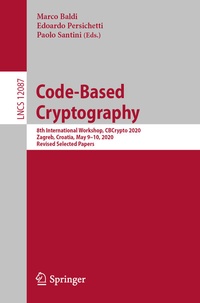
Code-Based Cryptography
Description
Alles über E-Books | Antworten auf Fragen rund um E-Books, Kopierschutz und Dateiformate finden Sie in unserem Info- & Hilfebereich.
The seven papers presented in this book were carefully reviewed and selected from numerous submissions. These contributions focus on various topics such as code-based cryptography, from design to implementation, security, new systems, and improved decoding algorithms.
* The conference was held virtually due to the COVID-19 pandemic.
More details
Other editions
Additional editions
Content
On the Security of NTS-KEM in the Quantum Random Oracle Model.- On the Decipherment of Sidel'nikov-type Cryptosystems.- A New Code-Based Cryptosystem.- On Constant-time QC-MDPC Decoders with Negligible Failure Rate.- Protograph-Based Decoding of Low-Density Parity-Check Codes with Hamming Weight Amplifiers.- MURAVE: A New Rank Code-based Signature with MUltiple RAnk VErification.- Optimized and secure implementation of ROLLO-I.

System requirements
File format: PDF
Copy protection: Watermark-DRM (Digital Rights Management)
System requirements:
- Computer (Windows; MacOS X; Linux): Use the free software Adobe Reader, Adobe Digital Editions, or any other PDF viewer of your choice (see eBook Help).
- Tablet/Smartphone (Android; iOS): Install the free app Adobe Digital Editions or another reading app for eBooks, e.g., PocketBook (see eBook Help).
- E-reader: Bookeen, Kobo, Pocketbook, Sony, Tolino and many more (only limited: Kindle).
The file format PDF always displays a book page identically on any hardware. This makes PDF suitable for complex layouts such as those used in textbooks and reference books (images, tables, columns, footnotes). Unfortunately, on the small screens of e-readers or smartphones, PDFs are rather annoying, requiring too much scrolling.
This eBook uses Watermark-DRM, a „soft” copy protection. This means that there are no technical restrictions to prevent illegal distribution. However, there is a personalised watermark embedded in the eBook that can be used to identify the purchaser of the eBook in the event of misuse and to provide evidence for legal purposes.
For more information, see our eBook Help page.