

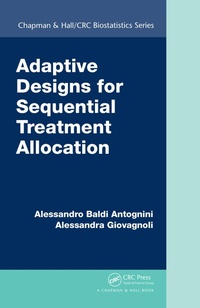
Adaptive Designs for Sequential Treatment Allocation
Published on 6. April 2015
216 pages
978-1-4665-0576-6 (ISBN)
Description

Adaptive Designs for Sequential Treatment Allocation presents a rigorous theoretical treatment of the results and mathematical foundation of adaptive design theory. The book focuses on designing sequential randomized experiments to compare two or more treatments incorporating information accrued along the way.
The authors first introduce the terminology and statistical models most commonly used in comparative experiments. They then illustrate biased coin and urn designs that only take into account past treatment allocations as well as designs that use past data, such as sequential maximum likelihood and various types of doubly adaptive designs. The book also covers multipurpose adaptive experiments involving utilitarian choices and ethical issues. It ends with adaptive methods that include covariates in the design. The appendices present basic tools of optimal design theory and address Bayesian adaptive designs.
This book helps readers fully understand the theoretical properties behind various adaptive designs. Readers are then equipped to choose the best design for their experiment.
The authors first introduce the terminology and statistical models most commonly used in comparative experiments. They then illustrate biased coin and urn designs that only take into account past treatment allocations as well as designs that use past data, such as sequential maximum likelihood and various types of doubly adaptive designs. The book also covers multipurpose adaptive experiments involving utilitarian choices and ethical issues. It ends with adaptive methods that include covariates in the design. The appendices present basic tools of optimal design theory and address Bayesian adaptive designs.
This book helps readers fully understand the theoretical properties behind various adaptive designs. Readers are then equipped to choose the best design for their experiment.
More details
Language
English
Place of publication
Philadelphia, PA
United States
Publishing group
Taylor & Francis Inc
Target group
Professional and scholarly
File size
1,36 MB
ISBN-13
978-1-4665-0576-6 (9781466505766)
Copyright in bibliographic data and cover images is held by Nielsen Book Services Limited or by the publishers or by their respective licensors: all rights reserved.
Schweitzer Classification
Other editions
Additional editions
Alessandro Baldi Antognini | Alessandra Giovagnoli
Adaptive Designs for Sequential Treatment Allocation
Book
09/2019
1st Edition
Chapman & Hall/CRC
€95.50
Shipment within 15-20 days
Alessandro Baldi Antognini | Alessandra Giovagnoli
Adaptive Designs for Sequential Treatment Allocation
Book
04/2015
1st Edition
CRC Press
€117.50
Shipment within 15-20 days
Persons
Alessandro Baldi Antognini is a full professor of statistics at the University of Bologna. His main research interests include optimal design theory, sequential methods, and applied probability with applications to industrial experiments and biostatistics.
Alessandra Giovagnoli, now retired, was a full professor in the Department of Statistical Sciences at the University of Bologna. Her main research area is the design of experiments, particularly sequential experiments. She is also interested in stochastic order relations and biomedical and technological applications of statistics. She served on the editorial board of Biometrika and was associate editor of SMA, the journal of the Italian Statistical Society. She is on the board of Model-Oriented Data Analysis and Optimum Design (MODA), an international statistical association that promotes research in the area of experimental designs.
Alessandra Giovagnoli, now retired, was a full professor in the Department of Statistical Sciences at the University of Bologna. Her main research area is the design of experiments, particularly sequential experiments. She is also interested in stochastic order relations and biomedical and technological applications of statistics. She served on the editorial board of Biometrika and was associate editor of SMA, the journal of the Italian Statistical Society. She is on the board of Model-Oriented Data Analysis and Optimum Design (MODA), an international statistical association that promotes research in the area of experimental designs.
Content
Fundamentals and Preliminary Results. Randomized Procedures That Are Functions of the Past Allocations. Randomized Procedures That Depend on the Responses. Multipurpose Adaptive Designs: Step-by-Step Procedures. Multipurpose Adaptive Designs: Constrained and Combined Optimality. Randomized Procedures That Depend on the Covariates. Appendices. Bibliography. Index.
