

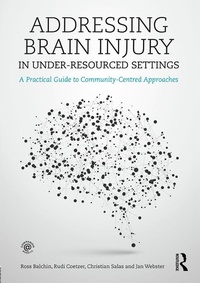
Addressing Brain Injury in Under-Resourced Settings
A Practical Guide to Community-Centred Approaches
Published on 30. October 2017
340 pages
978-1-317-44834-1 (ISBN)
Description

Many of the world's population have no access to appropriate diagnostic, neurorehabilitative or support services following brain injury. Addressing Brain Injury in Under-Resourced Settings: A Practical Guide to Community-Centred Approaches tackles this unacceptable gap in service provision by empowering the reader to provide basic care, education and support for patients with brain injuries and their families.
Written for an audience which does not necessarily have any prior knowledge of the brain, neurorehabilitation or brain injuries/pathologies, this practical guide first examines the global context of brain injury, considering the cross-cultural realities across communities worldwide. The book goes on to explore the reality of brain injury and how to work with its consequences, offering practical knowledge and advice in a user-friendly, richly illustrated format. It provides easily digestible information about the brain, including its normal functioning and the ways in which it can be damaged through injury and disease. The book also covers the basic skills needed to identify neurological difficulties and provides guidance on basic rehabilitation input and support. The final section of the book covers how to provide services, including working with organisations and communities, volunteering, initiating and developing community-based projects and programmes, and caring for patients and their families from emergency to recovery to rehabilitation.
This book is an invaluable resource for community health workers, voluntary sector workers and all professional healthcare providers who work with brain-injured patients around the world. It will also be important reading for policy developers, fundraising organisations and those who work with global humanitarian initiatives.
Written for an audience which does not necessarily have any prior knowledge of the brain, neurorehabilitation or brain injuries/pathologies, this practical guide first examines the global context of brain injury, considering the cross-cultural realities across communities worldwide. The book goes on to explore the reality of brain injury and how to work with its consequences, offering practical knowledge and advice in a user-friendly, richly illustrated format. It provides easily digestible information about the brain, including its normal functioning and the ways in which it can be damaged through injury and disease. The book also covers the basic skills needed to identify neurological difficulties and provides guidance on basic rehabilitation input and support. The final section of the book covers how to provide services, including working with organisations and communities, volunteering, initiating and developing community-based projects and programmes, and caring for patients and their families from emergency to recovery to rehabilitation.
This book is an invaluable resource for community health workers, voluntary sector workers and all professional healthcare providers who work with brain-injured patients around the world. It will also be important reading for policy developers, fundraising organisations and those who work with global humanitarian initiatives.
Reviews / Votes
"I am delighted to see a book that presents a global perspective on the understanding and management of brain injury. The emphasis on prevention and education to minimise injuries and disease in the first place is welcome, and the focus on understanding differences in culture and experience is vital. The book is full of resources at all levels of complexity to help people with little exposure to brain injury rehabilitation to find information and ideas to educate and inspire them in whatever corner of the world they inhabit." Jill Winegardner, Oliver Zangwill Centre, UK "I think this an exciting and timely proposal. It is an innovative and practical idea to present complex material that is usually the domain of specialists in a manner that makes it accessible to people without background knowledge but who are faced with dealing with people with brain injuries." Skye McDonald, School of Psychology, UNSW, Australia"The authors sound like they are trying to present important academic information in a pragmatic/ practical manner to be used by a wide audience. [Scholarship will be] outstanding... I can imagine it would appeal globally" Trevor Powell, Consultant Clinical Neuropsychologist, UK
"I think the scholarship with be excellent as the authors have good credentials both academically and in terms of their experience in under-resourced countries... a practical hands-on guide would be useful throughout the under-resourced world at the level of relatively under-educated health workers and lay volunteers and family members. A book about health policy would be useful internationally in universities for all levels of health professionals as well as those involved in health policy and programming." Jill Winegardner, Oliver Zangwill Centre, UK
More details
Language
English
Place of publication
London
United Kingdom
Publishing group
Taylor & Francis Ltd
Target group
Professional and scholarly
Product notice
Reflowable
Illustrations
1 Line drawings, black and white; 87 Halftones, black and white
File size
7,20 MB
ISBN-13
978-1-317-44834-1 (9781317448341)
Copyright in bibliographic data and cover images is held by Nielsen Book Services Limited or by the publishers or by their respective licensors: all rights reserved.
Schweitzer Classification
Other editions
Additional editions
Ross Balchin | Rudi Coetzer | Christian Salas
Addressing Brain Injury in Under-Resourced Settings
A Practical Guide to Community-Centred Approaches
Book
10/2017
1st Edition
Psychology Press Ltd
€62.08
Shipment within 10-20 days
Ross Balchin | Rudi Coetzer | Christian Salas
Addressing Brain Injury in Under-Resourced Settings
A Practical Guide to Community-Centred Approaches
Book
10/2017
1st Edition
Psychology Press Ltd
€193.13
Shipment within 10-20 days
Persons
Ross Balchin is a Clinical Neuropsychologist based at Groote Schuur Hospital in Cape Town, South Africa, and an Honorary Research Associate in the Division of Neurosurgery at the University of Cape Town. Dr Balchin also works with the Neuropsychoanalysis Foundation in New York as an independent contractor. He has formerly held both the National Research Foundation NPPD and the Claude Leon Foundation postdoctoral fellowships.
Rudi Coetzer is a Consultant Neuropsychologist, and Head of the North Wales Brain Injury Service, Betsi Cadwaladr University Health Board NHS Wales. He is an Honorary Senior Lecturer in Clinical Neuropsychology in the School of Psychology, Bangor University. Dr Coetzer is on the British Psychological Society Division of Neuropsychology Specialist Register.
Christian Salas is a Clinical Neuropsychologist and a Psychoanalytic Psychotherapist. He is a researcher at the Cognitive and Social Neuroscience Laboratory (Universidad Diego Portales) and Training Teacher at the Dynamic Psychotherapy Unit (J.H. Barak Psychiatric Institute), both in Santiago, Chile.
Jan Webster is an independent organization development consultant in the international charity sector. She founded The ComaCARE Trust in 2005 at Groote Schuur Hospital in Cape Town and served as its director for ten years, during which time she started its HeadsUP! community brain injury rehabilitation programme. She has successfully promoted public brain awareness through cofounding an official World Design Capital 2014 project entitled Brainstorm the City. In 2007, Jan became an Ashoka Fellow in recognition of her social entrepreneurship.
Rudi Coetzer is a Consultant Neuropsychologist, and Head of the North Wales Brain Injury Service, Betsi Cadwaladr University Health Board NHS Wales. He is an Honorary Senior Lecturer in Clinical Neuropsychology in the School of Psychology, Bangor University. Dr Coetzer is on the British Psychological Society Division of Neuropsychology Specialist Register.
Christian Salas is a Clinical Neuropsychologist and a Psychoanalytic Psychotherapist. He is a researcher at the Cognitive and Social Neuroscience Laboratory (Universidad Diego Portales) and Training Teacher at the Dynamic Psychotherapy Unit (J.H. Barak Psychiatric Institute), both in Santiago, Chile.
Jan Webster is an independent organization development consultant in the international charity sector. She founded The ComaCARE Trust in 2005 at Groote Schuur Hospital in Cape Town and served as its director for ten years, during which time she started its HeadsUP! community brain injury rehabilitation programme. She has successfully promoted public brain awareness through cofounding an official World Design Capital 2014 project entitled Brainstorm the City. In 2007, Jan became an Ashoka Fellow in recognition of her social entrepreneurship.
Content
Section 1: Under-resourced Settings: The Global Reality
1: Introduction: Brain Injury in the global context
2: Communities and cross-cultural realities
Section 2: Understanding Brain Injury and Working with its consequences
3: How the Brain works
4: The Injured Brain: Trauma and Diseases
5: How to recognise whether a patient is orientated
6: How to recognise and deal with memory problems
7: How to recognise and deal with language problems
8: How to recognise and deal with spatial cognition problems
9: How to recognise and deal with executive control problems
10: How to recognise and deal with mood problems, emotional dysregulation and other psychiatric presentations
11: How to recognise and deal with socio-emotional problems
12: How to recognise and deal with sleep problems
13: Understanding patients' medications and medical investigations
Section 3: How to Provide Services in Under-resourced Settings
14: Patients' Needs: The continuum of care
15: Emotional adjustment to brain injury: How to facilitate the process
16: How to educate and train community volunteers in the basic principles of neuropsychological rehabilitation
17: Transferable technology: Helpful tools
18: Working with NPO's/ NGOs, Charities and other Global Organisations
19: How to initiate and develop community-based projects and programmes
20: Community-based public health projects for preventing brain injury
21: Sustainability and Activism
1: Introduction: Brain Injury in the global context
2: Communities and cross-cultural realities
Section 2: Understanding Brain Injury and Working with its consequences
3: How the Brain works
4: The Injured Brain: Trauma and Diseases
5: How to recognise whether a patient is orientated
6: How to recognise and deal with memory problems
7: How to recognise and deal with language problems
8: How to recognise and deal with spatial cognition problems
9: How to recognise and deal with executive control problems
10: How to recognise and deal with mood problems, emotional dysregulation and other psychiatric presentations
11: How to recognise and deal with socio-emotional problems
12: How to recognise and deal with sleep problems
13: Understanding patients' medications and medical investigations
Section 3: How to Provide Services in Under-resourced Settings
14: Patients' Needs: The continuum of care
15: Emotional adjustment to brain injury: How to facilitate the process
16: How to educate and train community volunteers in the basic principles of neuropsychological rehabilitation
17: Transferable technology: Helpful tools
18: Working with NPO's/ NGOs, Charities and other Global Organisations
19: How to initiate and develop community-based projects and programmes
20: Community-based public health projects for preventing brain injury
21: Sustainability and Activism
