

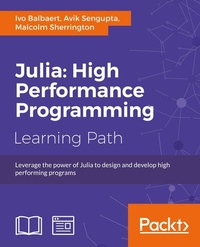
Julia: High Performance Programming
1st Edition
Published on 28. November 2016
697 pages
978-1-78712-610-7 (ISBN)
Description

Leverage the power of Julia to design and develop high performing programsAbout This BookGet to know the best techniques to create blazingly fast programs with JuliaStand out from the crowd by developing code that runs faster than your peers' codeComplete an extensive data science project through the entire cycle from ETL to analytics and data visualizationWho This Book Is ForThis learning path is for data scientists and for all those who work in technical and scientific computation projects. It will be great for Julia developers who are interested in high-performance technical computing.This learning path assumes that you already have some basic working knowledge of Julia's syntax and high-level dynamic languages such as MATLAB, R, Python, or Ruby.What You Will LearnSet up your Julia environment to achieve the highest productivitySolve your tasks in a high-level dynamic language and use types for your data only when neededApply Julia to tackle problems concurrently and in a distributed environmentGet a sense of the possibilities and limitations of Julia's performanceUse Julia arrays to write high performance codeBuild a data science project through the entire cycle of ETL, analytics, and data visualizationDisplay graphics and visualizations to carry out modeling and simulation in JuliaDevelop your own packages and contribute to the Julia CommunityIn DetailIn this learning path, you will learn to use an interesting and dynamic programming language-Julia! You will get a chance to tackle your numerical and data problems with Julia. You'll begin the journey by setting up a running Julia platform before exploring its various built-in types. We'll then move on to the various functions and constructs in Julia. We'll walk through the two important collection types-arrays and matrices in Julia.You will dive into how Julia uses type information to achieve its performance goals, and how to use multiple dispatch to help the compiler emit high performance machine code. You will see how Julia's design makes code fast, and you'll see its distributed computing capabilities.By the end of this learning path, you will see how data works using simple statistics and analytics, and you'll discover its high and dynamic performance-its real strength, which makes it particularly useful in highly intensive computing tasks. This learning path combines some of the best that Packt has to offer in one complete, curated package. It includes content from the following Packt products:Getting Started with Julia by Ivo BalvaertJulia High Performance by Avik SenguptaMastering Julia by Malcolm SherringtonStyle and approachThis hands-on manual will give you great explanations of the important concepts related to Julia programming.
All prices
More details
Content
- Intro
- Copyright
- Credits
- Preface
- Preface
- Table of Contents
- Module 1: Getting Started with Julia
- The Rationale for Julia
- The scope of Julia
- Julia's place among the other programming languages
- A comparison with other languages for the data scientist
- Useful links
- Summary
- Chapter 1: Installing the Julia Platform
- Installing Julia
- Working with Julia's shell
- Startup options and Julia scripts
- Packages
- Installing and working with Julia Studio
- Installing and working with IJulia
- Installing Sublime-IJulia
- Installing Juno
- Other editors and IDEs
- How Julia works
- Summary
- Chapter 2: Variables, Types, and Operations
- Variables, naming conventions, and comments
- Types
- Integers
- Floating point numbers
- Elementary mathematical functions and operations
- Rational and complex numbers
- Characters
- Strings
- Regular expressions
- Ranges and arrays
- Dates and times
- Scope and constants
- Summary
- Chapter 3: Functions
- Defining functions
- Optional and keyword arguments
- Anonymous functions
- First-class functions and closures
- Recursive functions
- Map, filter, and list comprehensions
- Generic functions and multiple dispatch
- Summary
- Chapter 4: Control Flow
- Conditional evaluation
- Repeated evaluation
- Exception handling
- Scope revisited
- Tasks
- Summary
- Chapter 5: Collection Types
- Matrices
- Tuples
- Dictionaries
- Sets
- Example project - word frequency
- Summary
- Chapter 6: More on Types, Methods, and Modules
- Type annotations and conversions
- The type hierarchy - subtypes and supertypes
- User-defined and composite types
- Types and collections - inner constructors
- Type unions
- Parametric types and methods
- Standard modules and paths
- Summary
- Chapter 7: Metaprogramming in Julia
- Expressions and symbols
- Eval and interpolation
- Defining macros
- Built-in macros
- Reflection capabilities
- Summary
- Chapter 8: I/O, Networking, and Parallel Computing
- Basic input and output
- Working with files
- Using DataFrames
- Working with TCP sockets and servers
- Interacting with databases
- Parallel operations and computing
- Summary
- Chapter 9: Running External Programs
- Running shell commands
- Calling C and FORTRAN
- Calling Python
- Performance tips
- Summary
- Chapter 10: The Standard Library and Packages
- Digging deeper into the standard library
- Julia's package manager
- Publishing a package
- Graphics in Julia
- Using Gadfly on data
- Summary
- Appendix: List of Macros and Packages
- Macros
- List of packages
- Module 2: Julia High Performance
- Chapter 1: Julia is Fast
- Julia - fast and dynamic
- Designed for speed
- How fast can Julia be?
- Summary
- Chapter 2: Analyzing Julia Performance
- Timing Julia code
- The Julia profiler
- Analyzing memory allocation
- Statistically accurate benchmarking
- Summary
- Chapter 3: Types in Julia
- The Julia type system
- Type-stability
- Kernel methods
- Types in storage locations
- Summary
- Chapter 4: Functions and Macros - Structuring Julia Code for High Performance
- Using globals
- Inlining
- Closures and anonymous functions
- Using macros for performance
- Generated functions
- Summary
- Chapter 5: Fast Numbers
- Numbers in Julia
- Trading performance for accuracy
- Subnormal numbers
- Summary
- Chapter 6: Fast Arrays
- Array internals in Julia
- Bound checking
- Allocations and in-place operations
- Array views
- SIMD parallelization
- Yeppp!
- Writing generic library functions with arrays
- Summary
- Chapter 7: Beyond the Single Processor
- Parallelism in Julia
- Programming parallel tasks
- Shared arrays
- Summary
- Module 3: Mastering Julia
- Chapter 1: The Julia Environment
- Introduction
- Getting started
- A quick look at some Julia
- Package management
- What makes Julia special
- Summary
- Chapter 2: Developing in Julia
- Integers, bits, bytes, and bools
- Arrays
- Char and strings
- Real, complex, and rational numbers
- Composite types
- More about matrices
- Data arrays and data frames
- Dictionaries, sets, and others
- Summary
- Chapter 3: Types and Dispatch
- Functions
- Julia's type system
- Enumerations (revisited)
- Multiple dispatch
- Summary
- Chapter 4: Interoperability
- Interfacing with other programming environments
- Metaprogramming
- Tasks
- Executing commands
- Summary
- Chapter 5: Working with Data
- Basic I/O
- Structured datasets
- DataFrames and RDatasets
- Statistics
- Selected topics
- Summary
- Chapter 6: Scientific Programming
- Linear algebra
- Signal processing
- Differential equations
- Optimization problems
- Stochastic problems
- Summary
- Chapter 7: Graphics
- Basic graphics in Julia
- Data visualization
- Graphic engines
- Using the Web
- Raster graphics
- Summary
- Chapter 8: Databases
- A basic view of databases
- Relational databases
- NoSQL datastores
- RESTful interfacing
- Summary
- Chapter 9: Networking
- Sockets and servers
- Working with the Web
- Messaging
- Cloud services
- Summary
- Chapter 10: Working with Julia
- Under the hood
- Performance tips
- Developing a package
- Community groups
- What's missing?
- Summary
- Bibliography

