

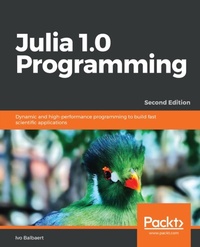
Julia 1.0 Programming
Dynamic and high-performance programming to build fast scientific applications
2nd Edition
Published on 23. September 2024
196 pages
978-1-78899-005-9 (ISBN)
Description

Enter the exciting world of Julia, a high-performance language for technical computing Key Features - Leverage Julia's high speed and efficiency for your applications
- Work with Julia in a multi-core, distributed, and networked environment
- Apply Julia to tackle problems concurrently and in a distributed environment
Book DescriptionThe release of Julia 1.0 is now ready to change the technical world by combining the high productivity and ease of use of Python and R with the lightning-fast speed of C++. Julia 1.0 programming gives you a head start in tackling your numerical and data problems. You will begin by learning how to set up a running Julia platform, before exploring its various built-in types. With the help of practical examples, this book walks you through two important collection types: arrays and matrices. In addition to this, you will be taken through how type conversions and promotions work. In the course of the book, you will be introduced to the homo-iconicity and metaprogramming concepts in Julia. You will understand how Julia provides different ways to interact with an operating system, as well as other languages, and then you'll discover what macros are. Once you have grasped the basics, you'll study what makes Julia suitable for numerical and scientific computing, and learn about the features provided by Julia. By the end of this book, you will also have learned how to run external programs. This book covers all you need to know about Julia in order to leverage its high speed and efficiency for your applications. What you will learn - Set up your Julia environment to achieve high productivity
- Create your own types to extend the built-in type system
- Visualize your data in Julia with plotting packages
- Explore the use of built-in macros for testing and debugging, among other uses
- Apply Julia to tackle problems concurrently
- Integrate Julia with other languages such as C, Python, and MATLAB
Who this book is forJulia 1.0 Programming is for you if you are a statistician or data scientist who wants a crash course in the Julia programming language while building big data applications. A basic knowledge of mathematics is needed to understand the various methods that are used or created during the course of the book to exploit the capabilities that Julia is designed with.
- Work with Julia in a multi-core, distributed, and networked environment
- Apply Julia to tackle problems concurrently and in a distributed environment
Book DescriptionThe release of Julia 1.0 is now ready to change the technical world by combining the high productivity and ease of use of Python and R with the lightning-fast speed of C++. Julia 1.0 programming gives you a head start in tackling your numerical and data problems. You will begin by learning how to set up a running Julia platform, before exploring its various built-in types. With the help of practical examples, this book walks you through two important collection types: arrays and matrices. In addition to this, you will be taken through how type conversions and promotions work. In the course of the book, you will be introduced to the homo-iconicity and metaprogramming concepts in Julia. You will understand how Julia provides different ways to interact with an operating system, as well as other languages, and then you'll discover what macros are. Once you have grasped the basics, you'll study what makes Julia suitable for numerical and scientific computing, and learn about the features provided by Julia. By the end of this book, you will also have learned how to run external programs. This book covers all you need to know about Julia in order to leverage its high speed and efficiency for your applications. What you will learn - Set up your Julia environment to achieve high productivity
- Create your own types to extend the built-in type system
- Visualize your data in Julia with plotting packages
- Explore the use of built-in macros for testing and debugging, among other uses
- Apply Julia to tackle problems concurrently
- Integrate Julia with other languages such as C, Python, and MATLAB
Who this book is forJulia 1.0 Programming is for you if you are a statistician or data scientist who wants a crash course in the Julia programming language while building big data applications. A basic knowledge of mathematics is needed to understand the various methods that are used or created during the course of the book to exploit the capabilities that Julia is designed with.
More details
Other editions
Additional editions
Ivo Balbaert
Julia 1.0 Programming
Dynamic and high-performance programming to build fast scientific applications, 2nd Edition
Book
09/2018
2nd Edition
Packt Publishing
€50.10
Shipment within 3-4 weeks
Person
Balbaert Ivo :
Ivo Balbaert is a lecturer in web programming and databases at CVO Antwerpen, a community college in Belgium. He received a PhD in applied physics from the University of Antwerp in 1986. He worked for 20 years in the software industry as a developer and consultant in several companies, and for 10 years as project manager at the University Hospital of Antwerp. From 2000 onwards, he switched to partly teaching and partly developing software (at KHM Mechelen, CVO Antwerpen). He also wrote an introductory book in Dutch about developing in Ruby and Rails, Programmeren met Ruby en Rails, published by Van Duuren Media. In 2012, he authored a book on the Go programming language, The Way to Go, published by iUniverse. He has written a number of introductory books for new programming languages, notably Dart, Julia, Rust, and Red, all published by Packt.
Ivo Balbaert is a lecturer in web programming and databases at CVO Antwerpen, a community college in Belgium. He received a PhD in applied physics from the University of Antwerp in 1986. He worked for 20 years in the software industry as a developer and consultant in several companies, and for 10 years as project manager at the University Hospital of Antwerp. From 2000 onwards, he switched to partly teaching and partly developing software (at KHM Mechelen, CVO Antwerpen). He also wrote an introductory book in Dutch about developing in Ruby and Rails, Programmeren met Ruby en Rails, published by Van Duuren Media. In 2012, he authored a book on the Go programming language, The Way to Go, published by iUniverse. He has written a number of introductory books for new programming languages, notably Dart, Julia, Rust, and Red, all published by Packt.
Content
Table of Contents - Installing the Julia Platform
- Variables, Types, and Operations
- Functions
- Control Flow
- Collection Types
- More on Types, Methods, and Modules
- Metaprogramming in Julia
- I/O, Networking, and Parallel Computing
- Running External Programs
- The Standard Library and Packages
- Variables, Types, and Operations
- Functions
- Control Flow
- Collection Types
- More on Types, Methods, and Modules
- Metaprogramming in Julia
- I/O, Networking, and Parallel Computing
- Running External Programs
- The Standard Library and Packages
