

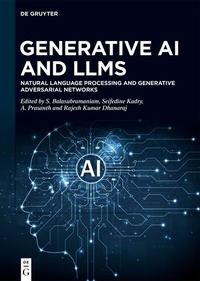
Generative AI and LLMs
Description

Generative artificial intelligence (GAI) and large language models (LLM) are machine learning algorithms that operate in an unsupervised or semi-supervised manner. These algorithms leverage pre-existing content, such as text, photos, audio, video, and code, to generate novel content. The primary objective is to produce authentic and novel material. In addition, there exists an absence of constraints on the quantity of novel material that they are capable of generating. New material can be generated through the utilization of Application Programming Interfaces (APIs) or natural language interfaces, such as the ChatGPT developed by Open AI and Bard developed by Google.
The field of generative artificial intelligence (AI) stands out due to its unique characteristic of undergoing development and maturation in a highly transparent manner, with its progress being observed by the public at large. The current era of artificial intelligence is being influenced by the imperative to effectively utilise its capabilities in order to enhance corporate operations. Specifically, the use of large language model (LLM) capabilities, which fall under the category of Generative AI, holds the potential to redefine the limits of innovation and productivity. However, as firms strive to include new technologies, there is a potential for compromising data privacy, long-term competitiveness, and environmental sustainability.
This book delves into the exploration of generative artificial intelligence (GAI) and LLM. It examines the historical and evolutionary development of generative AI models, as well as the challenges and issues that have emerged from these models and LLM. This book also discusses the necessity of generative AI-based systems and explores the various training methods that have been developed for generative AI models, including LLM pretraining, LLM fine-tuning, and reinforcement learning from human feedback. Additionally, it explores the potential use cases, applications, and ethical considerations associated with these models. This book concludes by discussing future directions in generative AI and presenting various case studies that highlight the applications of generative AI and LLM.
More details
Other editions
Additional editions
Persons
S. Balasubramaniam, S. Kadry , Norway; A. Prasanth, R. Dhanaraj, India.
Content
- Intro
- Preface
- Contents
- About the Editors
- List of Contributors
- 1 Unveiling the Power of Generative AI: A Journey into Large Language Models
- 2 Early Roots of Generative AI Models and LLM: A Diverse Landscape
- 3 Generative AI Models and LLM: Training Techniques and Evaluation Metrics
- 4 Importance of Prompt Engineering in Generative AI Models
- 5 LLM Pretraining Methods
- 6 LLM Fine-Tuning: Instruction and Parameter-Efficient Fine-Tuning (PEFT)
- 7 Reinforcement Learning from Human Feedback (RLHF)
- 8 Exploring the Applications on Generative AI and LLM
- 9 Bias and Fairness in Generative AI
- 10 Future Directions and Open Problems in Generative AI
- 11 Optimizing Sustainable Project Management Life Cycle Using Generative AI Modeling
- 12 Generative AI and LLM: Case Study in Finance
- 13 Generative AI and LLM: Case Study in E-Commerce
- Index
