

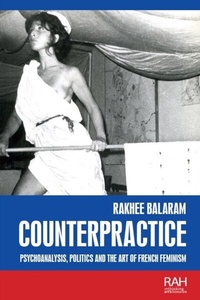
Counterpractice
Psychoanalysis, Politics and the Art of French Feminism
1st Edition
Published on 8. March 2022
480 pages
978-1-5261-2518-7 (ISBN)
Description

Counterpractice highlights a generation of women who used art to define a culture of experimental thought and practice during the period of the French women's movement or Mouvement de Liberation des Femmes (1970-81). It considers women's art in relation to some of the most exciting thinkers to have emerged from the French literature and philosophy of the 1970s - Helene Cixous, Luce Irigaray and Julia Kristeva - forcing a timely reconsideration of the full spectrum of revolutionary practices by women in the years following the events of May '68. Lavishly illustrated with over 200 images, the book also features an illuminating foreword by art historian Griselda Pollock. -- .
Reviews / Votes
'In this illuminating scholarship, we re-encounter the familiar names of (1970s) French feminisms, but Balaram's innovation is to reveal a swathe of obscured, forgotten, or lesser-known (French) artists and feminist actors. Balaram allows these artists and artworks to shine as she seamlessly weaves history, politics, artwork, and theory, nuancing the often monolithic presentation of 1970s French feminism.'Jasmine D. Cooper, French Studies
'Counterpractice provides an ambitious survey of the events leading up to May '68 and an invaluable document of the women artists who were working in Paris around that time. Taken together with her careful account of the ground-breaking feminist theory that informed their activism, Rakhee Balaram has made an essential and lasting contribution to the field.'
Mary Kelly, Judge Widney Professor, Roski School of Art and Design, University of Southern California
'This pioneering book is a major contribution to the history of feminist art, writing, theory, and activism. Rakhee Balaram has done meticulous research, placing the movement in its historical and political contexts and interpreting the issues debated and contested among these women. No stone is left unturned. Enjoy your journey with these original, stimulating artists, and with this wonderful author as your guide.'
Gloria Orenstein, Professor Emerita of Comparative Literature and Gender Studies, USC Dornsife College of Letters, Arts and Sciences -- .
All prices
More details
Series
Language
English
Place of publication
United Kingdom
Target group
College/higher education
Professional and scholarly
Illustrations
73 colour illustrations, 143 black & white illustrations
ISBN-13
978-1-5261-2518-7 (9781526125187)
Copyright in bibliographic data and cover images is held by Nielsen Book Services Limited or by the publishers or by their respective licensors: all rights reserved.
Schweitzer Classification
Other editions
Additional editions
Book
03/2022
Manchester University Press
€146.50
Shipment within 15-20 days
Person
Rakhee Balaram is Assistant Professor of Global Art and Art History at State University of New York-Albany -- .
Content
Foreword by Griselda Pollock
Introduction
1 On the streets: from May '68 to the MLF
2 The MLF 1970s
3 Liberation-creation: MLF, women artists and the militant body
4 Instase: Psychanalyse et Politique and the spaces of women's art
5 Women's groups and collective art practices
6 Hard politics, soft art: subversive practices from ecriture feminine to soft art
Conclusion: La revolution accomplie? Some legacies of women's art in 1970s France
Index -- .
Introduction
1 On the streets: from May '68 to the MLF
2 The MLF 1970s
3 Liberation-creation: MLF, women artists and the militant body
4 Instase: Psychanalyse et Politique and the spaces of women's art
5 Women's groups and collective art practices
6 Hard politics, soft art: subversive practices from ecriture feminine to soft art
Conclusion: La revolution accomplie? Some legacies of women's art in 1970s France
Index -- .
