

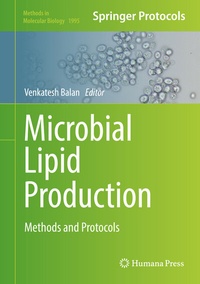
Microbial Lipid Production
Description

Comprehensive and cutting-edge, Microbial Lipid Production: Methods and Protocols is a valuable resource aimed at novice researchers who are working on improving their knowledge and skills in this developing field.
More details
Other editions
Additional editions
Content
Microbial Lipid Alternatives to Plant Lipids.- Laboratory Screening Protocol to Identify Novel Oleaginous Yeasts.- Fungi (Mold) Based Lipid Production.- Qualitative and Quantitative Estimation of Bacterial Lipid Production.- Rhodococcus and Yarrowia Based Lipid Production using Lignin-Containing Industrial Residues.- Quantifiation of Lipid Content in Oleaginous Biomass using Thermogravimetry.- Extraction and Characterization of Lipids from Macroalgae.- Genetic Engineering Approaches used to Increase Lipid Production and Alter Lipid Profile in Microbes.- Extraction Methods used to Separate Lipids from Microbes.- Novel Microbial Modification Tools to Convert Lipids into Other Value Added Products.- Alkaline and Alkaline-Oxidative Pretreatment and Hydrolysis of Herbaceous Biomass for Growth of Oleaginous Microbes.- Conversion of Cultivated Oleaginous Organisms into Biocrude for Biofuel Applications.- Life Cycle Analysis of Producing Microbial Lipids and Biodiesel: Comparison with Plant Lipid.- Assessment of Fuel Quality Parameters and Selection of Bacteria using PROMETHEE-GAIA Algorithm.- Production of High-Value Polyunsaturated Fatty Acids using Microbial Cultures.- Screening for Oily Yeasts Able to Convert Hydrolyzates from Biomass to Biofuels While Maintaining Industrial Process Relevance.- Conversion of Microbial Lipids to Biodiesel and Basic Lab Tests for Analysis of Fuel-Quality Parameters.- Impact of Culture Conditions on Neutral Lipid production of Oleaginous Yeast.- Producing Oleaginous Microorganisms using Wastewater: Methods and Guidelines for Lab and Industrial Scale Production.- Volatile Fatty Acid Production from Anaerobic Digestion of Organic Residues.- Producing Oleaginous Organisms using Food Waste: Challenge and Outcome.- Microbial Surfactants: Alternative to Vegetable Oil Surfactants.- Evaluation of Bacterial Lipid Production: Quantitative and Qualitative Measurements - Tips and Guidelines.- Production of Oleaginous Organisms or Lipids using Sewage Water and Industrial Waste Water.
