

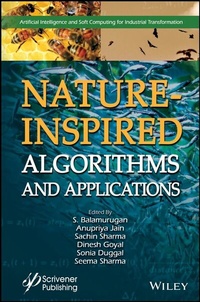
Nature-Inspired Algorithms and Applications
Description

The book's unified approach of balancing algorithm introduction, theoretical background and practical implementation, complements extensive literature with well-chosen case studies to illustrate how these algorithms work.
Inspired by the world around them, researchers are gathering information that can be developed for use in areas where certain practical applications of nature-inspired computation and machine learning can be applied. This book is designed to enhance the reader's understanding of this process by portraying certain practical applications of nature-inspired algorithms (NIAs) specifically designed to solve complex real-world problems in data analytics and pattern recognition by means of domain-specific solutions. Since various NIAs and their multidisciplinary applications in the mechanical engineering and electrical engineering sectors; and in machine learning, image processing, data mining, and wireless networks are dealt with in detail in this book, it can act as a handy reference guide.
Among the subjects of the 12 chapters are:
* A novel method based on TRIZ to map real-world problems to nature problems
* Applications of cuckoo search algorithm for optimization problems
* Performance analysis of nature-inspired algorithms in breast cancer diagnosis
* Nature-inspired computation in data mining
* Hybrid bat-genetic algorithm-based novel optimal wavelet filter for compression of image data
* Efficiency of finding best solutions through ant colony optimization techniques
* Applications of hybridized algorithms and novel algorithms in the field of machine learning.
Audience: Researchers and graduate students in mechanical engineering, electrical engineering, machine learning, image processing, data mining, and wireless networks will find this book very useful.
More details
Other editions
Additional editions
Persons
S. Balamurugan, PhD is the Director of Research and Development, Intelligent Research Consultancy Services (iRCS), Coimbatore, Tamilnadu, India. He is also Director of the Albert Einstein Engineering and Research Labs (AEER Labs), as well as Vice-Chairman, Renewable Energy Society of India (RESI), India. He has published 45 books, 200+ international journals/ conferences, and 35 patents.
Anupriya Jain, PhD is an associate professor at the Manav Rachna International Institute of Research and Studies, Faridabad, Haryana.
Sachin Sharma, PhD is an assistant professor in computer applications at the Manav Rachna International Institute of Research and Studies, Faridabad, India. He has published more than 30 research papers in different areas of technology and has been a part of two patents as well.
Dinesh Goyal, PhD is the Director at the Poornima Institute of Engineering and Technology, Jaipur, India. His research interests are related to information & network security, image processing, data analytics, and cloud computing, and has published more than 60 research articles.
Sonia Duggal, PhD is an associate professor at the Manav Rachna International Institute of Research and Studies, Faridabad, Haryana.
Seema Sharma is an assistant professor at the Manav Rachna International Institute of Research and Studies, Faridabad, India.
Content
Preface xv
1 Introduction to Nature-Inspired Computing 1
N.M. Saravana Kumar, K. Hariprasath, N. Kaviyavarshini and A. Kavinya
1.1 Introduction 1
1.2 Aspiration From Nature 2
1.3 Working of Nature 3
1.4 Nature-Inspired Computing 4
1.4.1 Autonomous Entity 5
1.5 General Stochastic Process of Nature-Inspired Computation 6
1.5.1 NIC Categorization 8
1.5.1.1 Bioinspired Algorithm 9
1.5.1.2 Swarm Intelligence 10
1.5.1.3 Physical Algorithms 11
1.5.1.4 Familiar NIC Algorithms 12
References 30
2 Applications of Hybridized Algorithms and Novel Algorithms in the Field of Machine Learning 33
P. Mary Jeyanthi and A. Mansurali
2.1 Introduction of Genetic Algorithm 33
2.1.1 Background of GA 35
2.1.2 Why Natural Selection Theory Compared With the Search Heuristic Algorithm? 35
2.1.3 Working Sequence of Genetic Algorithm 35
2.1.3.1 Population 35
2.1.3.2 Fitness Among the Individuals 36
2.1.3.3 Selection of Fitted Individuals 36
2.1.3.4 Crossover Point 37
2.1.3.5 Mutation 37
2.1.4 Application of Machine Learning in GA 38
2.1.4.1 Genetic Algorithm Role in Feature Selection for ML Problem 38
2.1.4.2 Traveling Salesman Problem 39
2.1.4.3 Blackjack-A Casino Game 40
2.1.4.4 Pong Against AI-Evolving Agents (Reinforcement Learning) Using GA 41
2.1.4.5 SNAKE AI-Game 41
2.1.4.6 Genetic Algorithm's Role in Neural Network 42
2.1.4.7 Solving a Battleship Board Game as an Optimization Problem Which Was Initially Released by Milton Bradley in 1967 43
2.1.4.8 Frozen Lake Problem From OpenAI Gym 43
2.1.4.9 N-Queen Problem 44
2.1.5 Application of Data Mining in GA 44
2.1.5.1 Association Rules Generation 44
2.1.5.2 Pattern Classification With Genetic Algorithm 45
2.1.5.3 Genetic Algorithms in Stock Market Data Mining Optimization 46
2.1.5.4 Market Basket Analysis 46
2.1.5.5 Job Scheduling 46
2.1.5.6 Classification Problem 47
2.1.5.7 Hybrid Decision Tree-Genetic Algorithm to Data Mining 47
2.1.5.8 Genetic Algorithm-Optimization of Data Mining in Education 47
2.1.6 Advantages of Genetic Algorithms 47
2.1.7 Genetic Algorithms Demerits in the Current Era 48
2.2 Introduction to Artificial Bear Optimization (ABO) 50
2.2.1 Bear's Nasal Cavity 52
2.2.2 Artificial Bear ABO Gist 54
2.2.3 Implementation Based on Requirement 58
2.2.3.1 Market Place 58
2.2.3.2 Industry-Specific 58
2.2.3.3 Semi-Structured or Unstructured Data 59
2.2.4 Merits of ABO 60
2.3 Performance Evaluation 61
2.4 What is Next? 62
References 63
3 Efficiency of Finding Best Solutions Through Ant Colony Optimization (ACO) Technique 67
K. Sasi Kala Rani and N. Pooranam
3.1 Introduction 68
3.1.1 Example of Optimization Process 69
3.1.2 Components of Optimization Algorithms 70
3.1.3 Optimization Techniques Based on Solutions 70
3.1.3.1 Optimization Techniques Based on Algorithms 72
3.1.4 Characteristics 73
3.1.5 Classes of Heuristic Algorithms 74
3.1.6 Metaheuristic Algorithms 75
3.1.6.1 Classification of Metaheuristic Algorithms: Nature-Inspired vs. Non-Nature-Inspired 75
3.1.6.2 Population-Based vs. Single-Point Search (Trajectory) 75
3.1.7 Data Processing Flow of ACO 76
3.2 A Case Study on Surgical Treatment in Operation Room 77
3.3 Case Study on Waste Management System 80
3.4 Working Process of the System 81
3.5 Background Knowledge to be Considered for Estimation 82
3.5.1 Heuristic Function 83
3.5.2 Functional Approach 85
3.6 Case Study on Traveling System 85
3.7 Future Trends and Conclusion 87
References 88
4 A Hybrid Bat-Genetic Algorithm-Based Novel Optimal Wavelet Filter for Compression of Image Data 89
Renjith V. Ravi and Kamalraj Subramaniam
4.1 Introduction 90
4.2 Review of Related Works 91
4.3 Existing Technique for Secure Image Transmission 93
4.4 Proposed Design of Optimal Wavelet Coefficients for Image Compression 93
4.4.1 Optimized Transformation Module 94
4.4.1.1 DWT Analysis and Synthesis Filter Bank 94
4.4.2 Compression and Encryption Module 100
4.4.2.1 SPIHT 100
4.4.2.2 Chaos-Based Encryption 102
4.5 Results and Discussion 104
4.5.1 Experimental Setup and Evaluation Metrics 104
4.5.2 Simulation Results 107
4.5.2.1 Performance Analysis of the Novel Filter KARELET 107
4.5.3 Result Analysis Proposed System 108
4.6 Conclusion 134
References 135
5 A Swarm Robot for Harvesting a Paddy Field 137
N. Pooranam and T. Vignesh
5.1 Introduction 137
5.1.1 Working Principle of Particle Swarm Optimization 138
5.1.2 First Case Study on Birds Fly 138
5.1.3 Operational Moves on Birds Dataset 138
5.1.4 Working Process of the Proposed Model 141
5.2 Second Case Study on Recommendation Systems 142
5.3 Third Case Study on Weight Lifting Robot 145
5.4 Background Knowledge of Harvesting Process 149
5.4.1 Data Flow of PSO Process 150
5.4.2 Working Flow of Harvesting Process 151
5.4.3 The First Phase of Harvesting Process 151
5.4.4 Separation Process in Harvesting 152
5.4.5 Cleaning Process in the Field 152
5.5 Future Trend and Conclusion 155
References 155
6 Firefly Algorithm 157
Anupriya Jain, Seema Sharma and Sachin Sharma
6.1 Introduction 158
6.2 Firefly Algorithm 160
6.2.1 Firefly Behavior 160
6.2.2 Standard Firefly Algorithm 161
6.2.3 Variations in Light Intensity and Attractiveness 163
6.2.4 Distance and Movement 164
6.2.5 Implementation of FA 165
6.2.6 Special Cases of Firefly Algorithm 166
6.2.7 Variants of FA 168
6.3 Applications of Firefly Algorithm 170
6.3.1 Job Shop Scheduling 170
6.3.2 Image Segmentation 171
6.3.3 Stroke Patient Rehabilitation 172
6.3.4 Economic Emission Load Dispatch 172
6.3.5 Structural Design 173
6.4 Why Firefly Algorithm is Efficient 174
6.4.1 FA is Not PSO 176
6.5 Discussion and Conclusion 176
References 177
7 The Comprehensive Review for Biobased FPA Algorithm 181
Meenakshi Rana
7.1 Introduction 182
7.1.1 Stochastic Optimization 183
7.1.2 Robust Optimization 183
7.1.3 Dynamic Optimization 184
7.1.4 Alogrithm 184
7.1.5 Swarm Intelligence 185
7.2 Related Work to FPA 185
7.2.1 Flower Pollination Algorithm 187
7.2.2 Versions of FPA 190
7.2.3 Methods and Description 190
7.2.3.1 Reproduction Factor 193
7.2.3.2 Levy Flights 193
7.2.3.3 User-Defined Parameters 195
7.2.3.4 Psuedo Code for FPA 195
7.2.3.5 Comparative Studies for FPA 196
7.2.3.6 Working Environment 197
7.2.3.7 Improved Versions of FPA 197
7.3 Limitations 202
7.4 Future Research 202
7.5 Conclusion 204
References 204
8 Nature-Inspired Computation in Data Mining 209
Aditi Sharma
8.1 Introduction 209
8.2 Classification of NIC 211
8.2.1 Swarm Intelligence for Data Mining 211
8.2.1.1 Swarm Intelligence Algorithm 212
8.2.1.2 Applications of Swarm Intelligence in Data Mining 214
8.2.1.3 Swarm-Based Intelligence Techniques 214
8.3 Evolutionary Computation 227
8.3.1 Genetic Algorithms 227
8.3.1.1 Applications of Genetic Algorithms in Data Mining 228
8.3.2 Evolutionary Programming 228
8.3.2.1 Applications of Evolutionary Programming in Data Mining 229
8.3.3 Genetic Programming 229
8.3.3.1 Applications of Genetic Programming in Data Mining 229
8.3.4 Evolution Strategies 230
8.3.4.1 Applications of Evolution Strategies in Data Mining 231
8.3.5 Differential Evolutions 231
8.3.5.1 Applications of Differential Evolution in Data Mining 231
8.4 Biological Neural Network 232
8.4.1 Artificial Neural Computation 232
8.4.1.1 Neural Network Models 232
8.4.1.2 Challenges of Artificial Neural Network in Data Mining 233
8.4.1.3 Applications of Artificial Neural Network in Data Mining 233
8.5 Molecular Biology 233
8.5.1 Membrane Computing 233
8.5.2 Algorithm Basis 234
8.5.3 Challenges of Membrane Computing in Data Mining 234
8.5.4 Applications of Membrane Computing in Data Mining 234
8.6 Immune System 235
8.6.1 Artificial Immune System 235
8.6.1.1 Artificial Immune System Algorithm (Enhanced) 236
8.6.1.2 Challenges of Artificial Immune System in Data Mining 236
8.6.1.3 Applications of Artificial Immune System in Data Mining 237
8.7 Applications of NIC in Data Mining 237
8.8 Conclusion 238
References 238
9 Optimization Techniques for Removing Noise in Digital Medical Images 243
D. Devasena, M. Jagadeeswari, B. Sharmila and K. Srinivasan
9.1 Introduction 244
9.2 Medical Imaging Techniques 245
9.2.1 X-Ray Images 245
9.2.2 Computer Tomography Imaging 245
9.2.3 Magnetic Resonance Images 246
9.2.4 Positron Emission Tomography 246
9.2.5 Ultrasound Imaging Techniques 246
9.3 Image Denoising 247
9.3.1 Impulse Noise and Speckle Noise Denoising 247
9.4 Optimization in Image Denoising 249
9.4.1 Particle Swarm Optimization 250
9.4.2 Adaptive Center Pixel Weighted Median Exponential Filter 250
9.4.3 Hybrid Wiener Filter 251
9.4.4 Removal of Noise in Medical Images Using Particle Swarm Optimization 252
9.4.4.1 Curvelet Transform 252
9.4.4.2 PSO With Curvelet Transform and Hybrid Wiener Filter 253
9.4.5 DFOA-Based Curvelet Transform and Hybrid Wiener Filter 255
9.4.5.1 Dragon Fly Optimization Algorithm 255
9.4.5.2 DFOA-Based HWACWMF 256
9.5 Results and Discussions 257
9.5.1 Simulation Results 257
9.5.2 Performance Metric Analysis 257
9.5.3 Summary 263
9.6 Conclusion and Future Scope 264
References 265
10 Performance Analysis of Nature-Inspired Algorithms in Breast Cancer Diagnosis 267
K. Hariprasath, S. Tamilselvi, N. M. Saravana Kumar, N. Kaviyavarshini and S. Balamurugan
10.1 Introduction 268
10.1.1 NIC Algorithms 268
10.2 Related Works 270
10.3 Dataset: Wisconsin Breast Cancer Dataset (WBCD) 274
10.4 Ten-Fold Cross-Validation 275
10.4.1 Training Data 275
10.4.2 Validation Data 275
10.4.3 Test Data 276
10.4.4 Pseudocode 276
10.4.5 Advantages of K-Fold or 10-Fold Cross-Validation 276
10.5 Naive Bayesian Classifier 276
10.5.1 Pseudocode of Naive Bayesian Classifier 278
10.5.2 Advantages of Naive Bayesian Classifier 278
10.6 K-Means Clustering 279
10.7 Support Vector Machine (SVM) 280
10.8 Swarm Intelligence Algorithms 282
10.8.1 Particle Swarm Optimization 283
10.8.2 Firefly Algorithm 285
10.8.3 Ant Colony Optimization 287
10.9 Evaluation Metrics 288
10.10 Results and Discussion 289
10.11 Conclusion 291
References 292
11 Applications of Cuckoo Search Algorithm for Optimization Problems 295
Akanksha Deep and Prasant Kumar Dash
11.1 Introduction 296
11.2 Related Works 298
11.3 Cuckoo Search Algorithm 299
11.3.1 Biological Description 300
11.3.2 Algorithm 300
11.4 Applications of Cuckoo Search 304
11.4.1 In Engineering 305
11.4.1.1 Applications in Mechanical Engineering 305
11.4.2 In Structural Optimization 308
11.4.2.1 Test Problems 308
11.4.3 Application CSA in Electrical Engineering, Power, and Energy 308
11.4.3.1 Embedded System 308
11.4.3.2 PCB 309
11.4.3.3 Power and Energy 309
11.4.4 Applications of CS in Field of Machine Learning and Computation 310
11.4.5 Applications of CS in Image Processing 311
11.4.6 Application of CSA in Data Processing 311
11.4.7 Applications of CSA in Computation and Neural Network 312
11.4.8 Application in Wireless Sensor Network 313
11.5 Conclusion and Future Work 314
References 315
12 Mapping of Real-World Problems to Nature-Inspired Algorithm Using Goal-Based Classification and TRIZ 317
Palak Sukharamwala and Manojkumar Parmar
12.1 Introduction and Background 318
12.2 Motivations Behind NIA Exploration 319
12.2.1 Prevailing Issues With Technology 319
12.2.1.1 Data Dependencies 319
12.2.1.2 Demand for Higher Software Complexity 320
12.2.1.3 NP-Hard Problems 320
12.2.1.4 Energy Consumption 321
12.2.2 Nature-Inspired Algorithm at a Rescue 321
12.3 Novel TRIZ + NIA Approach 322
12.3.1 Traditional Classification 322
12.3.1.1 Swarm Intelligence 322
12.3.1.2 Evolution Algorithm 323
12.3.1.3 Bio-Inspired Algorithms 324
12.3.1.4 Physics-Based Algorithm 324
12.3.1.5 Other Nature-Inspired Algorithms 324
12.3.2 Limitation of Traditional Classification 324
12.3.3 Combined Approach NIA + TRIZ 325
12.3.3.1 TRIZ 325
12.3.3.2 NIA + TRIZ 325
12.3.4 End Goal-Based Classification 326
12.4 Examples to Support the TRIZ + NIA Approach 327
12.4.1 Fruit Optimization Algorithm to Predict Monthly Electricity Consumption 327
12.4.2 Bat Algorithm to Model River Dissolved Oxygen Concentration 332
12.4.3 Genetic Algorithm to Tune the Structure and Parameters of a Neural Network 333
12.5 A Solution of NP-H Using NIA 335
12.5.1 The 0-1 Knapsack Problem 335
12.5.2 Traveling Salesman Problem 337
12.6 Conclusion 338
References 338
Index 341
1
Introduction to Nature-Inspired Computing
N.M. Saravana Kumar1*, K. Hariprasath2, N. Kaviyavarshini2 and A. Kavinya2
1Department of Artificial Intelligence and Data Science, M Kumarasamy College of Engineering, Karur, India
2Department of Information Technology, Vivekanandha College of Engineering for Women, Namakkal, India
Abstract
Nature-inspired algorithms have significance in solving many problems. This chapter provides an overview of nature-inspired algorithms like bio-inspired algorithm, swarm intelligence algorithm, and physical and chemical system-based algorithm. Many real-world problems are solved using nature-inspired algorithms and the role of optimization plays an important role. This chapter covers the basic working and classification of nature-inspired algorithms along with its area of applications. The purpose and its significance of each and every algorithm have been described. Also, the applications of algorithms comprise most of the real-time problems.
Keywords: Nature-inspired, bio-inspired, evolutionary computing, swarm intelligence, optimization, applications
1.1 Introduction
An algorithm is a finite series of definite procedure for finding significance of the pattern. They are utilized to explain a course of difficulties and then implement calculation. Algorithm are said to unambiguous and utilized for performing computation and dealing with other task.
Algorithm has different characteristics; they are unambiguous, well-defined input and output, determinate, realistic, and independent of language. Unambiguous refers to having only one interpretation which leads to only one conclusion. Well-defined input and output refers to defining the input and output clearly. Determinate refers to algorithm that must be finite as the algorithm should not conclude with infinite loop. Realistic refers to the algorithm that is general, simple, and practical which may be implemented with an accessible source. Independent of language refers to the algorithm that must be designed with independent of language that it can be implemented in any language.
The technique of optimization comprises nonlinear problem with huge variables containing design and more composite constraints in the application of real world. The problem of optimization is linked with decrease of cost, waste, and time or increase in performance, benefits, and profits. Optimization can be described as an attempt of generating solutions to a problem beneath bounded circumstances. Optimization techniques have arisen from a desire to utilize current resources inside the excellent possible way.
1.2 Aspiration From Nature
Always nature performs actions in an incredible approach. After the detectable phenomenon, the incalculable conspicuous effects at present are indiscernible. Theorists and experts have been penetrating this type of phenomenon in the centurial essence and making effort to grasp, recognize, accommodate, describe, and simulate the artificial structure. There are countless handler agents and extra energy that is present in both realistic and non-realistic world, nearly which are unfamiliar and hidden risk is beyond manhood apprehension in total. Those agents bear in collateral and usually in opposition to a very few other affording pattern and quality to nature and standardize the kinship, elegance, and agility of survival. This has to be noticed as the dialectical nature which prevails in the theory of the world progression. The expansion of risk in nature pursues a peculiar structure. In addition to this, also, intelligence dealing with the nature is implemented in a shared, self-formed, and optimum response without any fundamental domination.
This type of entire ordination, which is in various types-micro biological, physiologic, chemic, and sociality-is circulated as stated by the risk factor for low level to high level. This series formulate its common dependency and partnership with regard to mutual framework and its personal biography. The behavior retardation owing to the transformed conditions and these entire phenomenon best-known or little-known till now come up with an advanced concepts in science and various technologies, also computation which practice the procedures for resolving problems that is inspired by the nature additionally endeavor to comprehend the fundamental foundations and structures of nature that achieve complicated effort in an advantageous form with narrow assets and capableness. Science intermediates in-between the theorist and the world nature which was emerged before many years by developing advanced hypothesis, techniques, and implementation into well-known system of technological strive.
Manhood has been practicing to comprehend the nature of all time because of evolving advanced mechanisms as well as tools. Nature-inspired computing consists of several branches; one of them is integrative in nature that associates interpolating of knowledge together with information of science among various fields of sciences that permits the emerging of advanced computing processes like algorithms or both software and hardware for understanding the problems, combining of various models and territoriality.
1.3 Working of Nature
Acquiring from nature has become an entrenched practice in processing. The explanations behind this are straightforward. Figuring needs to manage progressively complex issues where customary strategies frequently do not function admirably. Regular frameworks have advanced approaches to take care of such issues. Techniques acquired from nature incorporate the two different ways to speak to and model frameworks, for example, cell automata or neural systems, and methods to tackle complex issues. The inspiration for putting together calculations with respect to nature is that the normal procedures concerned are known to deliver alluring outcomes, for example, finding an ideal estimation of some component. This perception has propelled numerous calculations dependent on nature. In spite of their viability, strategies displayed on nature have frequently been treated with suspiciousness. Customary scientific techniques, for example, straight writing computer programs, depend on notable hypothetical establishments. So, their understanding and their confinements can be tried diagnostically. Interestingly, nature-based techniques are specially appointed heuristics dependent on wonders whose properties are not constantly seen, even by science.
The above issues raise a need to recognize hypothetical establishments to support nature-based calculations. To address this need, we set out to do the accompanying right now. To start with, we recognize highlights that are normal to numerous nature move calculations and show how these are portrayed by a proper model that clarifies why the calculations work. Also, we portray three structures for depicting nature-inspired calculations and their activity. At long last, we examine some more profound issues about the contrasts between normal procedures and techniques dependent on them. This incorporates both the hazardousness of streamlining nature and further exercises that we can get from the manner in which forms really work in nature.
1.4 Nature-Inspired Computing
Nature-inspired computing is an emerging technique which introduces a new discipline by observing the phenomena happening in nature used to give solution to the difficult problem in the surroundings. NIC had has a best presentation for attracting responsiveness in a substantial way. NIC has developed new innovative study with new branch, namely, swarm intelligence (SI), evolutionary computation (EC), quantum computing, neural networks, fractal geometry, artificial life and artificial immune systems (AIS), and DNA computing. It also used in the field of biology, physics, engineering, management, and economics. Some of the examples of nature-inspired algorithms are like evolutionary computing (EC), artificial neural networks (ANN), fuzzy systems (FS), and SI. Nature-inspired computing is also referred as natural-inspired computation which is defined as an expression to include three methods of classes. They are as follows:
- For the improvement of innovative problem solving, it takes technique which is inspired by nature.
- Based on utilization of processer for the manufacture of phenomena by nature.
- Based on the molecules of natural material that hire for computation.
To solve optimization problem of real world is challenging and more application need to deal with problem of NP-hard. Even though optimization tool is used to solve this problem, there is no assurance for reaching the optimal solution. There is no efficiency of algorithm for NP problems. As a conclusion for NP problems, technique of optimization is used to solve by experimental method. Some of new algorithm like particle swarm optimization (PSO), cuckoo search (CS), and firefly algorithm (FA) are developed to face this challenging problem of optimization. These new algorithm are developed to gain popularity for the performance with high efficiency. In recent survey, there are about more than 40 new different algorithms. This classification of these different algorithms is risky as it should be based on criteria with no guideline [1].
In growth of new algorithm which is inspiration of nature, some algorithms like SI algorithms and bio-inspired algorithms are developed. Metaheuristic algorithm like nature-inspired algorithm is based on physical, biological, chemical, and SI. These algorithms are called as physical-based,...
