

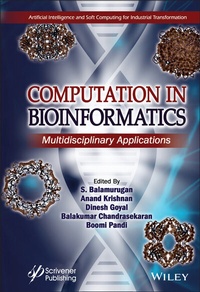
Computation in BioInformatics
Description

Bioinformatics is a platform between the biology and information technology and this book provides readers with an understanding of the use of bioinformatics tools in new drug design.
The discovery of new solutions to pandemics is facilitated through the use of promising bioinformatics techniques and integrated approaches. This book covers a broad spectrum of the bioinformatics field, starting with the basic principles, concepts, and application areas. Also covered is the role of bioinformatics in drug design and discovery, including aspects of molecular modeling. Some of the chapters provide detailed information on bioinformatics related topics, such as silicon design, protein modeling, DNA microarray analysis, DNA-RNA barcoding, and gene sequencing, all of which are currently needed in the industry. Also included are specialized topics, such as bioinformatics in cancer detection, genomics, and proteomics. Moreover, a few chapters explain highly advanced topics, like machine learning and covalent approaches to drug design and discovery, all of which are significant in pharma and biotech research and development.
Audience
Researchers and engineers in computation biology, information technology, bioinformatics, drug design, biotechnology, pharmaceutical sciences.
More details
Other editions
Additional editions
Persons
S. Balamurugan, PhD is the Director of Research and Development, Intelligent Research Consultancy Services (iRCS), Coimbatore, Tamilnadu, India. His PhD is in Information Technology, and he has published 45 books, 200+ international journals/conferences, and 35 patents.
Anand Krishnan, PhD is the NRF-DSI Innovation Fellow, Department of Chemical Pathology, University of the Free State (Bloemfontein Campus), Bloemfontein, South Africa. His expertise is in organic chemistry/medical biochemistry/integrative medicine/nano(bio)technology/drug discovery.
Dinesh Goyal, PhD is the Director at the Poornima Institute of Engineering and Technology, Jaipur, India. His research interests are related to information & network security, image processing, data analytics, and cloud computing.
Balakumar Chandrasekaran, PhD is an assistant professor at the Faculty of Pharmacy, Philadelphia University, Jordan. He has published many research articles and book chapters as well as two patents.
Boomi Pandi, PhD is an assistant professor in the Department of Bioinformatics, Alagappa University, Karaikudi, India. He has a number of international articles to his credit. Among his research interest are nanomaterials and polymer synthesis, bio-inorganic chemistry, and nano-drug delivery.
Content
Preface xiii
1 Bioinfomatics as a Tool in Drug Designing 1 Rene Barbie Browne, Shiny C. Thomas and Jayanti Datta Roy
1.1 Introduction 1
1.2 Steps Involved in Drug Designing 3
1.2.1 Identification of the Target Protein/Enzyme 5
1.2.2 Detection of Molecular Site (Active Site) in the Target Protein 6
1.2.3 Molecular Modeling 6
1.2.4 Virtual Screening 9
1.2.5 Molecular Docking 10
1.2.6 QSAR (Quantitative Structure-Activity Relationship) 12
1.2.7 Pharmacophore Modeling 14
1.2.8 Solubility of Molecule 14
1.2.9 Molecular Dynamic Simulation 14
1.2.10 ADME Prediction 15
1.3 Various Softwares Used in the Steps of Drug Designing 16
1.4 Applications 18
1.5 Conclusion 20
References 20
2 New Strategies in Drug Discovery 25 Vivek Chavda, Yogita Thalkari and Swati Marwadi
2.1 Introduction 26
2.2 Road Toward Advancement 27
2.3 Methodology 30
2.3.1 Target Identification 30
2.3.2 Docking-Based Virtual Screening 32
2.3.3 Conformation Sampling 33
2.3.4 Scoring Function 34
2.3.5 Molecular Similarity Methods 35
2.3.6 Virtual Library Construction 37
2.3.7 Sequence-Based Drug Design 37
2.4 Role of OMICS Technology 38
2.5 High-Throughput Screening and Its Tools 40
2.6 Chemoinformatic 44
2.6.1 Exploratory Data Analysis 45
2.6.2 Example Discovery 46
2.6.3 Pattern Explanation 46
2.6.4 New Technologies 46
2.7 Concluding Remarks and Future Prospects 46
References 48
3 Role of Bioinformatics in Early Drug Discovery: An Overview and Perspective 49 Shasank S. Swain and Tahziba Hussain
3.1 Introduction 50
3.2 Bioinformatics and Drug Discovery 51
3.2.1 Structure-Based Drug Design (SBDD) 52
3.2.2 Ligand-Based Drug Design (LBDD) 53
3.3 Bioinformatics Tools in Early Drug Discovery 54
3.3.1 Possible Biological Activity Prediction Tools 55
3.3.2 Possible Physicochemical and Drug-Likeness Properties Verification Tools 58
3.3.3 Possible Toxicity and ADME/T Profile Prediction Tools 60
3.4 Future Directions With Bioinformatics Tool 61
3.5 Conclusion 63
Acknowledgements 64
References 64
4 Role of Data Mining in Bioinformatics 69 Vivek P. Chavda, Amit Sorathiya, Disha Valu and Swati Marwadi
4.1 Introduction 70
4.2 Data Mining Methods/Techniques 71
4.2.1 Classification 71
4.2.1.1 Statistical Techniques 71
4.2.1.2 Clustering Technique 73
4.2.1.3 Visualization 74
4.2.1.4 Induction Decision Tree Technique 74
4.2.1.5 Neural Network 75
4.2.1.6 Association Rule Technique 75
4.2.1.7 Classification 75
4.3 DNA Data Analysis 77
4.4 RNA Data Analysis 79
4.5 Protein Data Analysis 79
4.6 Biomedical Data Analysis 80
4.7 Conclusion and Future Prospects 81
References 81
5 In Silico Protein Design and Virtual Screening 85 Vivek P. Chavda, Zeel Patel, Yashti Parmar and Disha Chavda
5.1 Introduction 86
5.2 Virtual Screening Process 88
5.2.1 Before Virtual Screening 90
5.2.2 General Process of Virtual Screening 90
5.2.2.1 Step 1 (The Establishment of the Receptor Model) 91
5.2.2.2 Step 2 (The Generation of Small-Molecule Libraries) 92
5.2.2.3 Step 3 (Molecular Docking) 92
5.2.2.4 Step 4 (Selection of Lead Protein Compounds) 94
5.3 Machine Learning and Scoring Functions 94
5.4 Conclusion and Future Prospects 95
References 96
6 New Bioinformatics Platform-Based Approach for Drug Design 101 Vivek Chavda, Soham Sheta, Divyesh Changani and Disha Chavda
6.1 Introduction 102
6.2 Platform-Based Approach and Regulatory Perspective 104
6.3 Bioinformatics Tools and Computer-Aided Drug Design 107
6.4 Target Identification 109
6.5 Target Validation 110
6.6 Lead Identification and Optimization 111
6.7 High-Throughput Methods (HTM) 112
6.8 Conclusion and Future Prospects 114
References 115
7 Bioinformatics and Its Application Areas 121 Ragini Bhardwaj, Mohit Sharma and Nikhil Agrawal
7.1 Introduction 121
7.2 Review of Bioinformatics 124
7.3 Bioinformatics Applications in Different Areas 126
7.3.1 Microbial Genome Application 126
7.3.2 Molecular Medicine 129
7.3.3 Agriculture 130
7.4 Conclusion 131
References 131
8 DNA Microarray Analysis: From Affymetrix CEL Files to Comparative Gene Expression 139 Sandeep Kumar, Shruti Shandilya, Suman Kapila, Mohit Sharma and Nikhil Agrawal
8.1 Introduction 140
8.2 Data Processing 140
8.2.1 Installation of Workflow 140
8.2.2 Importing the Raw Data for Processing 141
8.2.3 Retrieving Sample Annotation of the Data 142
8.2.4 Quality Control 143
8.2.4.1 Boxplot 144
8.2.4.2 Density Histogram 145
8.2.4.3 MA Plot 145
8.2.4.4 NUSE Plot 145
8.2.4.5 RLE Plot 145
8.2.4.6 RNA Degradation Plot 145
8.2.4.7 QCstat 148
8.3 Normalization of Microarray Data Using the RMA Method 148
8.3.1 Background Correction 148
8.3.2 Normalization 149
8.3.3 Summarization 149
8.4 Statistical Analysis for Differential Gene Expression 151
8.5 Conclusion 153
References 153
9 Machine Learning in Bioinformatics 155 Rahul Yadav, Mohit Sharma and Nikhil Agrawal
9.1 Introduction and Background 156
9.1.1 Bioinformatics 158
9.1.2 Text Mining 159
9.1.3 IoT Devices 159
9.2 Machine Learning Applications in Bioinformatics 159
9.3 Machine Learning Approaches 161
9.4 Conclusion and Closing Remarks 162
References 162
10 DNA-RNA Barcoding and Gene Sequencing 165 Gifty Sawhney, Mohit Sharma and Nikhil Agrawal
10.1 Introduction 166
10.2 RNA 169
10.3 DNA Barcoding 172
10.3.1 Introduction 172
10.3.2 DNA Barcoding and Molecular Phylogeny 177
10.3.3 Ribosomal DNA (rDNA) of the Nuclear Genome (nuDNA)-ITS 178
10.3.4 Chloroplast DNA 180
10.3.5 Mitochondrial DNA 181
10.3.6 Molecular Phylogenetic Analysis 181
10.3.7 Metabarcoding 189
10.3.8 Materials for DNA Barcoding 190
10.4 Main Reasons of DNA Barcoding 191
10.5 Limitations/Restrictions of DNA Barcoding 192
10.6 RNA Barcoding 192
10.6.1 Overview of the Method 193
10.7 Methodology 194
10.7.1 Materials Required 195
10.7.2 Barcoded RNA Sequencing High-Level Mapping of Single-Neuron Projections 196
10.7.3 Using RNA to Trace Neurons 196
10.7.4 A Life Conservation Barcoder 198
10.7.5 Gene Sequencing 199
10.7.5.1 DNA Sequencing Methods 200
10.7.5.2 First-Generation Sequencing Techniques 204
10.7.5.3 Maxam's and Gilbert's Chemical Method 204
10.7.5.4 Sanger Sequencing 205
10.7.5.5 Automation in DNA Sequencing 206
10.7.5.6 Use of Fluorescent-Marked Primers and ddNTPs 206
10.7.5.7 Dye Terminator Sequencing 207
10.7.5.8 Using Capillary Electrophoresis 207
10.7.6 Developments and High-Throughput Methods
in DNA Sequencing 208
10.7.7 Pyrosequencing Method 209
10.7.8 The Genome Sequencer 454 FLX System 210
10.7.9 Illumina/Solexa Genome Analyzer 210
10.7.10 Transition Sequencing Techniques 211
10.7.11 Ion-Torrent's Semiconductor Sequencing 211
10.7.12 Helico's Genetic Analysis Platform 211
10.7.13 Third-Generation Sequencing Techniques 212
10.8 Conclusion 212
Abbreviations 213
Acknowledgement 214
References 214
11 Bioinformatics in Cancer Detection 229 Mohit Sharma, Umme Abiha, Parul Chugh, Balakumar Chandrasekaran and Nikhil Agrawal
11.1 Introduction 230
11.2 The Era of Bioinformatics in Cancer 230
11.3 Aid in Cancer Research via NCI 232
11.4 Application of Big Data in Developing Precision Medicine 233
11.5 Historical Perspective and Development 235
11.6 Bioinformatics-Based Approaches in the Study of Cancer 237
11.6.1 SLAMS 237
11.6.2 Module Maps 238
11.6.3 COPA 239
11.7 Conclusion and Future Challenges 240
References 240
12 Genomic Association of Polycystic Ovarian Syndrome: Single-Nucleotide Polymorphisms and Their Role in Disease Progression 245 Gowtham Kumar Subbaraj and Sindhu Varghese
12.1 Introduction 246
12.2 FSHR Gene 252
12.3 IL-10 Gene 252
12.4 IRS-1 Gene 253
12.5 PCR Primers Used 254
12.6 Statistical Analysis 255
12.7 Conclusion 258
References 259
13 An Insight of Protein Structure Predictions Using Homology Modeling 265 S. Muthumanickam, P. Boomi, R. Subashkumar, S. Palanisamy, A. Sudha, K. Anand, C. Balakumar, M. Saravanan, G. Poorani, Yao Wang, K. Vijayakumar and M. Syed Ali
13.1 Introduction 266
13.2 Homology Modeling Approach 268
13.2.1 Strategies for Homology Modeling 269
13.2.2 Procedure 269
13.3 Steps Involved in Homology Modeling 270
13.3.1 Template Identification 270
13.3.2 Sequence Alignment 271
13.3.3 Backbone Generation 271
13.3.4 Loop Modeling 271
13.3.5 Side Chain Modeling 272
13.3.6 Model Optimization 272
13.3.6.1 Model Validation 272
13.4 Tools Used for Homology Modeling 273
13.4.1 Robetta 273
13.4.2 M4T (Multiple Templates) 273
13.4.3 I-Tasser (Iterative Implementation of the Threading Assembly Refinement) 273
13.4.4 ModBase 274
13.4.5 Swiss Model 274
13.4.6 PHYRE2 (Protein Homology/Analogy Recognition Engine 2) 274
13.4.7 Modeller 274
13.4.8 Conclusion 275
Acknowledgement 275
References 275
14 Basic Concepts in Proteomics and Applications 279 Jesudass Joseph Sahayarayan, A.S. Enogochitra and Murugesan Chandrasekaran
14.1 Introduction 280
14.2 Challenges on Proteomics 281
14.3 Proteomics Based on Gel 283
14.4 Non-Gel-Based Electrophoresis Method 284
14.5 Chromatography 284
14.6 Proteomics Based on Peptides 285
14.7 Stable Isotopic Labeling 286
14.8 Data Mining and Informatics 287
14.9 Applications of Proteomics 289
14.10 Future Scope 290
14.11 Conclusion 291
References 292
15 Prospects of Covalent Approaches in Drug Discovery: An Overview 295 Balajee Ramachandran, Saravanan Muthupandian and Jeyakanthan Jeyaraman
15.1 Introduction 296
15.2 Covalent Inhibitors Against the Biological Target 297
15.3 Application of Physical Chemistry Concepts in Drug Designing 299
15.4 Docking Methodologies-An Overview 301
15.5 Importance of Covalent Targets 302
15.6 Recent Framework on the Existing Docking Protocols 303
15.7 SN2 Reactions in the Computational Approaches 304
15.8 Other Crucial Factors to Consider in the Covalent Docking 305
15.8.1 Role of Ionizable Residues 305
15.8.2 Charge Regulation 306
15.8.3 Charge-Charge Interactions 306
15.9 QM/MM Approaches 309
15.10 Conclusion and Remarks 310
Acknowledgements 311
References 311
Index 321
1
Bioinfomatics as a Tool in Drug Designing
Rene Barbie Browne, Shiny C. Thomas and Jayanti Datta Roy*
Department of BioSciences, Assam Don Bosco University, Sonapur, Assam, India
Abstract
Drug discovery is the method of identifying and validating a disease target and discovering and developing a chemical compound which can interact with its specific target. This process is very complex and time consuming, requiring multidisciplinary expertise and innovative approaches. To overcome the difficulties and complexity, in silico approach is used that reduces the time and expenditure. This chapter addresses the importance of bioinformatics in drug designing. It focuses on bioinformatics tools like AutoDock, LigPlot, FlexX, and many other softwares which play an important role in rational designing of drug. Thus, the main goal of this chapter is to provide an overview of the importance of bioinformatics tools in designing a drug.
Keywords: AutoDock, LigPlot, FleX, GenBank, SWISS-PROT, PDB
1.1 Introduction
Bioinformatics is a multidisciplinary field of life sciences merging biology, computer science, and information technology into a single discipline [1]. A wide range of subject areas is included in this field. These subject areas are structural biology, gene expression studies, and genomics. Computational techniques play an important role analyzing information that are associated with biomolecules on a large scale [2].
The main goal of bioinformatics aims toward better understanding of living cells and how it functions at the molecular level. Besides being essential for basic genomic and molecular biology research, bioinformatics plays a pivotal role on many areas of biotechnology and biomedical sciences [3]. In this aspect, bioinformatics play a vital role in designing of novel drugs. The interactions between protein and ligand investigated computationally provide rational basis for rapidly identifying novel synthetic drugs [4]. Information available regarding the 3D structure of proteins makes it easier to design molecule in such a way that they are capable of binding to the receptor site of a target protein with great affinity and specificity. Consequently, it significantly reduces time and cost necessary to develop drugs with higher potency, fewer side effects, and less toxicity than using the traditional trial-and-error approach.
This field of computational study has also reduced the sacrifice of animals in research. Nowadays, the number of potential drug candidate molecules is increasing with the use of computational simulation and informatics methods. These methods help in reducing the number of animals sacrificed in drug discovery process [5]. By efficient use of existing knowledge, computational studies have also helped in reducing the number of animal experiments which is required in basic biological sciences [6].
Bioinformatics tools are now appreciably used for developing novel drugs, leading to a new variety of research. Discovery and development of a new drug is generally very complex process consuming a whole lot of time and resources. So, bioinformatics techniques in designing tools are now broadly used so as to growth the efficiency of designing and developing a novel synthetic drug [4]. Drug discovery is the method of identifying, validating a disease target, followed by designing a chemical compound which can interact with that target resulting in inhibition of biological response which increases the rate of the disease. All these processes can be supported by various computational tools and methodology. Some of the factors which need to be observed during identification of the drug target are sequences of protein and nucleotide, mapping information, functional prediction, and data of protein and gene expression. Bioinformatics tools have helped in collecting the information of all these factors leading to the development of primary and secondary databases of nucleic acid sequences, protein sequences, and structures. Some of the commonly used databases include GenBank, SWISS-PROT, PDB, PIR, SCOP, and CATH. These databases have become indispensable tools to accumulate information regarding disease target. Databases like PubChem and ChemFaces provide structural and biological information of known drug like compounds which helps to identify the drug target for designing drug in research field [7]. These databases help in saving time, money, and efforts of the researchers.
Designing of drugs using bioinformatics tools can be broadly classified into two main categories, viz.,
- a) Structure-based drug design (SBDD)
- b) Ligand-based drug design (LBDD)
- a) Structure-Based Drug Design (SBDD): Designing of drugs using SBDD method utilizes the 3D structure of the biological target which can be acquired via X-ray crystallography or NMR spectroscopy techniques [8]. Candidate drugs can be predicted on the basis of its binding affinity to the target using the structural information of the biological target. If the structure of the biological target/receptor is unavailable, then in that case, the structure can be predicted using homology modeling. It usually requires the amino acid sequence of the target protein, which when submitted constructs models that can be compared with the 3D structure of similar homologous protein (template). In order to know the interactions or bio-affinity for all tested compounds, molecular docking of each compound is performed into the binding site of the target, predicting the electrostatic fit between them.
- b) Ligand-Based Drug Design (LBDD): In this method of designing drug, the structural information of the small molecule/compound is known which binds to the target. The compounds/ligands which help in developing a Pharmacophore model possess all the important structural features necessary for binding to a target active site. Most common techniques used in this approach are Pharmacophore modeling and quantitative structure activity relationships (3D QSAR). These techniques are used in developing models with predictive ability that are suitable for lead identification and optimization [9]. Compound which are similar in structure also possess the same biological interaction with their target protein.
1.2 Steps Involved in Drug Designing
The flowchart in Figure 1.1 has been constructed to outline the phases that are involved in drug designing using in-silico approaches.
Figure 1.1 Flowchart of in silico approaches in drug designing.
1.2.1 Identification of the Target Protein/Enzyme
Before designing a novel synthetic drug, one needs to know all about the signaling pathways which lead to the disease. A novel drug needs to be designed in such a way that can interact with the target protein without interfering with normal metabolism. The most conventional method is to block the activity of the protein with a small molecule which can be the prospective drug. Virtual screenings of the target for compounds that can bind and inhibit the protein/enzyme are now performed using various bioinformatics softwares. Another strategy is to find other proteins which can regulate the activity of the target by binding and forming a complex, thereby controlling the disease.
- PDB: The Protein Data Bank (PDB) is the repository of information about the 3D structure structures of biological molecules which include nucleic acids and proteins (https://www.rcsb.org). The main function of this database is to provide 3D structural data of all the organisms which includes yeast, bacteria, plants, and other animals including humans. Techniques such as X-ray crystallography, electron microscopy, and nuclear magnetic resonance (NMR) spectroscopy help in extracting the information of the 3Dstructure of the macromolecules [10].
- Swiss Target Prediction: It is a web server which can accurately predict the targets of bioactive molecules based on similarity measures with known ligands [11]. In this web server, the predictions can be carried out in five different organisms, and mapping predictions by homology. The SwissTargetPrediction server is easily is accessible and is free of charge without any registration (www.swisstargetprediction.ch)
- SPPIDER: The SPPIDER protein interface recognition is a server that can be used to predict residues that needs to be in the putative protein interfaces by considering single protein chain with resolved 3D structure [12]. It can analyze protein-protein complex with given 3D structural information and can identify residues that are being in contact (http://sppider.cchmc.org/).
1.2.2 Detection of Molecular Site (Active Site) in the Target Protein
If a drug that needs to bind to a particular on a particular protein or nucleotide is known, then it can be tailor made to bind at that site. This is often performed computationally using several different techniques. Traditionally, the primary way is to identify compounds which can interact with the specific molecular site responsible for the disease. A second method is to test the specific compound against various molecular sites known for the occurrence of the disease. However, if the 3D structure of the protein target is not available, then the method of molecular modeling needs to be performed in order to construct the structure for further analysis.
- CASTp: Computed Atlas of Surface Topography of proteins (CASTp) is an online resource which is used for locating, delineating and measuring of...
