

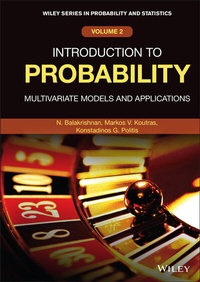
Introduction to Probability
Description

Discover practical models and real-world applications of multivariate models useful in engineering, business, and related disciplines
In Introduction to Probability: Multivariate Models and Applications, a team of distinguished researchers delivers a comprehensive exploration of the concepts, methods, and results in multivariate distributions and models. Intended for use in a second course in probability, the material is largely self-contained, with some knowledge of basic probability theory and univariate distributions as the only prerequisite.
This textbook is intended as the sequel to Introduction to Probability: Models and Applications. Each chapter begins with a brief historical account of some of the pioneers in probability who made significant contributions to the field. It goes on to describe and explain a critical concept or method in multivariate models and closes with two collections of exercises designed to test basic and advanced understanding of the theory.
A wide range of topics are covered, including joint distributions for two or more random variables, independence of two or more variables, transformations of variables, covariance and correlation, a presentation of the most important multivariate distributions, generating functions and limit theorems. This important text:
- Includes classroom-tested problems and solutions to probability exercises
- Highlights real-world exercises designed to make clear the concepts presented
- Uses Mathematica software to illustrate the text's computer exercises
- Features applications representing worldwide situations and processes
- Offers two types of self-assessment exercises at the end of each chapter, so that students may review the material in that chapter and monitor their progress
Perfect for students majoring in statistics, engineering, business, psychology, operations research and mathematics taking a second course in probability, Introduction to Probability: Multivariate Models and Applications is also an indispensable resource for anyone who is required to use multivariate distributions to model the uncertainty associated with random phenomena.
More details
Other editions
Additional editions
Persons
N. Balakrishnan, PhD, is Distinguished University Professor in the Department of Mathematics and Statistics at McMaster University in Ontario, Canada. He is the author of over twenty books, including Encyclopedia of Statistical Sciences, Second Edition.
Markos V. Koutras, PhD, is Professor in the Department of Statistics and Insurance Science at the University of Piraeus. He is the author/coauthor/editor of 19 books (13 in Greek, 6 in English). His research interests include multivariate analysis, combinatorial distributions, theory of runs/scans/patterns, statistical quality control, and reliability theory.
Konstadinos G. Politis, PhD, is Associate Professor in the Department of Statistics and Insurance Science at the University of Piraeus. He is the author of several articles published in scientific journals.
Content
Preface xi
Acknowledgments xv
1 Two-Dimensional Discrete Random Variables and Distributions 1
1.1 Introduction 2
1.2 Joint Probability Function 2
1.3 Marginal Distributions 15
1.4 Expectation of a Function 24
1.5 Conditional Distributions and Expectations 32
1.6 Basic Concepts and Formulas 41
1.7 Computational Exercises 42
1.8 Self-assessment Exercises 46
1.8.1 True-False Questions 46
1.8.2 Multiple Choice Questions 47
1.9 Review Problems 50
1.10 Applications 54
1.10.1 Mixture Distributions and Reinsurance 54
Key Terms 57
2 Two-Dimensional Continuous Random Variables and Distributions 59
2.1 Introduction 60
2.2 Joint Density Function 60
2.3 Marginal Distributions 73
2.4 Expectation of a Function 79
2.5 Conditional Distributions and Expectations 82
2.6 Geometric Probability 91
2.7 Basic Concepts and Formulas 98
2.8 Computational Exercises 100
2.9 Self-assessment Exercises 107
2.9.1 True-False Questions 107
2.9.2 Multiple Choice Questions 109
2.10 Review Problems 111
2.11 Applications 114
2.11.1 Modeling Proportions 114
Key Terms 119
3 Independence and Multivariate Distributions 121
3.1 Introduction 122
3.2 Independence 122
3.3 Properties of Independent Random Variables 137
3.4 Multivariate Joint Distributions 142
3.5 Independence of More Than Two Variables 156
3.6 Distribution of an Ordered Sample 165
3.7 Basic Concepts and Formulas 176
3.8 Computational Exercises 178
3.9 Self-assessment Exercises 185
3.9.1 True-False Questions 185
3.9.2 Multiple Choice Questions 186
3.10 Review Problems 189
3.11 Applications 194
3.11.1 Acceptance Sampling 194
Key Terms 200
4 Transformations of Variables 201
4.1 Introduction 202
4.2 Joint Distribution for Functions of Variables 202
4.3 Distributions of sum, difference, product and quotient 210
4.4 ¿¿¿¿2, t and F Distributions 223
4.5 Basic Concepts and Formulas 236
4.6 Computational Exercises 237
4.7 Self-assessment Exercises 242
4.7.1 True-False Questions 242
4.7.2 Multiple Choice Questions 243
4.8 Review Problems 246
4.9 Applications 250
4.9.1 Random Number Generators Coverage - Planning Under Random Event Occurrences 250
Key Terms 255
5 Covariance and Correlation 257
5.1 Introduction 258
5.2 Covariance 258
5.3 Correlation Coefficient 272
5.4 Conditional Expectation and Variance 281
5.5 Regression Curves 293
5.6 Basic Concepts and Formulas 307
5.7 Computational Exercises 308
5.8 Self-assessment Exercises 314
5.8.1 True-False Questions 314
5.8.2 Multiple Choice Questions 316
5.9 Review Problems 320
5.10 Applications 326
5.10.1 Portfolio Optimization Theory 326
Key Terms 330
6 Important Multivariate Distributions 331
6.1 Introduction 332
6.2 Multinomial Distribution 332
6.3 Multivariate Hypergeometric Distribution 344
6.4 Bivariate Normal Distribution 358
6.5 Basic Concepts and Formulas 371
6.6 Computational Exercises 373
6.7 Self-Assessment Exercises 378
6.7.1 True-False Questions 378
6.7.2 Multiple Choice Questions 380
6.8 Review Problems 383
6.9 Applications 387
6.9.1 The Effect of Dependence on the Distribution of the Sum 387
Key Terms 390
7 Generating Functions 391
7.1 Introduction 392
7.2 Moment Generating Function 392
7.3 Moment Generating Functions of Some Important Distributions 401
7.3.1 Binomial Distribution 401
7.3.2 Negative Binomial Distribution 402
7.3.3 Poisson Distribution 403
7.3.4 Uniform Distribution 403
7.3.5 Normal Distribution 403
7.3.6 Gamma Distribution 404
7.4 Moment Generating Functions for Sum of Variables 407
7.5 Probability Generating Function 416
7.6 Characteristic Function 428
7.7 Generating Functions for Multivariate Case 433
7.8 Basic Concepts and Formulas 441
7.9 Computational Exercises 443
7.10 Self-assessment Exercises 446
7.10.1 True-False Questions 446
7.10.2 Multiple Choice Questions 448
7.11 Review Problems 452
7.12 Applications 460
7.12.1 Random Walks 460
Key Terms 465
8 Limit Theorems 467
8.1 Introduction 468
8.2 Laws of Large Numbers 468
8.3 Central Limit Theorem 476
8.4 Basic Concepts and Formulas 492
8.5 Computational Exercises 493
8.6 Self-assessment Exercises 497
8.6.1 True-False Questions 497
8.6.2 Multiple Choice Questions 498
8.7 Review Problems 501
8.8 Applications 504
8.8.1 Use of the CLT for Capacity Planning 504
Key Terms 507
Appendix A Tail Probability Under Standard Normal Distribution 509
Appendix B Critical Values Under Chi-Square Distribution 511
Appendix C Student's t-Distribution 515
Appendix D F-Distribution: 5% (Lightface Type) and 1% (Boldface Type) Points for the F-Distribution 517
Appendix E Generating Functions 521
Bibliography 525
Index 527
PREFACE
This book is a follow-up of the book Introduction to Probability: Models and Applications, written by the same authors (which is referred throughout as Volume I). It thus forms the second volume for teaching probability theory.
In the first volume, we discussed the basic rules and concepts of probability, introduced the notion of conditional probability and independence, presented several combinatorial methods for probabilistic computations and finally went on to the introduction and study of discrete and continuous random variables; besides the presentation of general properties of random variables, we also discussed some well-known discrete and continuous distributions. These topics, in our view, form the core for an introduction to probability. The present volume discusses more advanced topics such as joint distributions, measures of dependence, multivariate random variables, some well-known multivariate discrete and continuous distributions, generating functions, laws of large numbers and the central limit theorem, which are the key topics for a second course on probability.
The form and structure of each chapter are similar to those in Volume I. In the beginning of each chapter, we provide a brief historical account of some pioneers in Probability who made exemplary contributions to the topic discussed in that chapter. This is done in order to provide students with a feeling of the history of Probability Theory and an appreciation of the vital contributions made by some renowned probabilists. Of course, books on the history of Probability and Statistics, would provide more elaborate details on their lives and contributions!
At the end of each section, the exercises have been classified into two groups, Group A and Group B. Exercises in Group A are usually routine extensions of the theory, involve simple calculations based on the theoretical tools presented in that section and are meant to consolidate the knowledge gained by the reader. Exercises in Group B are more advanced and would require both critical thinking and an ability to understand and use in an appropriate way the corresponding theory. In addition to regular exercises, we have also provided in each chapter, a long set of True/False questions and a set of multiple-choice questions. In our view, these will not only be useful for students to practice with (and assess their progress) but also for instructors to conduct regular in-class quizzes.
Special effort has been made to give the theoretical results in their simplest forms, so that they can be understood easily by the reader. In an effort to offer additional means for understanding the concepts presented, intuitive approaches as well as illustrative graphical representations/figures have been used throughout.
In each chapter, we have also included a section with some examples/problems for which the use of a computer is necessary. We demonstrate, through ample examples, how one can make effective use of computers for understanding probability concepts and carrying out various probability calculations. For these examples, the use of computer algebra software, such as Mathematica, Maple, and Derive, is recommended. These programs provide excellent tools for creating graphs in an easy way as well as for performing mathematical operations such as derivative, summation, integration, etc.; most importantly, one can handle symbols and variables without having to replace them with specific numerical values. To assist in this process, an example set of Mathematica commands is given each time (analogous commands can be assembled for other programs mentioned above as well). These commands may be used to perform a specific task and then several other similar tasks are set forth in the form of exercises. No effort is made to present the most effective Mathematica program for tackling the suggested problem and no detailed description of the Mathematica syntax is provided; the interested reader may refer to the Mathematica Instruction Manual (Wolfram Research) to check the, virtually unlimited, commands available in this software package (or any other computer algebra software) and use them for creating several alternative instruction sets for the suggested exercises.
Moreover, as in the first volume, at the end of each chapter, we have included a section detailing a case study (application) through which we demonstrate the usefulness of the results and concepts discussed in that chapter for a real-life problem.
In the first volume, we focused on situations wherein we assigned probabilities to events with regard to a single random variable X. In particular, we distinguished between discrete and continuous random variables and discussed the most important probability distributions in both cases. Even though there were examples in which more than one variable can be defined within the same random experiment, we were only interested in how each of these variables varied individually. However, there are many instances wherein our interest may be to study the way two or more variables vary simultaneously and, as a result, our primary objective will be to formulate, and answer, probability statements concerning more than one variable. For example, suppose a company wishes to forecast its annual turnover, along with its total expenses, for next year. Let X denote the company's turnover and Y the company's expenses; then, our interest may be on probability statements of the form
for some intervals (A and B) on the positive half-line. If the company sets as a target the turnover to be at least x and the expenses to be at most y (x and y are specific values), then the probability that both these targets of the company will be met is
When x and y are treated as fixed, problems of this type have already been considered in Volume I. To be specific, let A be the event {X?=?x} and B be the event {Y?=?y}. Then, we simply want to find the probability that A and B occur at the same time, which is simply P(A ?n? B). However, and in analogy with the case of a single variable (i.e. univariate case), the company for its financial planning may want to see how the probability in the above equation varies for different values of x and y. This is accomplished with the concept of joint distribution of X and Y, which would explain how the two variables vary together. The central role played by probability distributions in the first volume is now extended to joint probability distributions of two or more variables, referred to as multivariate probability distributions. The particular case of two variables (known as the bivariate case) deserves special consideration and is therefore treated separately. This makes the transition from the univariate to the multivariate case smoother, and helps one to get a better understanding about the main changes needed to pass from the case of one variable to the multivariate case. For this reason, we have adhered to this structure, and in the first two chapters, we discuss (discrete and continuous) bivariate random variables and distributions, while in the third chapter, we treat the multivariate case, along with the fundamental concept of independence between random variables. In Chapter 4, we present techniques for obtaining the distribution of transformations of random variables, and then we use them to derive three additional distributions that are of special importance in Statistics.
The presentation of the concept of independence between random variables in Chapter 3, is restricted to the consideration whether two or more variable are independent or not. However, if two random variables are not independent, we would naturally be interested to introduce a measure to quantify their relationship. In Chapter 5, we discuss two such measures, called covariance and correlation. In Chapter 6, we present in detail some of the most important multivariate distributions. The last two chapters of the book deal with two areas of probability theory that provide essential tools for handling a wide range of applications: generating functions (Chapter 7) and limit theorems (Chapter 8). Their common appeal is in situations when one is interested in sums or averages of random variables. For example, when we want to estimate the mean from a (potentially large) population, we draw a random sample from that population. In this case, essentially no statistical knowledge is needed for one to imagine that our best "guess" (i.e. estimate) for the population mean will be the sample average, that is, the arithmetic mean of the data collected. The theoretical justification for this (intuitively appealing) guess is provided by the results of Chapter 8, with the use of the so-called laws of large numbers. The central limit theorem, one of the fundamental results in probability theory, is also presented in the same chapter; it goes further to consider the difference between the sample average and the theoretical mean and highlights the importance of the normal distribution in statistical theory and practice.
This book is intended as a textbook for a...
