

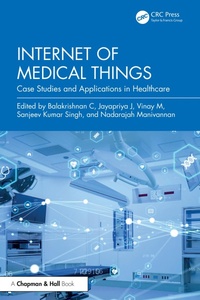
Internet of Medical Things
Case Studies and Applications in Healthcare
Published on 2. December 2025
226 pages
978-1-040-50436-9 (ISBN)
Description

The book presents a comprehensive overview of emerging IoT technologies, IoT devices and sensors and their role in the healthcare industry. It offers recent developments in the creation, application, and impact of new IoMT data security, IoMT devices used in a variety of applications, including telemedicine, monitoring patients, and intelligence-based medical data analysis. It includes discussions on the use of medical data analysis to make various predictions and diagnoses that lead to the right treatment. The security of medical data from Internet of Things (IoT) devices, where there is a risk of data leakage during transmission from the device to the server, is also discussed.
* Offers Software Application Framework for Sustainable Healthcare
* Includes feature case studies and real-world examples of IoT devices and technologies in use in healthcare settings
* Provide insight into the security risks associated with connected medical devices and the measures that can be taken to mitigate these risks.
* Discusses various integration strategies and technologies, including data interoperability standards, application programming interfaces (APIs), and other tools
* Contains discussions on emerging IoT technologies, such as blockchain and edge computing, as well as their potential applications in healthcare
This book is for researchers, professionals and students interested in the latest advancements on Internal of Medical Things.
* Offers Software Application Framework for Sustainable Healthcare
* Includes feature case studies and real-world examples of IoT devices and technologies in use in healthcare settings
* Provide insight into the security risks associated with connected medical devices and the measures that can be taken to mitigate these risks.
* Discusses various integration strategies and technologies, including data interoperability standards, application programming interfaces (APIs), and other tools
* Contains discussions on emerging IoT technologies, such as blockchain and edge computing, as well as their potential applications in healthcare
This book is for researchers, professionals and students interested in the latest advancements on Internal of Medical Things.
More details
Language
English
Place of publication
London
United Kingdom
Publishing group
Taylor & Francis Ltd
Target group
Professional and scholarly
Illustrations
15 Tables, black and white; 39 Line drawings, black and white; 5 Halftones, black and white; 44 Illustrations, black and white
File size
8,25 MB
ISBN-13
978-1-040-50436-9 (9781040504369)
Copyright in bibliographic data and cover images is held by Nielsen Book Services Limited or by the publishers or by their respective licensors: all rights reserved.
Schweitzer Classification
Other editions
Additional editions
Balakrishnan C | Jayapriya J | Vinay M
Internet of Medical Things
Case Studies and Applications in Healthcare
Book
approx. 12/2025
1st Edition
Chapman & Hall/CRC
€175.90
Not yet published
Persons
Balakrishnan C, PhD, is currently working as an Associate Professor of Computer Science at CHRIST (Deemed to be University), Bengaluru, India. Formerly, teaching in Alagappa University, Karaikudi, and St. Joseph's College, Tiruchirappalli, India. He has 20 years of teaching experience. He obtained his Ph.D in Computer Science from Bharathidasan University, Tiruchirappalli, India. He authored five books and published more than 50 research articles in international Conferences and indexed journals. He published 5 Indian Patents and contributed to three funded research projects. Presently, serving as the Coordinator of prestigious ICSSR Funded Research Programme for an outlay of Rs. 46 Lakhs. His areas of interest are Healthcare IoT, Vision-Language Models, Data Analytics, and Machine Learning.
Jayapriya J, PhD, is currently working as an Assistant Professor at the Department of Computer Science, CHRIST (Deemed to be University), Bangalore, Karnataka, India. She has 12 years of teaching experience, including working abroad and 5 years of research experience. She completed her Ph.D. at the National Institute of Technology, Tiruchirapalli, in the year 2017. She has published 35+ papers in reputed journals and presented at numerous International Conferences. She has also been a reviewer for reputed journals and acted as a resource person for many workshops and seminars. She specialises in Computational Intelligence, Bioinformatics, Cybersecurity, and Data Science. She completed a project funded by the Australian Consulate funding of Rs. 9.9 Lakhs and is currently working on an ICSSR project with a funding of Rs. 17 Lakhs. She is a member of IEEE, CS, and WIE.
Vinay M, PhD, is an academic and researcher with a distinguished career spanning nearly two decades. Currently serving as the Head of the Department at CHRIST (Deemed to be University) his expertise lies in the fields of Artificial Intelligence (AI), Information and Communication Technology (ICT) tools, and he is a Google Certified Trainer. His research interests encompass cutting-edge domains such as Generative AI, Virtual Reality (VR), Augmented Reality (AR), and Cyber Security. He has published 25 research papers indexed in Scopus and has participated in 30+ conferences. His contributions to the field have been recognised with 3 Best Paper Awards. His expertise extends beyond research, and he served as a resource person for over 150 academic programs, sharing knowledge and insights with various audiences. Moreover, he is a member of the Institute of Electrical and Electronics Engineers (IEEE) and is involved in numerous projects.
Sanjeev Kumar Singh, PhD, is presently working as a Professor at the Department of Bioinformatics, Alagappa University, Karaikudi, India. He received his PhD in Applied Chemistry from CJSM University, Kanpur, in 2004. He holds several administrative positions in different capacities within the University. He has vast experience of twenty years in research/teaching and has published more than 250 international and national research articles/reviews/book chapters in peer-reviewed journals. His outstanding research in HIV integrates and protease has been recognized by the Indian Council of Medical Research (ICMR) through the honor of ICMR Lala Ram Chand Kandhari Award for the year 2014. He also has received several awards and honors in research career name the few, 'Fellow of Royal Society of Chemistry' from the Royal Society of Chemistry, London, United Kingdom for the outstanding contribution in the field of Molecular Modelling and Computer Aided Drug Design with Quantum chemistry applications, 'Fellow of Royal Society of Biology' from the Royal Society of Biology, London, United Kingdom for the extensive research involved in the field of Biological Sciences, 'Member of Board of Governors (2021 - 2023)' for the Biotech Research Society of India (BRSI), India. Dr. Sanjeev Kumar Singh's research interests include neutralizing the HIV infection by targeting different proteins crucial for the virus's existence. He is keenly interested in investigating small molecules that exclusively interact with CDKs, HAT, h-GPCR, Retinoblastoma, and HPV to potentially aid therapeutics.
Nadarajah Manivannan, DPhil, is currently a Senior Lecturer for Electronics, Computer languages, and Embedded systems in the Brunel School of Design. He has been associated with Brunel University London for the past 15 years as a Researcher and Teaching Faculty. He received his Doctor of Philosophy (DPhil) in Optical Pattern Recognition, Electronic Engineering from the University of Oxford in 1997. Currently, he is working on multiple projects; viz. Plasma engineering, Microwave plasma, Electron gun plasma, Emission control, Lab-on-chip, Optical pattern recognition, and Liveness detection of fingerprint biometrics. He is supervising and supporting PhDs and MSc Students on their research work in the Brunel School of Design. To his credit, he is holding prestigious memberships like Senior Member IEEE, Member of IOP, Member of Oxford Engineering Society, and many more. He contributed in many research projects, like, Plasma and microwave technologies in emission control funded under DEECON, FP7 EU and MAGS, InnovateUK, Optical pattern recognition to explore 4f optical correlator for challenging optical information processing tasks in collaboration with the photonics group at Imperial College, London, Fingerprint biometrics for liveness detection of fingerprint, cancelable fingerprint template generation, multi-model biometric fusion techniques, fingerprint in M-health and many more.
Jayapriya J, PhD, is currently working as an Assistant Professor at the Department of Computer Science, CHRIST (Deemed to be University), Bangalore, Karnataka, India. She has 12 years of teaching experience, including working abroad and 5 years of research experience. She completed her Ph.D. at the National Institute of Technology, Tiruchirapalli, in the year 2017. She has published 35+ papers in reputed journals and presented at numerous International Conferences. She has also been a reviewer for reputed journals and acted as a resource person for many workshops and seminars. She specialises in Computational Intelligence, Bioinformatics, Cybersecurity, and Data Science. She completed a project funded by the Australian Consulate funding of Rs. 9.9 Lakhs and is currently working on an ICSSR project with a funding of Rs. 17 Lakhs. She is a member of IEEE, CS, and WIE.
Vinay M, PhD, is an academic and researcher with a distinguished career spanning nearly two decades. Currently serving as the Head of the Department at CHRIST (Deemed to be University) his expertise lies in the fields of Artificial Intelligence (AI), Information and Communication Technology (ICT) tools, and he is a Google Certified Trainer. His research interests encompass cutting-edge domains such as Generative AI, Virtual Reality (VR), Augmented Reality (AR), and Cyber Security. He has published 25 research papers indexed in Scopus and has participated in 30+ conferences. His contributions to the field have been recognised with 3 Best Paper Awards. His expertise extends beyond research, and he served as a resource person for over 150 academic programs, sharing knowledge and insights with various audiences. Moreover, he is a member of the Institute of Electrical and Electronics Engineers (IEEE) and is involved in numerous projects.
Sanjeev Kumar Singh, PhD, is presently working as a Professor at the Department of Bioinformatics, Alagappa University, Karaikudi, India. He received his PhD in Applied Chemistry from CJSM University, Kanpur, in 2004. He holds several administrative positions in different capacities within the University. He has vast experience of twenty years in research/teaching and has published more than 250 international and national research articles/reviews/book chapters in peer-reviewed journals. His outstanding research in HIV integrates and protease has been recognized by the Indian Council of Medical Research (ICMR) through the honor of ICMR Lala Ram Chand Kandhari Award for the year 2014. He also has received several awards and honors in research career name the few, 'Fellow of Royal Society of Chemistry' from the Royal Society of Chemistry, London, United Kingdom for the outstanding contribution in the field of Molecular Modelling and Computer Aided Drug Design with Quantum chemistry applications, 'Fellow of Royal Society of Biology' from the Royal Society of Biology, London, United Kingdom for the extensive research involved in the field of Biological Sciences, 'Member of Board of Governors (2021 - 2023)' for the Biotech Research Society of India (BRSI), India. Dr. Sanjeev Kumar Singh's research interests include neutralizing the HIV infection by targeting different proteins crucial for the virus's existence. He is keenly interested in investigating small molecules that exclusively interact with CDKs, HAT, h-GPCR, Retinoblastoma, and HPV to potentially aid therapeutics.
Nadarajah Manivannan, DPhil, is currently a Senior Lecturer for Electronics, Computer languages, and Embedded systems in the Brunel School of Design. He has been associated with Brunel University London for the past 15 years as a Researcher and Teaching Faculty. He received his Doctor of Philosophy (DPhil) in Optical Pattern Recognition, Electronic Engineering from the University of Oxford in 1997. Currently, he is working on multiple projects; viz. Plasma engineering, Microwave plasma, Electron gun plasma, Emission control, Lab-on-chip, Optical pattern recognition, and Liveness detection of fingerprint biometrics. He is supervising and supporting PhDs and MSc Students on their research work in the Brunel School of Design. To his credit, he is holding prestigious memberships like Senior Member IEEE, Member of IOP, Member of Oxford Engineering Society, and many more. He contributed in many research projects, like, Plasma and microwave technologies in emission control funded under DEECON, FP7 EU and MAGS, InnovateUK, Optical pattern recognition to explore 4f optical correlator for challenging optical information processing tasks in collaboration with the photonics group at Imperial College, London, Fingerprint biometrics for liveness detection of fingerprint, cancelable fingerprint template generation, multi-model biometric fusion techniques, fingerprint in M-health and many more.
Content
Introduction to IoMT: A Revolution in Healthcare 2. Optimizing Smart Hospitals with IoMT: A Deep Dive into the Next-Generation Paradigm for Digital Healthcare 3. Internet of Medical Things: Architecture and Technologies 4. Tapestry of Promise and Peril: NLP, AI, and IoMT in Healthcare Transformation - A Review 5. AI - Driven Health Coach for Diabetes Management 6. An Enhancement of Security System using Curve Based Cryptosystem with Decentralized Scalable Group Key Agreement for IoMT 7. Post Processing of Unmanned Aerial Vehicle Images of Search & Rescue Mission 8. Revolutionizing Mental Health Care: The Transformative Power of Internet of Medical Things (IoMT): A Comprehensive Overview and Case Studies 9. Internet of Medical Things Based Smart System for the Mental Healthcare Challenges in 21st Century: Trends and Progress 10. Healing Beyond Beliefs: A PostHumanist Reading of IoMT Advancements 11. Adverse Childhood Experiences, Psychological Well-Being and Grit: A Comparative Study Between LGBTQIA+ And Cis-Heterogenous Sample of India 12. Global research trends on implementing internet based mental health programs: A bibliometric analysis 13. Transformative Tales: Unveiling Success Stories and Advancements in Healthcare through Internet of Medical Things (IoMT) and Machine Learning Integration
