

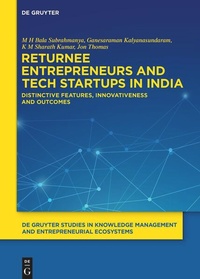
Returnee Entrepreneurs and Tech Startups in India
Description

Returnee entrepreneurship is gaining traction globally. Returnee entrepreneurs tend to possess significant knowledge capital, international social capital, financial capital, managerial, and entrepreneurial skills, among others, relative to domestic entrepreneurs. Therefore, they can contribute to bridging the knowledge gap, technology gap, skill gap, and entrepreneurship gap that may exist between home and host economies. As a result, they can more effectively contribute to the acceleration of economic growth and transformation of emerging economies like India and China. However, evidence of the role of returnee entrepreneurs in the Indian innovation ecosystem is very limited and fragmented. Therefore, this book is the first attempt to explore and understand comprehensively the distinctive characteristics of returnee entrepreneurs, the level of innovativeness and market focus of their products and services, and their ability to launch, sustain and scale up tech startups (relative to domestic entrepreneurs) based on primary data in the context of startup capital of India, Bengaluru.
More details
Other editions
Additional editions
Persons
M H Bala Subrahmanya is a Senior Professor (Economics) at the Department of Management Studies, Indian Institute of Science (IISc), Bangalore. He is a recipient of Commonwealth Fellowship (1999/00), Japan Foundation Fellowship (2004/05) and Fulbright-Nehru Senior Research Fellowship (2009/10). He has more than 200 publications to his credit comprising research papers in refereed national and international journals including Journal of Business Research, Technovation, Technology Forecasting & Social Change, and Economic & Political Weekly . He is on the Editorial Board of Current Science Journal, Competition Commission of India (CCI) Journal on Competition Law and Policy and on the Editorial Advisory Board of International Journal of Entrepreneurial Behaviour & Research, and International Journal of Global Business and Competitiveness . His research monographs, Entrepreneurial Ecosystems for Tech Start-ups in India and Technology Business Incubators India: Structure, Role & Performance were published by De Gruyter in 2021 . His field of specialization is Industrial Economics with special reference to startups, SMEs, innovation and entrepreneurial economics.
Ganesaraman Kalyanasundaram is a Professor of Practice at the Faculty of Management and Commerce at Ramaiah University of Applied Sciences. He is Vice President at [24]7.ai and heads Global Internal Audit & Global Information Systems. He obtained his Ph.D. from the Indian Institute of Science (IISc), Bangalore (2021). He was awarded a Gold Medal from the Indian Economic Association for the thesis on "Tech Startup Failures in India: Causal Attributes, Life Expectancy, and Exits". His areas of specialization include entrepreneurship, financial management, and operations management research. He has a number of peer-reviewed publications and delivered many invited talks to various academic and corporate platforms across India.
K M Sharath Kumar is a Professor and Dean for the Faculty of Management and Commerce at Ramaiah University of Applied Sciences. He was also the Founding Director for Research at the University between 2014 and 2022. He has more than 20 years of teaching, research and service experience. His areas of specialization include supply chain management, operations research, data envelopment analysis, and entrepreneurship. Dr. Sharath has more than 30 peer-reviewed publications and 5 students have been awarded Ph.D's under his guidance. He is a 'Management Committee' member of the Bangalore Management Association for the Year 2024-25 and on the steering committee of the 'Asian Society of Innovation and Policy', South Korea.
Dr. Jon Thomas is a BC Regional Innovation Chair and the Founding Director of the Esposito Family Centre for Innovation & Entrepreneurship (EFCIE) at the University of the Fraser Valley, Canada. He is an Associate Professor at UFV's School of Business and studies science and technology commercialization, particularly from university settings. Dr. Thomas is the Research Director, EDII Lead, and one of a four-member National Leadership Team (NLT) of researchers heading Canada's National invention to Innovation (i2I) Network. This network has received nearly $23 million in 2025 to expand science and technology commercialization training for STEM graduates, postdocs, and faculty members across Canada. His research has been published in Nature Nanotechnology, Technovation, and Journal of Engineering and Technology Management and a recent paper he led was selected as one of the best papers by the TIM division at the Academy of Management Annual Meeting in Chicago (2024).
Content
- Intro
- Acknowledgments
- Preface
- Contents
- List of Abbreviation
- Chapter 1 Introduction
- 1.1 Prelude
- 1.2 Emergence of Returnee Entrepreneurship: Prompting Factors
- 1.3 Startups, Startup Hubs, and Startup Policies in India
- 1.3.1 Startups
- 1.3.2 Startup Hubs
- 1.3.3 Startup Policies in India
- 1.4 Research Questions
- 1.5 Scope
- 1.6 Methodology
- 1.7 Chapter Scheme of the Monograph
- Chapter 2 Returnee Entrepreneurs in the Global Economy:Opportunities and Challenges
- 2.1 Introduction
- 2.2 Emergence: Origin and Causes
- 2.3 Unique Strengths and Opportunities
- 2.3.1 Knowledge Capital
- 2.3.2 Social Capital
- 2.3.3 Financial Capital
- 2.3.4 Triple Sources of Returnees' Competitive Advantage and their Implications
- 2.4 Flip Side
- 2.5 Measures to Overcome the Liability of Foreignness
- 2.6 Dimensions of Startup Performance: An Empirical View
- 2.7 Returnee Entrepreneurship and Startups: Unanswered Questions
- 2.8 Returnee Entrepreneurs and Startups: A Conceptual Framework
- 2.9 Research Hypotheses
- Chapter 3 Profiles of Stakeholders, Returnee Entrepreneurs and Domestic Entrepreneurs
- 3.1 Introduction
- 3.2 Characteristics of Stakeholders
- 3.3 Characteristics of REs and DEs
- 3.4 Summary
- Chapter 4 Distinctive Characteristics of Returnee Entrepreneurs
- 4.1 Introduction
- 4.2 Distinctive Characteristics of REs and DEs: Hypotheses
- 4.3 Perspective of Stakeholders' on REs
- 4.4 Perspectives of REs and DEs
- 4.5 Distinctive Characteristics of REs and DEs
- 4.6 Summary
- Chapter 5 Determinants of Ability to Recognize and Exploit Entrepreneurial Opportunities
- 5.1 Introduction
- 5.2 Recognition and Exploitation of Entrepreneurial Opportunities: A Conceptual Framework
- 5.3 Stakeholders' Perspective
- 5.4 Perspectives of REs and DEs
- 5.5 Summary
- Chapter 6 Determinants of Innovativeness and Market Focus (Part A)
- 6.1 Introduction
- 6.2 Innovativeness and Market Focus of Returnee Entrepreneurial Ventures: A Conceptual Framework
- 6.3 Innovativeness: Stakeholders' Perspective
- 6.4 Innovativeness: Perspectives of REs and DEs
- 6.5 Market Focus of Entrepreneurial Ventures: Perspectives of REs and DEs
- 6.6 Summary
- 6.7 Profiles and Success Stories of Returnee Entrepreneurs (PART - B)
- Chapter 7 Time to Emergence, Stability and Scaling Up of Startups
- 7.1 Introduction
- 7.2 Emergence, Stability, and Scaling up of Returnee Startups: A Conceptual Framework
- 7.3 Stakeholders' Perspective
- 7.4 Perspectives of REs and DEs
- 7.5 Summary
- Chapter 8 Summary and Conclusions
- 8.1 Background
- 8.2 Returnee Entrepreneurs in the Global Context
- 8.3 Research Objectives, Scope and Data Sources
- 8.4 Major Research Findings
- 8.4.1 Profiles
- 8.4.2 Distinctive Characteristics
- 8.4.3 Recognition and Exploitation
- 8.4.4 Innovativeness and Market Focus
- 8.4.5 Time to Launch, Achieve Stability, and Scaling-up
- 8.5 Inferences and General Implications
- 8.6 Literature Contributions, Managerial and Policy Implications
- 8.6.1 Literature Contributions
- 8.6.2 Managerial Implications
- 8.6.3 Policy Implications
- 8.7 Scope for Future Work
- References
- Appendices
- Appendix 1: Questionnaire for Stakeholders
- Appendix 2: Questionnaire for Returnee Entrepreneurs
- Appendix 3: Questionnaire for Domestic Entrepreneurs
- Index
