

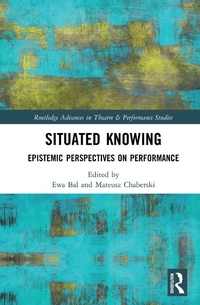
Situated Knowing
Epistemic Perspectives on Performance
1st Edition
Published on 11. August 2020
212 pages
978-1-000-08208-1 (ISBN)
Description

Situated Knowing aims to critically examine performance studies' ideological and socio-political underpinnings while also challenging the Anglo-centrism of the discipline.
This book reworks the concept of situated knowledges put forward over thirty years ago by American biologist and philosopher Donna Haraway in order to challenge the Enlightenment paradigm of objectivity in sciences by emphasising the role of the embodied and partial socio-cultural perspective of the scholar in the production of knowledge.
Through carefully selected case studies of contemporary natural, cultural and technological performances, contributors to this volume show that the proposed approach requires new genealogies of traditional concepts, emerges from encounters with contemporary performative arts or contact zones and may potentially go beyond the human in order to include non-human ways of being in the world. It will be of great interest to students and scholars of performance studies, cultural studies, media studies and theatre studies.
This book reworks the concept of situated knowledges put forward over thirty years ago by American biologist and philosopher Donna Haraway in order to challenge the Enlightenment paradigm of objectivity in sciences by emphasising the role of the embodied and partial socio-cultural perspective of the scholar in the production of knowledge.
Through carefully selected case studies of contemporary natural, cultural and technological performances, contributors to this volume show that the proposed approach requires new genealogies of traditional concepts, emerges from encounters with contemporary performative arts or contact zones and may potentially go beyond the human in order to include non-human ways of being in the world. It will be of great interest to students and scholars of performance studies, cultural studies, media studies and theatre studies.
More details
Series
Edition
1. Auflage
Language
English
Place of publication
London
United Kingdom
Publishing group
Taylor & Francis Ltd
Target group
College/higher education
Illustrations
25 Halftones, black and white; 25 Illustrations, black and white
ISBN-13
978-1-000-08208-1 (9781000082081)
Copyright in bibliographic data and cover images is held by Nielsen Book Services Limited or by the publishers or by their respective licensors: all rights reserved.
Schweitzer Classification
Other editions
Additional editions
Book
03/2022
1st Edition
Routledge
€65.10
Shipment within 15-20 days
Book
08/2020
1st Edition
Routledge
€205.40
Shipment within 15-20 days
Persons
Ewa Bal is Professor in the Department of Performativity Studies at Jagellonian University in Krakow, Poland, and a visiting professor at Italian and Spanish universities. She is a member of EASTAP and IFTR, and the author of two monographs: Corporeality in Drama: The Theatre of Pier Paolo Pasolini and its Legacy (2006), In the Footsteps of Harlequin and Pulcinella. Cultural Mobility and Localness of the Theatre (2017, soon to be published in English) and over forty papers in scientific journals. She has also edited Performance, Performativity, Performer: Definitions and Critical Analysis (2013), and Performance Studies: Territories (2017). She has translated and edited several Italian and Polish plays by Pier Paolo Pasolini, Emma Dante, Davide Enia, Annibale Ruccello, Enzo Moscato, Fausto Paravidino, Jan Klata and Michal Walczak. Her major academic interests are the cultural mobility of performance and theatre, minority language theatre and performance, translation studies, gender and queer studies, and (de)postcolonial studies.
Mateusz Chaberski has a PhD from the Department for Performativity Studies at the Jagiellonian University, Krakow, Poland. In 2016, he won a Foundation for Polish Science scholarship for innovative research in Humanities. His academic interests range from performance studies, affect and assemblage theories to Anthropocene studies. He is also Deputy Managing Director at the Jagiellonian University Press. In 2015 he published Doswiadczenie (syn)estetyczne. Performatywne aspekty przedstawien and in 2019 Asamblaze, Asamblaze. Doswiadczenie w zamglonym antropocenie.
Mateusz Chaberski has a PhD from the Department for Performativity Studies at the Jagiellonian University, Krakow, Poland. In 2016, he won a Foundation for Polish Science scholarship for innovative research in Humanities. His academic interests range from performance studies, affect and assemblage theories to Anthropocene studies. He is also Deputy Managing Director at the Jagiellonian University Press. In 2015 he published Doswiadczenie (syn)estetyczne. Performatywne aspekty przedstawien and in 2019 Asamblaze, Asamblaze. Doswiadczenie w zamglonym antropocenie.
Content
Introduction: Situated Knowing: From Performance Art to the Laboratory of Knowledge-Making, Ewa Bal and Mateusz Chaberski
Part 1. Knowing and Alternative Genealogies - introduction by Ewa Bal
Chapter 1. Slough Media, Rebecca Schneider
Chapter 2. The Performing Arts as 'Cognitive Hybrids': The Power of the Performatic Spiel-Raum, Fabrizio Deriu
Part 2. Knowing with Performative Arts - introduction by Mateusz Chaberski
Chapter 3. Dead Capital, Diana Taylor
Chapter 4. Beyond Presence: Performing the Limits of Knowing, Malgorzata Sugiera
Chapter 5. Performative Approaches to the Cultural Policy Field, Fabiola Camuti
Part 3. Knowing in Contact Zones - introduction by Ewa Bal
Chapter 6. Decolonizing Documentary: Wojtek Doroszuk's Sape and Prince, Mateusz Borowski
Chapter 7. Beyond Ethnicity? New Architectures of Access to Local Cultures in Dorota Nieznalska's Memory and Violence (2019), Ewa Bal
Part 4. Knowing Beyond the Human - introduction by Mateusz Chaberski
Chapter 8. The Shadow of a Pine Tree: Authorship, Agency and Performing Beyond the Human, Annette Arlander
Chapter 9. What Performativity Scholars Can Learn from Mushrooms: Situated Knowing in Polyphonic Assemblages, Mateusz Chaberski
Part 1. Knowing and Alternative Genealogies - introduction by Ewa Bal
Chapter 1. Slough Media, Rebecca Schneider
Chapter 2. The Performing Arts as 'Cognitive Hybrids': The Power of the Performatic Spiel-Raum, Fabrizio Deriu
Part 2. Knowing with Performative Arts - introduction by Mateusz Chaberski
Chapter 3. Dead Capital, Diana Taylor
Chapter 4. Beyond Presence: Performing the Limits of Knowing, Malgorzata Sugiera
Chapter 5. Performative Approaches to the Cultural Policy Field, Fabiola Camuti
Part 3. Knowing in Contact Zones - introduction by Ewa Bal
Chapter 6. Decolonizing Documentary: Wojtek Doroszuk's Sape and Prince, Mateusz Borowski
Chapter 7. Beyond Ethnicity? New Architectures of Access to Local Cultures in Dorota Nieznalska's Memory and Violence (2019), Ewa Bal
Part 4. Knowing Beyond the Human - introduction by Mateusz Chaberski
Chapter 8. The Shadow of a Pine Tree: Authorship, Agency and Performing Beyond the Human, Annette Arlander
Chapter 9. What Performativity Scholars Can Learn from Mushrooms: Situated Knowing in Polyphonic Assemblages, Mateusz Chaberski
