

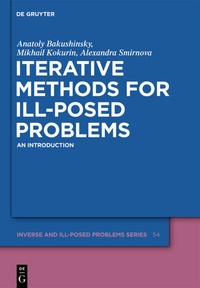
Iterative Methods for Ill-Posed Problems
An Introduction
1st Edition
Published on 23. December 2010
XI, 136 pages
978-3-11-025065-7 (ISBN)
Description

Ill-posed problems are encountered in countless areas of real world science and technology. A variety of processes in science and engineering is commonly modeled by algebraic, differential, integral and other equations. In a more difficult case, it can be systems of equations combined with the associated initial and boundary conditions.
Frequently, the study of applied optimization problems is also reduced to solving the corresponding equations. These equations, encountered both in theoretical and applied areas, may naturally be classified as operator equations. The current textbook will focus on iterative methods for operator equations in Hilbert spaces.
Reviews / Votes
"The book is an introduction to iterative methods for ill-posed problems. The style of writing is very user-friendly, in the best tradition of the Russian mathematical school. It is a valuable addition to the literature of ill-posed problems."Anton Suhadolc in: University of Michigan Mathematical Reviews 2012cMore details
Other editions
Additional editions
Anatoly B. Bakushinsky | Mihail Yu. Kokurin | Alexandra Smirnova
Iterative Methods for Ill-Posed Problems
An Introduction
Book
12/2010
1st Edition
De Gruyter
€144.95
Shipment within 7-9 days
Persons
Anatoly B. Bakushinsky, Institute of System Analysis, Russian Academy of Sciences, Moscow, Russia; Mihail Yu. Kokurin, Mari State Technical University, Yoshkar-Ola, Russia; Alexandra Smirnova, Georgia State University, Atlanta, Georgia, USA.
Content
1 Regularity Condition. Newton's Method
2 The Gauss-Newton Method
3 The Gradient Method
4 Tikhonov's Scheme
5 Tikhonov's Scheme for Linear Equations
6 The Gradient Scheme for Linear Equations
7 Convergence Rates for the Approximation Methods in the Case of Linear Irregular Equations
8 Equations with a Convex Discrepancy Functional by Tikhonov's Method
9 Iterative Regularization Principle
10 The Iteratively Regularized Gauss-Newton Method
11 The Stable Gradient Method for Irregular Nonlinear Equations
12 Relative Computational Efficiency of Iteratively Regularized Methods
13 Numerical Investigation of Two-Dimensional Inverse Gravimetry Problem
14 Iteratively Regularized Methods for Inverse Problem in Optical Tomography
15 Feigenbaum's Universality Equation
16 Conclusion
References
Index?
2 The Gauss-Newton Method
3 The Gradient Method
4 Tikhonov's Scheme
5 Tikhonov's Scheme for Linear Equations
6 The Gradient Scheme for Linear Equations
7 Convergence Rates for the Approximation Methods in the Case of Linear Irregular Equations
8 Equations with a Convex Discrepancy Functional by Tikhonov's Method
9 Iterative Regularization Principle
10 The Iteratively Regularized Gauss-Newton Method
11 The Stable Gradient Method for Irregular Nonlinear Equations
12 Relative Computational Efficiency of Iteratively Regularized Methods
13 Numerical Investigation of Two-Dimensional Inverse Gravimetry Problem
14 Iteratively Regularized Methods for Inverse Problem in Optical Tomography
15 Feigenbaum's Universality Equation
16 Conclusion
References
Index?
