

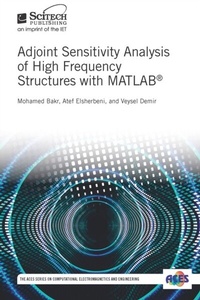
Adjoint Sensitivity Analysis of High Frequency Structures with MATLAB (R)
1st Edition
Published on 7. April 2017
280 pages
978-1-61353-232-4 (ISBN)
Available for download
Description

This book presents the theory of adjoint sensitivity analysis for high frequency applications through time-domain electromagnetic simulations in MATLAB (R). This theory enables the efficient estimation of the sensitivities of an arbitrary response with respect to all parameters in the considered problem. These sensitivities are required in many applications including gradient-based optimization, surrogate-based modeling, statistical analysis, and yield analysis.
Using the popular FDTD method, the book shows how wideband sensitivities can be efficiently estimated for different types of materials and structures, and includes plenty of well explained MATLAB (R) examples to help readers absorb the content more easily and to make the theory more understandable to the broadest possible audience. Topics covered include a review of FDTD and an introduction to adjoint sensitivity analysis; the adjoint variable method for frequency-independent constitutive parameters; sensitivity analysis for frequency-dependent objective functions; transient adjoint sensitivity analysis; adjoint sensitivity analysis with dispersive materials; adjoint sensitivity analysis of anisotropic structures; nonlinear adjoint sensitivity analysis; second-order adjoint sensitivities; and advanced topics.
Using the popular FDTD method, the book shows how wideband sensitivities can be efficiently estimated for different types of materials and structures, and includes plenty of well explained MATLAB (R) examples to help readers absorb the content more easily and to make the theory more understandable to the broadest possible audience. Topics covered include a review of FDTD and an introduction to adjoint sensitivity analysis; the adjoint variable method for frequency-independent constitutive parameters; sensitivity analysis for frequency-dependent objective functions; transient adjoint sensitivity analysis; adjoint sensitivity analysis with dispersive materials; adjoint sensitivity analysis of anisotropic structures; nonlinear adjoint sensitivity analysis; second-order adjoint sensitivities; and advanced topics.
More details
Series
Language
English
Place of publication
NY
United States
Target group
College/higher education
Professional and scholarly
ISBN-13
978-1-61353-232-4 (9781613532324)
Copyright in bibliographic data and cover images is held by Nielsen Book Services Limited or by the publishers or by their respective licensors: all rights reserved.
Schweitzer Classification
Other editions
Additional editions
Mohamed H. Bakr | Atef Z. Elsherbeni | Veysel Demir
Adjoint Sensitivity Analysis of High Frequency Structures with MATLAB (R)
Book
03/2017
SciTech Publishing Inc
€152.50
Shipment within 3-4 weeks
Persons
Mohamed H. Bakr is a Professor of Electrical and Computer Engineering, McMaster University, Canada. He is a senior member of IEEE and a member of ACES and OSA. He authored/ co-authored over 220 journal and conference publications, 2 books, and 2 book chapters. He is associate editor of the IEEE Transactions on Antennas and Propagation.
Atef Z. Elsherbeni is the Dobelman Distinguished Chair Professor and the Electrical Engineering Department Head at Colorado School of Mines. He was President of the Applied Computational Electromagnetics Society, ACES, from 2013 to 2015, is a Fellow of the IEEE and ACES, Editor-in-Chief for ACES Journal, and a past Associate Editor to the Radio Science Journal. He has advised/co-advised 21 PhD and 33 MS students, 4 postdoctoral fellows, and 5 visiting professors.
Veysel Demir is an associate professor at the Department of Electrical Engineering at Northern Illinois University. He is a member of IEEE, ACES, and SigmaXi, has co-authored more than 50 technical journal and conference papers, and served as a technical program co-chair for the 2014 IEEE International Symposium on Antennas and Propagation and USNC-URSI Radio Science Meeting and for the ACES 2015 conference.
Atef Z. Elsherbeni is the Dobelman Distinguished Chair Professor and the Electrical Engineering Department Head at Colorado School of Mines. He was President of the Applied Computational Electromagnetics Society, ACES, from 2013 to 2015, is a Fellow of the IEEE and ACES, Editor-in-Chief for ACES Journal, and a past Associate Editor to the Radio Science Journal. He has advised/co-advised 21 PhD and 33 MS students, 4 postdoctoral fellows, and 5 visiting professors.
Veysel Demir is an associate professor at the Department of Electrical Engineering at Northern Illinois University. He is a member of IEEE, ACES, and SigmaXi, has co-authored more than 50 technical journal and conference papers, and served as a technical program co-chair for the 2014 IEEE International Symposium on Antennas and Propagation and USNC-URSI Radio Science Meeting and for the ACES 2015 conference.
Content
Chapter 1: Introduction to sensitivity analysis approaches
Chapter 2: Introduction to FDTD
Chapter 3: The adjoint variable method for frequency-independent constitutive parameters
Chapter 4: Sensitivity analysis for frequency-dependent objective functions
Chapter 5: Transient adjoint sensitivity analysis
Chapter 6: Adjoint sensitivity analysis with dispersive materials
Chapter 7: Adjoint densitivity analysis of anisotropic structures
Chapter 8: Nonlinear adjoint sensitivity analysis
Chapter 9: Second-order adjoint sensitivities
Chapter 10: Advanced topics
Chapter 2: Introduction to FDTD
Chapter 3: The adjoint variable method for frequency-independent constitutive parameters
Chapter 4: Sensitivity analysis for frequency-dependent objective functions
Chapter 5: Transient adjoint sensitivity analysis
Chapter 6: Adjoint sensitivity analysis with dispersive materials
Chapter 7: Adjoint densitivity analysis of anisotropic structures
Chapter 8: Nonlinear adjoint sensitivity analysis
Chapter 9: Second-order adjoint sensitivities
Chapter 10: Advanced topics

