

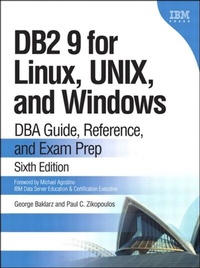
DB2 9 for Linux, UNIX, and Windows
Description

DB2® 9 builds on the world's number one enterprise database to simplify the delivery of information as a service, accelerate development, and dramatically improve operational efficiency, security, and resiliency.
Now, this new edition offers complete, start-to-finish coverage of DB2 9 administration and development for Linux®, UNIX®, and Windows® platforms, as well as authoritative preparation for the latest IBM DB2 certification exam.
Written for both DBAs and developers, this definitive reference and self-study guide covers all aspects of deploying and managing DB2 9, including DB2 database design and development; day-to-day administration and backup; deployment of networked, Internet-centered, and SOA-based applications; migration; and much more. You'll also find an unparalleled collection of expert tips for optimizing performance, availability, and value.
Coverage includes:
- Important security and resiliency enhancements, including advanced access control; fine-grained, label-based security; and the new security administrator role
- Breakthrough pureXML(TM) features that make it easier to succeed with service-oriented architecture
- Operational improvements that enhance DBA efficiency--including self-tuning memory allocation, automated storage management, and storage optimization
- Table-partitioning features that improve scalability and manageability
- Powerful improvements for more agile and rapid development, including the new Eclipse-based Developer Workbench and simple SQL or XQuery access to all data
Whatever your role in working with DB2 or preparing for certification, DB2 9 for Linux, UNIX, and Windows, Sixth Edition is the one book you can't afford to be without.
Download Complete DB2 V9 Trial Version
Visit ibm.com/db2/9/download.html to download a complete trial version of DB2, which enables you to try out dozens of the most powerful features of DB2 for yourself: everything from pureXML support to automated administration and optimization.
- Straight from IBM, the ultimate guide to running DB2 9 and preparing for the latest IBM DB2 certification exam!
- Covers powerful DB2 9 enhancements ranging from automated management to improved compression
- Covers the full spectrum of DBA responsibilities, including server management, data placement, XML concepts, activity analysis, high availability, and security
- Presents expert tips and best practices from the DB2 customer support organization
All prices
More details
Other editions
Additional editions
Persons
George Baklarz, B. Math, M.Sc., Ph.D., has spent 22 years at IBM working on various aspects of database technology. From 1987 to 1991 he worked on SQL/DS as part of the product planning department, system test team, performance team, and application development group. In 1991, Baklarz was part of the team that helped moved the OS/2 ES database to Toronto to become part of the DB2 family of products. Since that time he has worked on vendor enablement, competitive analysis, product marketing, product planning, and technical sales support. Today, Baklarz is the Program Director responsible for Dynamic Warehousing Pre-Sales Support, and he works with customers to help them understand DB2 technology directions and uses their feedback to improve the product. When not traveling the world, Baklarz lectures at the University of Guelph, teaching relational database concepts to students. You can reach him at gbaklarz@uoguelph.ca.
Paul C. Zikopoulos, B.A., M.B.A., is an award-winning writer and speaker with the IBM Database Competitive Technology team. He has more than thirteen years of experience with DB2 and has written more than 150 magazine articles and is currently working on book number twelve. Zikopoulos has authored the books Information on Demand: Introduction to DB2 9.5 New Features; DB2 9 Database Administration Certification Guide and Reference (6th Edition); DB2 9: New Features; Information on Demand: Introduction to DB2 9 New Features; Off to the Races with Apache Derby; DB2 Version 8: The Official Guide; DB2: The Complete Reference; DB2 Fundamentals Certification for Dummies; DB2 for Dummies; and A DBA's Guide to Databases on Linux. Zikopoulos is a DB2 Certified Advanced Technical Expert (DRDA and Cluster/EEE) and a DB2 Certified Solutions Expert (Business Intelligence and Database Administration). In his spare time, he enjoys all sorts of sporting activities, including running with his dog Chachi, avoiding punches in his MMA class, and trying to figure out the world according to Chloë, his daughter. You can reach him at paulz_ibm@msn.com.
Content
Foreword xxi Preface xxiii
Part ONE: Introduction to DB2 1Chapter 1: Product Overview 3
- Information as a Service 4 The DB2 for Linux, UNIX, and Windows Data Server 9 DB2 Connectivity 28 DB2 Administration 45 Summary 60
Chapter 2: Getting Started 63
- Product Installation 64 The DB2 Environment 98 Summary 115
Chapter 3: Getting Connected 117
- DB2 Client Overview 118 Roadmap to Distributed Communications 124 Summary 164
Chapter 4: Controlling Data Access 167
- Overview of Security 168 Auditing 216 Summary 221
Chapter 5: Database Objects 225
- Understanding Database Objects 227 Managing Database Objects 235 Tables 263 Database Design and Implementation 316 Summary 325
Chapter 6: Manipulating Database Objects 327
- Data Retrieval 328 Data Modification 365 View Classification 383 Summary 395
Chapter 7: Advanced SQL 397
- Triggers 398 Recursive SQL 405 Outer Join 409 OLAP Features 414 Advanced CASE Expressions 432 Structured Types and Typed Tables 434 Summary Tables 456 Sequences 469 Advanced Functions 472 Summary 487
Chapter 8: pureXML Storage Engine 489
- pureXML Feature Pack 490 The Difference: pureXML 495 Creating an XML-enabled Database 500 Creating Tables with pureXML 502 Inserting Data into pureXML Columns 504 Selecting Data from pureXML Columns 513 Updating and Deleting pureXML Columns 520 Indexing pureXML Columns 521 XML Schema Repository (XSR) 533 Summary 537
Chapter 9: Development SQL 539
- User-Defined Functions 540 Structured Data Types 549 Schemas and Aliases 555 COMMIT and ROLLBACK 558 SQL Procedural Language 559 Stored Procedures 578 Summary 597
Chapter 10: Concurrency 599
- Concurrency 600 Isolation Levels 607 Lockingv610 Summary 621
Chapter 11: Data Storage Management 625
- Processor, Memory, and Disk Resources 626 DB2 Storage Model 628 Table Space Design 640 Implementation Examples 652 Automatic Storage 664 Table Space Maintenance 666 Table (Range) Partitioning 674 Summary 699
Chapter 12: Maintaining Data 701
- Moving Data 702 Data Movement Utilities 705 Data Maintenance 766 Data Maintenance Process 786 Summary 791
Chapter 13: Database Recovery 793
- Database Recovery Concepts 794 Types of Recovery 795 Recovery Strategies 796 Use of Log Files 797 Version Recovery Using Backup and Restore 805 Roll-Forward Recovery 827 Managing Log Files 837 Other Recovery Considerations 838 High Availability 845 High-Availability Disaster Recovery 850 Summary 869
Chapter 14: Monitoring and Tuning 871
- Elements of Performance 872 DB2 Architecture Overview 876 DB2 Sorting Methods 887 Monitoring the DB2 System 887 Database Monitoring 890 SQL Monitoring 921 Diagnostics and Problem Determination 947 Self-Tuning Memory Manager 960 Summary 973
Chapter 15: Application Development Overview 977
- DB2 Application Development Environment 978 DB2 Programming Interfaces 982 Summary 995
Chapter 16: Development Considerations 997
- Embedded SQL Overview 998 Support for CLI and ODBC Programming 1009 Support for Java Programming 1018 DB2 Developer Workbench 1021 Summary 1022
Appendix A: DB2 9 Certification Test Objectives 1025
- DB2 Certification Levels 1026 DB2 9 Fundamentals (730) 1027 DB2 for LUW Database Administration (731) 1029 DB2 for LUW Advanced DBA (734) 1032 IBM Certified DBA for DB2 9 for LUW, Upgrade (736) 1034
Appendix B: DB2DEMO Installation 1037
- Installation Requirements 1038 Using the DB2DEMO Program 1045 Advanced Programming Information 1066 Support 1095
