

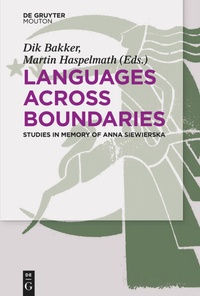
Languages Across Boundaries
Description

This book is dedicated to Anna Siewierska, who died, far too young, in 2011. It contains 15 contributions by 20 linguists who may be counted among the foremost scholars in the field of linguistic typology. All of these articles discuss a topic that is prominent in Anna's work, whose journal articles and monographs on the passive, on word order, and on the category of person are standard literature in these respective fields. Mindful of Anna's last monograph, Person, the majority of the contributions in this volume discuss free and bound person forms, argument indexing, reference tracking systems, impersonals, and related issues, such as suppletion and incompleteness in person paradigms, the origin of referential systems, dependent versus independent marking, and referential hierarchies. Other topics are grammatical alignment, grammatical voice, ditransitives, and word order. Most of the contributions take a broad, typological perspective. Others give a more in depth treatment, based on data from a specific language, notably Spanish, Russian, Mandinka, and Mohawk. The book contains a complete bibliography of Anna Siewierska's linguistic production.
Reviews / Votes
"In all, the contributions to this volume do much to advance the field of typology. I believe any typologist would be remiss not to have this book on their shelf, especially given its reasonable price. I strongly recommend this book to anyone with an interest in person or typology, and I suspect that it will soon become an important and much-referenced book in the field."Malgorzata Cavar, Sara Couture in: Linguist List 26.542More details
Other editions
Additional editions
Content
2 - Contributors [Seite 11]
3 - Bibliography of Anna Siewierska [Seite 12]
4 - Person by other means [Seite 21]
5 - Patterns of alignment in verb agreement [Seite 35]
6 - Human themes in Spanish ditransitive constructions [Seite 57]
7 - The generic use of the second person singular pronoun in Mandinka [Seite 73]
8 - The referential hierarchy: reviewing the evidence in diachronic perspective [Seite 89]
9 - Agreement as anaphora, anaphora as coreference [Seite 115]
10 - Towards a distributional typology of human impersonal pronouns, based on data from European languages [Seite 139]
11 - Partial coreference [Seite 179]
12 - Argument indexing: a conceptual framework for the syntactic status of bound person forms [Seite 217]
13 - Peculiarities and origins of the Russian referential system [Seite 247]
14 - Alignment preferences in basic and derived ditransitives [Seite 283]
15 - Prosody and independence: free and bound person marking [Seite 311]
16 - The origin and evolution of case-suppletive pronouns: Eurasian evidence [Seite 333]
17 - Suppletion in person forms: the role of iconicity and frequency [Seite 367]
18 - Index [Seite 417]
