

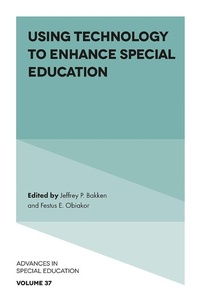
Using Technology to Enhance Special Education
Published on 2. February 2023
272 pages
978-1-80262-651-3 (ISBN)
Description

Using Technology to Enhance Special Education, Volume 37 of Advances in Special Education, is a logically, thoughtfully organized, and well-sequenced text. It focuses on how general and special educators can use technology to work with children and youth with disabilities.
This cutting-edge book involves researchers, scholars, educators, and leaders who are knowledge producers in the field. It is written to respond to today's changing world where technology has become a very powerful force. As it stands, the world is getting smaller and smaller; and what is happening in a location quickly becomes known everywhere. For example, during the tense periods of the global COVID pandemic, technology became the livewire of our world. This book begins with an introduction to technology and students with disabilities; and the remaining chapters focus on the role of technology in the education of students with learning disabilities, emotional and/or behavioral disorders, and intellectual disabilities, autism spectrum disorders, physical and health impairments, hearing impairments/deafness, visual impairments, and traumatic brain injuries.
In addition, some chapters focus on the role of technology in achieving equitable and inclusive education, building culturally and linguistically responsive general and special education, and creatively using digital comics to improve written narratives. In the end, this book concludes with a chapter that forward looking ways to infuse technology in special education. We feel that this volume is an excellent resource for special education researchers, scholars, practitioners, and professionals who teach and serve students with disabilities.
This cutting-edge book involves researchers, scholars, educators, and leaders who are knowledge producers in the field. It is written to respond to today's changing world where technology has become a very powerful force. As it stands, the world is getting smaller and smaller; and what is happening in a location quickly becomes known everywhere. For example, during the tense periods of the global COVID pandemic, technology became the livewire of our world. This book begins with an introduction to technology and students with disabilities; and the remaining chapters focus on the role of technology in the education of students with learning disabilities, emotional and/or behavioral disorders, and intellectual disabilities, autism spectrum disorders, physical and health impairments, hearing impairments/deafness, visual impairments, and traumatic brain injuries.
In addition, some chapters focus on the role of technology in achieving equitable and inclusive education, building culturally and linguistically responsive general and special education, and creatively using digital comics to improve written narratives. In the end, this book concludes with a chapter that forward looking ways to infuse technology in special education. We feel that this volume is an excellent resource for special education researchers, scholars, practitioners, and professionals who teach and serve students with disabilities.
More details
Series
Language
English
Place of publication
Bingley
United Kingdom
Target group
Professional and scholarly
File size
4,17 MB
ISBN-13
978-1-80262-651-3 (9781802626513)
Copyright in bibliographic data and cover images is held by Nielsen Book Services Limited or by the publishers or by their respective licensors: all rights reserved.
Schweitzer Classification
Other editions
Additional editions
Jeffrey P. Bakken | Festus E. Obiakor
Using Technology to Enhance Special Education
Book
02/2023
Emerald Publishing Limited
€155.00
Shipment within 3-4 weeks
Persons
Jeffrey P. Bakken, is Professor of Special Education at Bradley University.
Festus E. Obiakor, Ph.D., is the Chief Executive Manager, Sunny Educational Consulting, Shorewood, Wisconsin.
Festus E. Obiakor, Ph.D., is the Chief Executive Manager, Sunny Educational Consulting, Shorewood, Wisconsin.
Content
Chapter 1. Using Technology to Enhance Special Education: An Introduction; Erik A. Dalmasso, Jeffrey P. Bakken, L. Scott Estes, and Quentin M. Wherfel
Chapter 2. Using Technology to Enhance Learning for Students with Learning Disabilities; Alicia Schmeisser and Carrie Anna Courtad
Chapter 3. Research on Using Technology for Students with Emotional and/or Behavioral Disorders: Cruel Optimism or Meaningful Progress?; Frederick J. Brigham, Christopher Claude, John William McKenna, and Larissa Lemp
Chapter 4. Using Technology to Enhance Learning for Students with Intellectual Disabilities; Emily C. Bouck, Holly Long, and Larissa Jakubow
Chapter 5. Using Technology to Enhance Learning for Students who are Deaf /Hard of Hearing; Angi Martin and Julie Cox
Chapter 6. Using Technology to Enhance Learning for Students with Visually Impairments; Stacy M. Kelly
Chapter 7. Using Technology to Enhance Learning for Students with Autism Spectrum Disorders; Shannon Stuart and Kris Van Handel
Chapter 8. Using Technology to Enhance Learning for Students with Extensive Support Needs; Robert C. Pennington, Monique Pinczynski, and Kathryn Davis
Chapter 9. Using Technology to Enhance Learning for Students with Traumatic Brain Injuries; Quentin M. Wherfel and Jeffrey P. Bakken
Chapter 10. Using Digital Comic Creation to Improve Adolescents' Written Narratives; Ginger G. Collins and Stephanie F. Reid
Chapter 11. Technology as a Bridge to Co-Create Inclusive and Equitable Learning Environments for Students with Intersectional Identities; Cristina Santamaria Graff, Jeremy F. Price, and M. Nickie Coomer
Chapter 12. Using Technology to Enhance Learning for Students from Culturally and Linguistically Diverse Backgrounds; Lenwood Gibson, Festus E. Obiakor, and Sunday Obi
Chapter 13. Using Technology to Enhance Learning for Students with Physical Disabilities and Other Health Impairments; Eugene Asola, Matthew Grant, and Samuel Hodge
Chapter 14. Using Technology to Enhance Learning in Special Education: Moving Forward; Sunday Obi, Festus E. Obiakor, Lenwood Gibson, Kristen E. Obiakor, and Nkechi Amadife
Chapter 2. Using Technology to Enhance Learning for Students with Learning Disabilities; Alicia Schmeisser and Carrie Anna Courtad
Chapter 3. Research on Using Technology for Students with Emotional and/or Behavioral Disorders: Cruel Optimism or Meaningful Progress?; Frederick J. Brigham, Christopher Claude, John William McKenna, and Larissa Lemp
Chapter 4. Using Technology to Enhance Learning for Students with Intellectual Disabilities; Emily C. Bouck, Holly Long, and Larissa Jakubow
Chapter 5. Using Technology to Enhance Learning for Students who are Deaf /Hard of Hearing; Angi Martin and Julie Cox
Chapter 6. Using Technology to Enhance Learning for Students with Visually Impairments; Stacy M. Kelly
Chapter 7. Using Technology to Enhance Learning for Students with Autism Spectrum Disorders; Shannon Stuart and Kris Van Handel
Chapter 8. Using Technology to Enhance Learning for Students with Extensive Support Needs; Robert C. Pennington, Monique Pinczynski, and Kathryn Davis
Chapter 9. Using Technology to Enhance Learning for Students with Traumatic Brain Injuries; Quentin M. Wherfel and Jeffrey P. Bakken
Chapter 10. Using Digital Comic Creation to Improve Adolescents' Written Narratives; Ginger G. Collins and Stephanie F. Reid
Chapter 11. Technology as a Bridge to Co-Create Inclusive and Equitable Learning Environments for Students with Intersectional Identities; Cristina Santamaria Graff, Jeremy F. Price, and M. Nickie Coomer
Chapter 12. Using Technology to Enhance Learning for Students from Culturally and Linguistically Diverse Backgrounds; Lenwood Gibson, Festus E. Obiakor, and Sunday Obi
Chapter 13. Using Technology to Enhance Learning for Students with Physical Disabilities and Other Health Impairments; Eugene Asola, Matthew Grant, and Samuel Hodge
Chapter 14. Using Technology to Enhance Learning in Special Education: Moving Forward; Sunday Obi, Festus E. Obiakor, Lenwood Gibson, Kristen E. Obiakor, and Nkechi Amadife
