

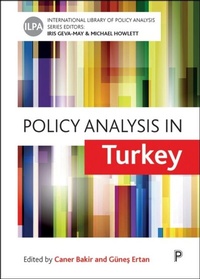
Policy Analysis in Turkey
1st Edition
Published on 6. June 2018
320 pages
978-1-4473-3896-3 (ISBN)
Description

This volume provides the first comprehensive overview of the state of policy analysis in Turkey for an international audience. Noting Turkey's traditionally strong, highly centralised state, the book documents the evolution of policy analysis in the country, providing an in-depth review of the context, constraints, and dominant modes of policy analysis performed by both state and non-state actors.
The book examines the role of committees, experts, international actors, bureaucrats as well as public opinion in shaping policy analysis in the country through their varying ideas, interests and resources. In doing so, it presents the complex decision-making mechanisms that vary significantly among policy-making actors and institutions, documenting the key, yet unexamined, aspects of policy analysis in Turkey.
It will be a valuable resource for those studying policy analysis within Turkey and as a comparison with other volumes in the International Library of Policy Analysis Series.
The book examines the role of committees, experts, international actors, bureaucrats as well as public opinion in shaping policy analysis in the country through their varying ideas, interests and resources. In doing so, it presents the complex decision-making mechanisms that vary significantly among policy-making actors and institutions, documenting the key, yet unexamined, aspects of policy analysis in Turkey.
It will be a valuable resource for those studying policy analysis within Turkey and as a comparison with other volumes in the International Library of Policy Analysis Series.
More details
Other editions
Additional editions
Caner Bakir | Guene? Ertan
Policy Analysis in Turkey
Book
06/2018
1st Edition
Policy Press
€140.70
Shipment within 15-20 days
Persons
Editor
Koç University, Istanbul
Dr. Caner Bakir is Associate Professor of Political Science, with a special focus on International and Comparative Political Economy, and Public Policy and Administration at Koc University, Istanbul. He is co-director of Centre for Globalisation, Peace and Democratic Governance.
Dr. Caner Bakir is Associate Professor of Political Science, with a special focus on International and Comparative Political Economy, and Public Policy and Administration at Koc University, Istanbul. He is co-director of Centre for Globalisation, Peace and Democratic Governance.
Koç University, Istanbul
Dr. Gunes Ertan is an Assistant Professor of International Affairs at Koç University. She received her Ph.D. from Graduate School of Public and International Affairs at University of Pittsburgh in 2013 with a specialization on Public Policy.
Dr. Gunes Ertan is an Assistant Professor of International Affairs at Koç University. She received her Ph.D. from Graduate School of Public and International Affairs at University of Pittsburgh in 2013 with a specialization on Public Policy.
Contributions
Koç University, Istanbul
Dr. Gunes Ertan is an Assistant Professor of International Affairs at Koç University. She received her Ph.D. from Graduate School of Public and International Affairs at University of Pittsburgh in 2013 with a specialization on Public Policy.
Dr. Gunes Ertan is an Assistant Professor of International Affairs at Koç University. She received her Ph.D. from Graduate School of Public and International Affairs at University of Pittsburgh in 2013 with a specialization on Public Policy.
Content
Introduction: Pushing the pendulum from politics to policy: the state of policy analysis in Turkey - Caner Bakir and Günes Ertan;
Part I: Historical roots, styles and methods of policy analysis in Turkey;
The past, present, and future of policy analysis in Turkey ~ Akif Argun Akdogan, Göktug Morçöl, Gökhan Orhan and Mete Yildiz;
Boomerang effect: The bottleneck of public policy analysis in Turkey ~ Akif Argun Akdogan;
Methods of policy analysis: The US and Turkish cases ~ Hüseyin Gül and Muhittin Acar;
Part II: Policy analysis by governments;
Policy analysis in Turkey's central government: current practices and future challenges ~ Ugur Sadioglu;
Territorial policy-making and administrative reform in Turkey ~ Can Umut Çiner;
Policy-making at local level: An analysis of Turkish municipalities ~ Ulas Bayraktar;
Part III: Experts, international actors, and public opinion;
Beyond developmentalism: The role of experts and expertise in Turkey's environmental policy disputes ~ Gökhan Orhan;
Europeanisation of policy-making in Turkey and its limits ~ H. Tolga Bölükbasi, Ebru Ertugal and Saime Özçürümez;
Public opinion and public policy in Turkey ~ Sedef Turper;
Part IV: Parties and civil society-based policy analysis;
Political parties and public policy in Turkey ~ Selem Erdem Aytaç;
Policy analysis in civil society organisations ~ Günes Ertan;
Part V: Academic, bureaucratic and advocacy-based policy analysis;
Policy analysis in the Central Bank of Turkey ~ Caner Bakir and Mehmet Kerem Çoban;
Think tanks and policy analysis in Turkey ~ Göktug Morçöl, Özer Köseoglu, Zahid Sobaci and Ömer Faruk Koktas;
Public policy and media in Turkey ~ Basak Yavcan and Hakan Övünç Ongur;
Public policy education in Turkey ~ Mete Yildiz and Cenay Babaoglu.
Part I: Historical roots, styles and methods of policy analysis in Turkey;
The past, present, and future of policy analysis in Turkey ~ Akif Argun Akdogan, Göktug Morçöl, Gökhan Orhan and Mete Yildiz;
Boomerang effect: The bottleneck of public policy analysis in Turkey ~ Akif Argun Akdogan;
Methods of policy analysis: The US and Turkish cases ~ Hüseyin Gül and Muhittin Acar;
Part II: Policy analysis by governments;
Policy analysis in Turkey's central government: current practices and future challenges ~ Ugur Sadioglu;
Territorial policy-making and administrative reform in Turkey ~ Can Umut Çiner;
Policy-making at local level: An analysis of Turkish municipalities ~ Ulas Bayraktar;
Part III: Experts, international actors, and public opinion;
Beyond developmentalism: The role of experts and expertise in Turkey's environmental policy disputes ~ Gökhan Orhan;
Europeanisation of policy-making in Turkey and its limits ~ H. Tolga Bölükbasi, Ebru Ertugal and Saime Özçürümez;
Public opinion and public policy in Turkey ~ Sedef Turper;
Part IV: Parties and civil society-based policy analysis;
Political parties and public policy in Turkey ~ Selem Erdem Aytaç;
Policy analysis in civil society organisations ~ Günes Ertan;
Part V: Academic, bureaucratic and advocacy-based policy analysis;
Policy analysis in the Central Bank of Turkey ~ Caner Bakir and Mehmet Kerem Çoban;
Think tanks and policy analysis in Turkey ~ Göktug Morçöl, Özer Köseoglu, Zahid Sobaci and Ömer Faruk Koktas;
Public policy and media in Turkey ~ Basak Yavcan and Hakan Övünç Ongur;
Public policy education in Turkey ~ Mete Yildiz and Cenay Babaoglu.
