

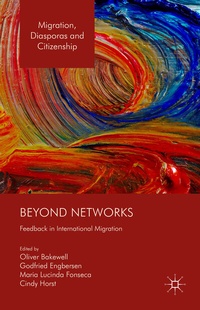
Beyond Networks
Description

Reviews / Votes
"Beyond Network anthology adds to migration scholarship a much overlooked aspect, which is an exploration of feedback mechanisms that operate to create links across time and space. . This volume provides a great entry point for anyone interested in doing research based on migration feedback or migration in general. . This volume is highly recommended to students and scholars who are newly interested in media and migration studies and the ones who are interested in conducting mixed methods research projects." (Madhuri Prabhakar, Nordic Journal of Migration Research, Vol.8 (1), 2018)More details
Other editions
Additional editions

Persons
Godfried Engbersen is Professor of General Sociology at the Erasmus University of Rotterdam (EUR), the Netherlands. He is Research Director of the Sociology Department and Director of the research group Citizenship, Migration & the City (CIMIC) of the EUR. His current research activities focus on irregular migration, transnational citizenship, social inequality and labour migration from Central and Eastern Europe.
Maria Lucinda Fonseca is Full Professor of Human Geography and Migration Studies at the Institute of Geography and Spatial Planning (IGOT), Universidade de Lisboa, Portugal. She is also the coordinator of the Research Group MIGRARE - Migration, Spaces and Societies at the Centre for Geographical Studies (CEG) at the same institute.
Cindy Horst is Research Professor in Migration and Refugee Studies at the Peace Research Institute Oslo (PRIO), Norway. Her current research interests include: mobility in conflict; diaspora; humanitarianism; refugee protection; transnational civic engagement; and theorizing on social transformation. She is particularly interested in methodological innovations that allow for critical and ethical conscious research engagement, through shared anthropology and multi-sited ethnography.
Content
1. Introduction: Feedback in Migration Processes; Oliver Bakewell; Agnieszka Kubal; Sonia Pereira
2. Exploring twelve migration corridors: rationale, methodology, and overview; Jørgen Carling; Dominique Jolivet
3. New roles for social networks in migration? Assistance in Brazilian migration to Portugal and The Netherlands; Masja van Meeteren; Sonia Pereira
4. Online Feedback in Migration Networks; Rianne Dekker; Godfried Engbersen; Marije Faber
5. The impact of class on feedback mechanisms. Brazilian migration to Norway, Poland and the UK; Cindy Horst; Sonia Pereira; Olivia Sheringham
6. The economic crisis as a feedback generating mechanism? Brazilian and Ukrainian migration to Portugal; Maria Lucinda Fonseca; Alina Esteves; Jennifer McGarrigle
7. From bridgeheads to gate closers. How migrant networks contribute to declining migration from Morocco to the Netherlands; Erik Snel; Godfried Engbersen; Marije Faber
8. Making and breaking a chain: migrants' decisions about helping others migrate; Jørgen Carling
9. Broadcasting migration outcomes; Oliver Bakewell; Dominique Jolivet
10. Migration mechanisms of the middle range. On the concept of reverse cumulative causation; Godfried Engbersen; Erik Snel; Alina Esteves
11. Beyond networks: insights on feedback and mechanisms of the middle range; Godfried Engbersen; Erik Snel; Cindy Horst
