

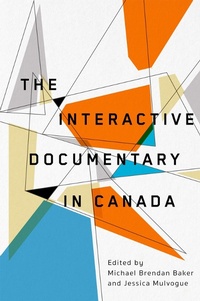
The Interactive Documentary in Canada
1st Edition
Published on 18. June 2024
371 pages
978-0-2280-2161-2 (ISBN)
Description

Interactive documentary emerged rapidly from a constellation of changing technologies and practices to much excitement, yet its history is short and its future uncertain. In the mid-2010s Canada was a world leader in the creation of i-docs. Less than a decade later technological obsolescence has rendered many of these celebrated projects inaccessible, while rapid digital innovation continues to change the i-doc form and its modes of experience.
The Interactive Documentary in Canada captures this transitional moment in documentary filmmaking and media production. Bringing together a range of historical, theoretical, and critical approaches, this collection examines the past - and the imagined future - of a nonfiction storytelling phenomenon that has Canadian institutions, figures, and works at its centre. Embracing a polyphonic conception of interactive documentary, the volume includes explorations of web-based, app-based, installation, and virtual reality works that push the boundaries of what is understood as documentary cinema. Leading documentary scholars and makers consider the historical and technological contexts of i-doc production, innovation, and exhibition; the political and pedagogical potential of the genre; the ethics of the i-doc experience; and the format's future lifespan in the contemporary media landscape.
The Interactive Documentary in Canada establishes a place for the i-doc in the history of Canadian film, highlighting the genre's significant impact on the National Film Board of Canada and on contemporary global documentary media.
The Interactive Documentary in Canada captures this transitional moment in documentary filmmaking and media production. Bringing together a range of historical, theoretical, and critical approaches, this collection examines the past - and the imagined future - of a nonfiction storytelling phenomenon that has Canadian institutions, figures, and works at its centre. Embracing a polyphonic conception of interactive documentary, the volume includes explorations of web-based, app-based, installation, and virtual reality works that push the boundaries of what is understood as documentary cinema. Leading documentary scholars and makers consider the historical and technological contexts of i-doc production, innovation, and exhibition; the political and pedagogical potential of the genre; the ethics of the i-doc experience; and the format's future lifespan in the contemporary media landscape.
The Interactive Documentary in Canada establishes a place for the i-doc in the history of Canadian film, highlighting the genre's significant impact on the National Film Board of Canada and on contemporary global documentary media.
Reviews / Votes
"Those things most recently outdated tell us much about our present. I-docs reflect their conditions of production: a moment of transition between media paradigms, the new one of which we are now just catching sight of. At stake is not only what these i-docs were but also how they changed our sense of what it means to interact. Baker and Mulvogue are doing a great service by creating a record of this receding moment in Canadian documentary media history; these essays are already an archive for the future." Jaimie Baron, University of California, BerkeleyMore details
Language
English
Place of publication
Montreal, QC
Canada
Target group
Professional and scholarly
Edition type
Digital original
Illustrations
19 photos
19 photos
File size
18,64 MB
ISBN-13
978-0-2280-2161-2 (9780228021612)
Copyright in bibliographic data and cover images is held by Nielsen Book Services Limited or by the publishers or by their respective licensors: all rights reserved.
Schweitzer Classification
Other editions
Additional editions
Michael Brendan Baker | Jessica Mulvogue
The Interactive Documentary in Canada
Book
06/2024
McGill-Queen's University Press
€37.50
Article not available at the moment
Michael Brendan Baker | Jessica Mulvogue
The Interactive Documentary in Canada
Book
06/2024
McGill-Queen's University Press
€135.41
Shipment within 15-20 days
Persons
Michael Brendan Baker is professor of film studies at Sheridan College.
Jessica Mulvogue is lecturer of film studies at the University of St. Andrews.
Jessica Mulvogue is lecturer of film studies at the University of St. Andrews.
Content
- Cover
- THE INTERACTIVE DOCUMENTARY IN CANADA
- Title
- Copyright
- Dedication
- CONTENTS
- Figures
- Acknowledgments
- Introduction - The Interactive Documentary in Canada
- Part 1 Technology, Innovation, Experimentation: Histories and Case Studies of I-Doc Production and Exhibition in Canada
- 1 The National Film Board of Canada's Digital Studio: An Oral History
- 2 Notes on Impact: The Case of the Interactive Documentary GDP
- 3 Fort McMoney: The Challenge of Maintaining Interactive Documentary
- 4 Viewfinders: Exploring Travelling and Landscapes via Augmented Reality
- 5 Always Already Old: Looking Back with the Korsakow System
- 6 I-Docs and Live Performance: Highrise: Universe Within at Hot Docs
- Part 2 Encounters with Others: Activism, Agency, and Ethics
- 7 Collaborative Encounters: I-Docs and Environmental Pedagogy in and beyond the Classroom
- 8 Thinking in Networks: The Interactive Documentary as a Tool for Social Change
- 9 Interactivity as Ethical Encounter in The Space We Hold
- 10 Fish Love: Digital Technology and Passivity in Nettie Wild's Uninterrupted
- 11 Playing with Extreme Oil: Slow Catastrophe and the Melancholic Imaginary in Offshore and Fort McMoney
- Part 3 Image and Sound beyond "the Real": Media Pasts, Presents, and Futures
- 12 Nostalgia, "Old" Media, and Welcome to Pine Point
- 13 Acoustic Profiling in Hogan's Alley: Mapping Intersectional Soundways in the Lost Vancouver Neighbourhood of Stan Douglas's ios app Circa 1948
- 14 A Journal of Insomnia: The Individualization of Sleep in a Wired World
- 15 Going Deep: Hybrid Capture in Documentary
- 16 Indigenous Futurism and the Immersive Worlding of Inherent Rights, Vision Rights, 2167, and Biidaaban: First Light
- Afterword - On the Outside Looking In: Perspective on the New Media Documentary in Canada
- Contributors
- Index
