

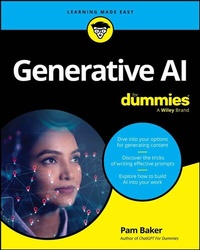
Generative AI For Dummies
Description

Generate a personal assistant with generative AI
Generative AI tools capable of creating text, images, and even ideas seemingly out of thin air have exploded in popularity and sophistication. This valuable technology can assist in authoring short and long-form content, producing audio and video, serving as a research assistant, and tons of other professional and personal tasks. Generative AI For Dummies is your roadmap to using the world of artificial intelligence to enhance your personal and professional lives. You'll learn how to identify the best platforms for your needs and write the prompts that coax out the content you want. Written by the best-selling author of ChatGPT For Dummies, this book is the ideal place to start when you're ready to fully dive into the world of generative AI.
- Discover the best generative AI tools and learn how to use them for writing, designing, and beyond
- Write strong AI prompts so you can generate valuable output and save time
- Create AI-generated audio, video, and imagery
- Incorporate AI into your everyday tasks for enhanced productivity
This book offers an easy-to-follow overview of the capabilities of generative AI and how to incorporate them into any job. It's perfect for anyone who wants to add AI know-how into their work.
More details
Other editions
Additional editions
Person
Pam Baker is an award-winning freelance journalist, analyst, and author. Her previous book, ChatGPT For Dummies, was one of the first how-to guides for effective use of the ChatGPT platform. She writes for several media outlets, including The New York Times, CNN, Ars Technica, InformationWeek, and CSO. Baker is also an instructor on GenAI for LinkedIn Learning.
Content
PART 1: DIVING INTO GENERATIVE AI FUNDAMENTALS 5
CHAPTER 1: Mapping the Lay of the Generative AI Land 7
CHAPTER 2: Introducing the Art of Prompt Engineering 23
CHAPTER 3: Collaborating Creatively with GenAI 35
CHAPTER 4: Navigating the Evolving Landscape of GenAI 49
CHAPTER 5: Applying GenAI in Practical Scenarios 63
PART 2: MASTERING CREATIVE CONTENT WITH GENERATIVE AI 75
CHAPTER 6: Manipulating the GenAI Model to Milk It for More or Better Content 77
CHAPTER 7: Producing Long-Form Content 97
CHAPTER 8: Customizing Content for Niche Topics 119
CHAPTER 9: Creating Short-Form Content 133
CHAPTER 10: Luring Images, Music, and Video Out of GenAI 157
CHAPTER 11: Speeding, Improving, and Checking Your and GenAI's Work 171
PART 3: EXPLORING ADVANCED GENAI MODELS AND TECHNIQUES 191
CHAPTER 12: Leaning on Advanced Tactics to Move Your Content to Another Level 193
CHAPTER 13: Delving into Specialized GenAI Tools 203
CHAPTER 14: Enhancing Creativity and Productivity with GenAI 217
PART 4: NAVIGATING THE INTERSECTION OF ETHICS, QUALITY, AND HUMANITY 239
CHAPTER 15: Upholding Responsible AI Standards in GenAI Use 241
CHAPTER 16: Unveiling the Human Element in GenAI 255
PART 5: THE PART OF TENS 267
CHAPTER 17: Ten Ways GenAI Can Boost Your Creativity 269
CHAPTER 18: Ten Tips for Advanced Prompting 277
INDEX 283
Chapter 1
Mapping the Lay of the Generative AI Land
IN THIS CHAPTER
Selecting the right GenAI model
Understanding GenAI capabilities
Creating with GenAI
Grasping its many uses
Conquering fears and piloting opportunities
Welcome to the exciting world of Generative AI (GenAI)! This chapter is your starting point in understanding the vast landscape of GenAI and its transformative capabilities. Whether you're a curious beginner or a tech enthusiast, you'll find the information here to be an accessible guide to the basics of GenAI. You can easily build on these skills through practice, regular use of an AI application, or by returning to this book from time to time to enhance your skills further.
So, What Exactly Is Generative AI?
You can think of AI (short for artificial intelligence) as incredibly sophisticated software. Although it doesn't behave like any other software ever made, it is still software. Illustrations depicting AI as robots reflect the difficulty in drawing AI software in a way everyone will instantly recognize. But the robot is actually mindless hardware, and the AI is the "smart" brain-mimicking software installed to enable it to function in ways we consider to be intelligent in a nonorganic sense.
Technically speaking, GenAI refers to a subset of artificial intelligence technologies that use sophisticated natural language processing (NLP), neural networks, and machine learning (ML) models to generate unique and humanlike content. It belongs to a classification of AI called Large Language Models (LLMs), which analyze huge amounts of data in numerous languages including human languages, computer code, math equations, and images.
LLMs typically have a substantial number of parameters, which are numerical values used to assign weight and define connections between nodes and layers in the neural network architecture. Parameters can be adjusted to change the weights of various values, which in turn, changes what the model prioritizes in the prompt and data and how it interprets various data points, words, and connections.
Imagine you have a recipe for making a cake, and the recipe is your GenAI model. The ingredients - like flour, sugar, eggs, and butter - are like the data points, words, and connections in the model. Now, the amount of each ingredient you use (how many cups of flour, how much sugar, and so on) are like the weights of various values in the GenAI model or GenAI application.
Just as you might adjust the ingredients in your cake to make it sweeter or fluffier by adding more sugar or an extra egg, you can adjust the parameters in a GenAI model to change what it focuses on and how it interprets the information it's given. If you want your GenAI to pay more attention to certain words or data points, you increase their weight just like adding more chocolate chips to your cake if you want it to be extra chocolatey. This way, the GenAI model, like your cake, turns out the way you want it to, based on what you prioritize in the recipe.
LLMs use parameters to predict the next word in a sequence - meaning they predict the word most likely to follow the words in your prompt, and then the word that most likely follows its first predicted word, and so on until the model believes it has finished the most probable pattern. It generates images in much the same way by predicting the image that follows your description in the prompt. The models can complete the process incredibly quickly. For example, LLMs like GPT-3 and GPT-4o developed by OpenAI are capable of processing billions of words per second. It is the speed of its response, the appearance of nuanced understanding, and its fluid use of natural language that gives GenAI interactions a humanlike feel.
However, GenAI and LLMs are not human and do not think - again, they predict. It's a very complicated prediction process, to be sure. Nonetheless, it is a prediction. And if anything happens to tilt its predictive capabilities, nonsense ensues. You can see one example of that in Figure 1-1, which is an OpenAI incident report about an adjustment they made to the model resulting in ChatGPT responding to users in incomprehensible gibberish.
Source: OpenAI incident report
FIGURE 1-1: A routine effort to optimize ChatGPT resulted in its producing gibberish in response to users' prompts.
GenAI VERSUS VIRTUAL ASSISTANTS
AI models and applications are the software driving the robot or the autonomous car or whatever form it's given in the corporeal world. But strictly speaking, AI has a digital form. Because of that, it can be squeezed into almost anything, and many a vendor does exactly that. You'll find various types of AI are embedded or otherwise at use in all sorts of products and services. However, not all AI is the same.
Here are the main differences between GenAI apps like ChatGPT and virtual assistants like Siri, Alexa, and Google Assistant.
Virtual assistants:
- This class of AI runs on a proprietary mix of technologies in a blend developed by their respective corporate owners. Certain components, such as machine learning, deep learning, natural language processing, smart search or search engines, and speech synthesis make the assistants appear and sound much like ChatGPT.
- However, their responses are more limited than GenAI models. People typically use these to retrieve answers to common questions or perform uncomplicated tasks like "where is the nearest pharmacy?" or "play a song by Taylor Swift" rather than to generate original answers.
GenAI models (specifically ChatGPT in this comparison):
- This class of AI runs on a single AI model, meaning on one version or another of Generative Pre-trained Transformers (GPT) AI models. GenAI is a broad category of AI that includes models capable of varying capabilities such as generating text, images, or computer code or some combination of these.
- People typically use GenAI web apps, but some mobile apps and a few wearable devices are available as well. But in all cases, the apps run on a single GenAI model.
Unveiling the BIG Secret to Working Successfully with GenAI
If you remember nothing else I've written in this book, you must remember what I tell you in this section. For here is the big secret - the master key - that you need to make GenAI models work at the level you need them to perform. If you don't grasp this, GenAI will likely appear to you to be nothing more than a fascinating toy or a tool that falls far too short of your expectations.
In a nutshell, GenAI generates outputs that appear to be original thoughts or images from a computer, rather than results produced by very advanced, contextual predictive software. GenAI retrieves words or images pulled from a database and repurposes them into a new response. The big secret is that the humanlike feel in the "conversation" is an illusion. You are not having a conversation with a machine. It doesn't understand a word you wrote in your prompt.
Current GenAI models don't think or create things per se, but instead generate new things from parts of old things found in its database. (The term "things" in this context being images, videos, numbers, or text, depending on the GenAI application you are using.) A GenAI output is the model's best prediction of what you are seeking. In an oversimplified explanation of a complex technology, GenAI seeks to complete a pattern that you began with your prompt, which is your question or command as entered into the prompt bar on the GenAI's user interface (UI). In other words, GenAI predicts what letters, words, or images are likely to follow those that are in your prompt. Its predictions are based upon comparison to patterns that exist within its training dataset and/or datasets to which it was subsequently given access.
Think of GenAI outputs as the result of repurposing or remixing information that the model has access to in datasets, including the following:
- Data it is exposed to in its training database along with any additional data provided in subsequent fine-tuning.
- Data added in system messages or prompts.
-
Data added via methods such as retrieval-augmented generation (RAG), which is a tactic to enhance accuracy, relevancy, and reliability by adding external sources to the GenAI's database.
RAG combines the strengths of both information retrieval AI, which is a set of algorithms that retrieve contextually relevant information from huge datasets, and GenAI, which uses neural networks and machine learning models to generate new content. It might help to think of RAG as GenAI that is augmented by more traditional information retrieval AI, or retrieval AI for short.
Since GenAI generates outputs that are the result of its remixing or repurposing of information, it has no concept of true or false, fact or fiction. GenAI can accurately define these terms, but it does not understand their meaning. It doesn't understand anything you wrote in the prompt or that it wrote in its response. It only appears to understand terms and concepts. This is an illusion. This is why you must always factcheck its work.
GenAI responses are limited to the confines...
