

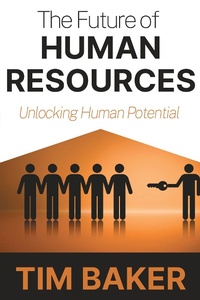
The Future of Human Resources
Description

Warp speed change is now a constant. What do organizations need to do to maximize the potential of their employees in the new reality?
The tired cliché that employees are our greatest asset is false. It's unlocking the potential of employees that's the greatest asset.
THE FUTURE OF HUMAN RESOURCES confronts the conventional employment practices of selecting, inducting, developing, rewarding, and exiting employees. This book is a comprehensive blueprint for HR professionals to make the necessary changes to accommodate a new mentality.
Thirteen traditional practices are challenged, and fresh, practical pathways offered. Dr. Tim Baker, according to leadership guru, Marshall Goldsmith, is "one of today's most influential HR experts." He offers new insights about what's still considered conventional wisdom, such as employee induction, the job description, and succession planning.
THE FUTURE OF HUMAN RESOURCES provides you with a roadmap to navigate the post-Covid world of work.
More details
Other editions
Additional editions
Person
Dr. Tim Baker is a thought leader, international consultant, and successful author. He was recently voted one of The Most Talented Global Training & Development Leaders by the World HRD Congress, which is awarded by a distinguished international panel of professionals "who are doing extraordinary work" in the field of HRD. In 2018, Tim was a Finalist in the Learning Professional of the Year for the Asia Pacific Institute of Learning Professionals Awards. His consulting firm WINNERS-at-WORK Pty Ltd was listed in the Top 10 Change Management Consulting Service Companies in APAC 2020 (HR Tech Outlook).
Content
- Cover
- Halftitle
- Title
- Copyright
- Dedication
- Description
- Contents
- Testimonials
- Acknowledgments
- Introduction
- Part 1: Employee-Centered Approach
- Chapter 1: The Changing World of Work
- Chapter 2: A World Without Work?
- Chapter 3: Employee Purpose, Potential, and Perspective
- Chapter 4: The Employee Lifecycle Framework
- Chapter 5: The Big HR Mindset Shifts
- Part 2: Starting Phase of Employment
- Chapter 6: Shift 1: Past Performance to Future Potential
- Chapter 7: Shift 2: Induction to Integration
- Chapter 8: Shift 3: Onsite to Hybrid Working
- Chapter 9: Shift 4: Them and Us to Collaboration
- Part 3: Developing Phase of Employment
- Chapter 10: Shift 5: Training to Multidimensional Learning
- Chapter 11: Shift 6: Job to Nonjob Roles
- Chapter 12: Shift 7: Job Description to Role Description
- Chapter 13: Shift 8: Job Design to Job Redesign
- Chapter 14: Shift 9: Competition to Partnership
- Part 4: Rewarding Phase of Employment
- Chapter 15: Shift 10: Technical Knowhow to People Leadership
- Chapter 16: Shift 11: Appraising to Developing Performance
- Chapter 17: Shift 12: Carrot and Stick to Human Spirit and Work
- Part 5: Parting Phase of Employment
- Chapter 18: Shift 13: Exit Interviews to Building Networks
- Action Plan
- Notes
- References
- About the Author
- Index
- Adpage
- Backcover
