

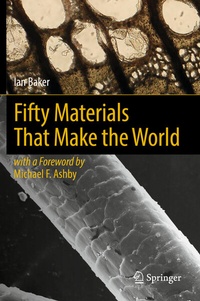
Fifty Materials That Make the World
Description

This book introduces materials and how advances in materials result in advances in technology and our daily lives. Each chapter covers a particular material, how the material was discovered or invented, when it was first used, how this material has impacted the world, what makes the material important, how it is used today, and future applications. The list of materials covered in this book includes stone, wood, natural fibers, metals, clay, lead, iron, steel, silicon, glass, rubber, composites, polyethylene, rare earth magnet, and alloys.
Reviews / Votes
"This fascinating and useful book, aimed at a wide readership, adopts the point of view that human civilization has been materials-based throughout its history. . Readers with a basic (high school level) understanding of chemistry or physics can easily grasp the material. . the selection of 50 solid materials is quite thorough; readers will be hard pressed to name solid materials important to human history that were omitted. Summing Up: Recommended. All levels." (J. Lambropoulos, Choice, Vol. 56 (5), January, 2019)More details
Other editions
Additional editions
Person
Ian Baker is a Professor of Engineering at Dartmouth College. His research interests include mechanical behavior of metallic alloys, magnetic materials, ice and snow, phase transformations, electron microscopy, and x-ray techniques.
