

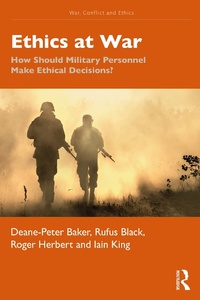
Ethics at War
How Should Military Personnel Make Ethical Decisions?
1st Edition
Published on 20. December 2023
174 pages
978-1-003-83025-2 (ISBN)
Description

This book debates competing approaches to ethical decision-making for members of the armed forces of liberal democratic states.
In this volume, four prominent thinkers propose and debate competing approaches to ethical decision-making for military personnel. Deane-Peter Baker presents and expounds the 'Ethical Triangulation' model, an ethical decision-making method he has employed through much of his career as an applied military ethicist. Rufus Black advocates for a natural law-based approach, one which has heavily influenced the framework formally adopted by the Australian Defence Force. Roger Herbert outlines the 'Moral Deliberation Roadmap', the moral reasoning framework recently adopted by the US Naval Academy. Iain King then sets out a model of quasi-utilitarian decision-making developed in several post-conflict settings and refined at the UK's Royal College of Defence Studies. After the opening chapters in which each author outlines their favoured decision-making approach, the four contributors then evaluate each other's proposals, often critically. Philosopher David Whetham offers some concluding thoughts in which he summarizes areas of agreement between the authors, identifies key areas of difference, and suggests directions for future research.
This book will be of great interest to students of military ethics, the ethics of war, moral philosophy, and International Relations, as well as military professionals.
In this volume, four prominent thinkers propose and debate competing approaches to ethical decision-making for military personnel. Deane-Peter Baker presents and expounds the 'Ethical Triangulation' model, an ethical decision-making method he has employed through much of his career as an applied military ethicist. Rufus Black advocates for a natural law-based approach, one which has heavily influenced the framework formally adopted by the Australian Defence Force. Roger Herbert outlines the 'Moral Deliberation Roadmap', the moral reasoning framework recently adopted by the US Naval Academy. Iain King then sets out a model of quasi-utilitarian decision-making developed in several post-conflict settings and refined at the UK's Royal College of Defence Studies. After the opening chapters in which each author outlines their favoured decision-making approach, the four contributors then evaluate each other's proposals, often critically. Philosopher David Whetham offers some concluding thoughts in which he summarizes areas of agreement between the authors, identifies key areas of difference, and suggests directions for future research.
This book will be of great interest to students of military ethics, the ethics of war, moral philosophy, and International Relations, as well as military professionals.
Reviews / Votes
'How best to teach ethics to our military? This volume explores four intriguing possibilities, and places them in dialogue with each other. A must read for anyone trying to implement a successful military ethics program.'Martin L. Cook, Admiral Stockdale Chair of Professional Military Ethics (Emeritus), US Naval War College
'Internationally-renowned military educators, literally drawn from the four corners of the globe, provide distinct, compelling, competing, but ultimately compatible views of military ethics drawn from a reservoir of shared experiences. Fascinating, engaging, and more than worthy of a close study.'
George R. Lucas, Jr., Senior Consultant, Geneva Center for Security Sector Governance, Distinguished Chair of Ethics, U.S. Naval Academy Emeritus, and Professor of Ethics & Public Policy, U.S. Naval Postgraduate School Emeritus
'We all strive to do the "right thing" in our lives but making the right decisions in stressful situations is often fraught with moral hazards. Fortunately, the approaches in this book help clarify even the murkiest of ethical dilemmas. A "must read" for decision makers, not just the military.'
Major General (Ret'd) Craig Lawrence CBE, Formerly the UK's Director of Joint Warfare and author of The Quick Guide to Effective Strategy
'An important contribution that will be of immediate interest to both specialists and more general readers. Accessible, informed and perceptive.'
Jason Burke, International Security Correspondent of The Guardian, and author
'This is, by far, the best book on this vital topic.'
Lieutenant General Sameer Al Akabi, General Secretary to the Chief of Defence, Iraq
More details
Series
Edition
1. Auflage
Language
English
Place of publication
London
United Kingdom
Publishing group
Taylor & Francis Ebooks
Target group
College/higher education
Professional and scholarly
Illustrations
2 Line drawings, black and white; 2 Illustrations, black and white
ISBN-13
978-1-003-83025-2 (9781003830252)
Copyright in bibliographic data and cover images is held by Nielsen Book Services Limited or by the publishers or by their respective licensors: all rights reserved.
Schweitzer Classification
Other editions
Additional editions
Deane-Peter Baker | Rufus Black | Roger Herbert
Ethics at War
How Should Military Personnel Make Ethical Decisions?
Book
12/2023
1st Edition
Routledge
€207.20
Shipment within 10-20 days
Deane-Peter Baker | Rufus Black | Roger Herbert
Ethics at War
How Should Military Personnel Make Ethical Decisions?
Book
12/2023
1st Edition
Routledge
€62.80
Shipment within 10-20 days
Persons
Deane-Peter Baker is Associate Professor in the School of Humanities and Social Sciences at the University of New South Wales, Canberra. He is Director of the UNSW Military Ethics Research Lab and Innovation Network (MERLIN) and a co-convenor (with Professor David Kilcullen) of the UNSW Canberra Future Operations Research Group.
Rufus Black is Vice Chancellor and President of the University of Tasmania. He has held a range of senior executive, academic, board, and advisory roles in the public, private, and education sectors in Australia including conducting major reviews for the Australian government on Defence and Security matters.
Roger Herbert, following a 26-year career as a US Naval Special Warfare Officer, joined the faculty of the US Naval Academy, where he served until 2021 as the Robert T. Herres Distinguished Military Professor of Ethics and Director of the USNA's core ethics course.
Iain King is an author and defence expert with an extensive background in both ethics and conflict work; most recently he worked as Director of NATO's Mission in Iraq. He led the UK's government research programme into conflict and was a Fellow at the US-based think tank, the Center for Strategic and International Studies (CSIS), as well as being an in-studio commentator for CNN and BBC.
Rufus Black is Vice Chancellor and President of the University of Tasmania. He has held a range of senior executive, academic, board, and advisory roles in the public, private, and education sectors in Australia including conducting major reviews for the Australian government on Defence and Security matters.
Roger Herbert, following a 26-year career as a US Naval Special Warfare Officer, joined the faculty of the US Naval Academy, where he served until 2021 as the Robert T. Herres Distinguished Military Professor of Ethics and Director of the USNA's core ethics course.
Iain King is an author and defence expert with an extensive background in both ethics and conflict work; most recently he worked as Director of NATO's Mission in Iraq. He led the UK's government research programme into conflict and was a Fellow at the US-based think tank, the Center for Strategic and International Studies (CSIS), as well as being an in-studio commentator for CNN and BBC.
Content
1. Introduction Part I: Theory 2. The Ethical Triangulation Model 3. The Moral Deliberation Roadmap: The US Naval Academy's Moral Reasoning Framework 4. The Quasi-Utilitarian Approach to Decision-Making in War 5. A Natural Law Basis for Military Ethics Part II: Analysis and Critique 6. Baker Response 7. Herbert Response 8. King Response 9. Black Response Afterword. A Concluding Reflection on Military Ethical Decision-Making
