

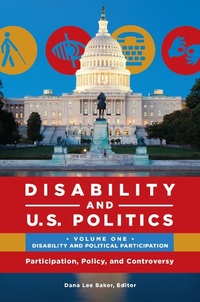
Disability and U.S. Politics
Participation, Policy, and Controversy [2 Volumes]
1st Edition
Published on 16. January 2017
576 pages
979-8-216-07482-3 (ISBN)
Description

More than 1 billion people worldwide have a disability, and they are all affected by politics. This two-volume work explores key topics at the heart of disability policy, such as voting, race, gender, age, health care, social security, transportation, abuse, and the environment.
Disability policy is no longer an area that can be adequately addressed within major areas of public policy such as welfare, health, labor, and education. Disability has become widely acknowledged in recent decades, partly because of the increasing number of disabled citizens across all demographic populations. Advocates argue that diversity of all kinds deserves recognition and accommodation. This set examines policies targeting disability to provide a multifaceted description of the political participation of people with disabilities as well as disability policy development in the United States. The first volume focuses on political participation and voting issues, and the second volume covers disability public policy.
In these two volumes, numerous scholars and experts in the social sciences and humanities explore timely topics that are key to disability policy questions, including activism, voting, race, gender, age, health care, social security, civil rights, abuse, the environment, and even death. Readers will better understand the challenges that policymakers face in grappling with controversies over issues of social engineering and public policy, often attempting to reconcile majority experience with minority rights. The chapters analyze the history of disability politics, describe the disability policy infrastructure as it currently exists in the United States, and provide insight into current disability-related controversies.
Disability policy is no longer an area that can be adequately addressed within major areas of public policy such as welfare, health, labor, and education. Disability has become widely acknowledged in recent decades, partly because of the increasing number of disabled citizens across all demographic populations. Advocates argue that diversity of all kinds deserves recognition and accommodation. This set examines policies targeting disability to provide a multifaceted description of the political participation of people with disabilities as well as disability policy development in the United States. The first volume focuses on political participation and voting issues, and the second volume covers disability public policy.
In these two volumes, numerous scholars and experts in the social sciences and humanities explore timely topics that are key to disability policy questions, including activism, voting, race, gender, age, health care, social security, civil rights, abuse, the environment, and even death. Readers will better understand the challenges that policymakers face in grappling with controversies over issues of social engineering and public policy, often attempting to reconcile majority experience with minority rights. The chapters analyze the history of disability politics, describe the disability policy infrastructure as it currently exists in the United States, and provide insight into current disability-related controversies.
More details
Edition
1. Auflage
Language
English
Place of publication
New York
United States
Publishing group
Bloomsbury Publishing Plc
Target group
Interest Age: From 7 to 17 years
ISBN-13
979-8-216-07482-3 (9798216074823)
Copyright in bibliographic data and cover images is held by Nielsen Book Services Limited or by the publishers or by their respective licensors: all rights reserved.
Schweitzer Classification
Other editions
Additional editions
Book
01/2017
Praeger Publishers Inc
€184.21
Article exhausted; check different version
Person
Dana Lee Baker, PhD, is associate professor in the School of Politics, Philosophy, and Public Affairs at Washington State University.
Content
Acknowledgments
Volume 2: Disability Policy
Chapter One Introduction
Dana Lee Baker
Chapter Two The Americans with Disabilities Act and Its Case Law
Joice Chang
Chapter Three Getting There: Intersections of Identity and the Journey toward Accessible Transportation
Morsal Hashimee and Matthew B. Bentson-Royal
Chapter Four The Social Safety Net for Disabled Persons
Lael R. Keiser, Susan M. Miller, and JoyAnna S. Hopper
Chapter Five The History of Special Education in the United States
Aaron David Whelchel
Chapter Six Navigating with Disabilities in the U.S. Health Care System
Irina Kobzar, Davi Israel Kallman, and Whitney Ann Stefani
Chapter Seven Beyond Isolation: When Care Turns to Abuse
Geriann Bartz
Chapter Eight Do "Best Practices" Exist for Youth Who Have Autism Spectrum Disorder?
Laurie A. Drapela
Chapter Nine Adulthood and Disability: New Challenges and Unintended Consequences
Lacee Case and Brandon Leonard
Chapter Ten Preparing for the Worst: The Environment, Environmental Disaster, and Disability Policy
Audrey Anna Miller
Chapter Eleven Concluding Thoughts
Dana Lee Baker and Jubilee Belle Lawhead
About the Editor and Contributors
Index
Volume 2: Disability Policy
Chapter One Introduction
Dana Lee Baker
Chapter Two The Americans with Disabilities Act and Its Case Law
Joice Chang
Chapter Three Getting There: Intersections of Identity and the Journey toward Accessible Transportation
Morsal Hashimee and Matthew B. Bentson-Royal
Chapter Four The Social Safety Net for Disabled Persons
Lael R. Keiser, Susan M. Miller, and JoyAnna S. Hopper
Chapter Five The History of Special Education in the United States
Aaron David Whelchel
Chapter Six Navigating with Disabilities in the U.S. Health Care System
Irina Kobzar, Davi Israel Kallman, and Whitney Ann Stefani
Chapter Seven Beyond Isolation: When Care Turns to Abuse
Geriann Bartz
Chapter Eight Do "Best Practices" Exist for Youth Who Have Autism Spectrum Disorder?
Laurie A. Drapela
Chapter Nine Adulthood and Disability: New Challenges and Unintended Consequences
Lacee Case and Brandon Leonard
Chapter Ten Preparing for the Worst: The Environment, Environmental Disaster, and Disability Policy
Audrey Anna Miller
Chapter Eleven Concluding Thoughts
Dana Lee Baker and Jubilee Belle Lawhead
About the Editor and Contributors
Index
