

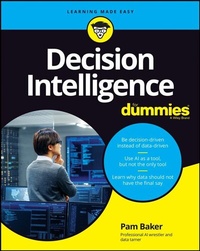
Decision Intelligence For Dummies
Description

Learn to use, and not be used by, data to make more insightful decisions
The availability of data and various forms of AI unlock countless possibilities for business decision makers. But what do you do when you feel pressured to cede your position in the decision-making process altogether?
Decision Intelligence For Dummies pumps the brakes on the growing trend to take human beings out of the decision loop and walks you through the best way to make data-informed but human-driven decisions. The book shows you how to achieve maximum flexibility by using every available resource, and not just raw data, to make the most insightful decisions possible.
In this timely book, you'll learn to:
- Make data a means to an end, rather than an end in itself, by expanding your decision-making inquiries
- Find a new path to solid decisions that includes, but isn't dominated, by quantitative data
- Measure the results of your new framework to prove its effectiveness and efficiency and expand it to a whole team or company
Perfect for business leaders in technology and finance, Decision Intelligence For Dummies is ideal for anyone who recognizes that data is not the only powerful tool in your decision-making toolbox. This book shows you how to be guided, and not ruled, by the data.
More details
Other editions
Additional editions
Person
Pam Bakeris a veteran business analyst and journalist whose work is focused on big data, artificial intelligence, machine learning, business intelligence, and data analysis. She is the author of Data Divination - Big Data Strategies.
Content
Introduction 1
About This Book 2
Conventions Used in This Book 3
Foolish Assumptions 3
What You Don't Have to Read 4
How This Book Is Organized 5
Part 1: Getting Started with Decision Intelligence 5
Part 2: Reaching the Best Possible Decision 5
Part 3: Establishing Reality Checks 5
Part 4: Proposing a New Directive 6
Part 5: The Part of Tens 6
Icons Used in This Book 6
Beyond the Book 7
Where to Go from Here 7
Part 1: Getting Started with Decision Intelligence 9
Chapter 1: Short Takes on Decision Intelligence 11
The Tale of Two Decision Trails 12
Pointing out the way 13
Making a decision 16
Deputizing AI as Your Faithful Sidekick 18
Seeing How Decision Intelligence Looks on Paper 20
Tracking the Inverted V 21
Estimating How Much Decision Intelligence Will Cost You 22
Chapter 2: Mining Data versus Minding the Answer 25
Knowledge Is Power - Data Is Just Information 26
Experiencing the epiphany 26
Embracing the new, not-so-new idea 28
Avoiding thought boxes and data query borders 29
Reinventing Actionable Outcomes 32
Living with the fact that we have answers and still don't know what to do 32
Going where humans fear to tread on data 34
Ushering in The Great Revival: Institutional knowledge and human expertise 36
Chapter 3: Cryptic Patterns and Wild Guesses 39
Machines Make Human Mistakes, Too 40
Seeing the Trouble Math Makes 42
The limits of math-only approaches 42
The right math for the wrong question 43
Why data scientists and statisticians often make bad question-makers 46
Identifying Patterns and Missing the Big Picture 48
All the helicopters are broken 48
MIA: Chunks of crucial but hard-to-get real-world data 49
Evaluating man-versus-machine in decision-making 51
Chapter 4: The Inverted V Approach 53
Putting Data First Is the Wrong Move 54
What's a decision, anyway? 55
Any road will take you there 56
The great rethink when it comes to making decisions at scale 57
Applying the Upside-Down V: The Path to the Output and Back Again 59
Evaluating Your Inverted V Revelations 60
Having Your Inverted V Lightbulb Moment 61
Recognizing Why Things Go Wrong 63
Aiming for too broad an outcome 63
Mimicking data outcomes 64
Failing to consider other decision sciences 64
Mistaking gut instincts for decision science 64
Failing to change the culture 65
Part 2: Reaching the Best Possible Decision 67
Chapter 5: Shaping a Decision into a Query 69
Defining Smart versus Intelligent 70
Discovering That Business Intelligence Is Not Decision Intelligence 71
Discovering the Value of Context and Nuance 72
Defining the Action You Seek 73
Setting Up the Decision 74
Decision science versus data science 75
Framing your decision 77
Heuristics and other leaps of faith 78
Chapter 6: Mapping a Path Forward 81
Putting Data Last 82
Recognizing when you can (and should) skip the data entirely 83
Leaning on CRISP-DM 84
Using the result you seek to identify the data you need 85
Digital decisioning and decision intelligence 85
Don't store all your data - know when to throw it out 87
Adding More Humans to the Equation 88
The shift in thinking at the business line level 90
How decision intelligence puts executives and ordinary humans back in charge 92
Limiting Actions to What Your Company Will Actually Do 94
Looking at budgets versus the company will 95
Setting company culture against company resources 98
Using long-term decisioning to craft short-term returns 99
Chapter 7: Your DI Toolbox 101
Decision Intelligence Is a Rethink, Not a Data Science Redo 102
Taking Stock of What You Already Have 103
The tool overview 104
Working with BI apps 105
Accessing cloud tools 106
Taking inventory and finding the gaps 107
Adding Other Tools to the Mix 108
Decision modeling software 109
Business rule management systems 110
Machine learning and model stores 110
Data platforms 112
Data visualization tools 112
Option round-up 113
Taking a Look at What Your Computing Stack Should Look Like Now 113
Part 3: Establishing Reality Checks 115
Chapter 8: Taking a Bow: Goodbye, Data Scientists - Hello, Data Strategists 117
Making Changes in Organizational Roles 118
Leveraging your current data scientist roles 120
Realigning your existing data teams 121
Looking at Emerging DI Jobs 122
Hiring data strategists versus hiring decision strategists 125
Onboarding mechanics and pot washers 127
The Chief Data Officer's Fate 127
Freeing Executives to Lead Again 129
Chapter 9: Trusting AI and Tackling Scary Things 131
Discovering the Truth about AI 132
Thinking in AI 133
Thinking in human 136
Letting go of your ego 137
Seeing Whether You Can Trust AI 138
Finding out why AI is hard to test and harder to understand 140
Hearing AI's confession 142
Two AIs Walk into a Bar 144
Doing the right math but asking the wrong question 146
Dealing with conflicting outputs 147
Battling AIs 148
Chapter 10: Meddling Data and Mindful Humans 151
Engaging with Decision Theory 152
Working with your gut instincts 153
Looking at the role of the social sciences 155
Examining the role of the managerial sciences 156
The Role of Data Science in Decision Intelligence 157
Fitting data science to decision intelligence 157
Reimagining the rules 159
Expanding the notion of a data source 161
Where There's a Will, There's a Way 163
Chapter 11: Decisions at Scale 165
Plugging and Unplugging AI into Automation 167
Dealing with Model Drifts and Bad Calls 168
Reining in AutoML 170
Seeing the Value of ModelOps 173
Bracing for Impact 174
Decide and dedicate 174
Make decisions with a specific impact in mind 175
Chapter 12: Metrics and Measures 179
Living with Uncertainty 180
Making the Decision 182
Seeing How Much a Decision Is Worth 185
Matching the Metrics to the Measure 187
Leaning into KPIs 188
Tapping into change data 191
Testing AI 193
Deciding When to Weigh the Decision and When to Weigh the Impact 195
Part 4: Proposing A New Directive 197
Chapter 13: The Role of DI in the Idea Economy 199
Turning Decisions into Ideas 200
Repeating previous successes 201
Predicting new successes 202
Weighing the value of repeating successes versus creating new successes 202
Leveraging AI to find more idea patterns 203
Disruption Is the Point 205
Creative problem-solving is the new competitive edge 205
Bending the company culture 207
Competing in the Moment 207
Changing Winds and Changing Business Models 209
Counting Wins in Terms of Impacts 210
Chapter 14: Seeing How Decision Intelligence Changes Industries and Markets 213
Facing the What-If Challenge 214
What-if analysis in scenarios in Excel 216
What-if analysis using a Data Tables feature 217
What-if analysis using a Goal Seek feature 218
Learning Lessons from the Pandemic 220
Refusing to make decisions in a vacuum 221
Living with toilet paper shortages and supply chain woes 222
Revamping businesses overnight 224
Seeing how decisions impact more than the Land of Now 226
Rebuilding at the Speed of Disruption 228
Redefining Industries 230
Chapter 15: Trickle-Down and Streaming-Up Decisioning 231
Understanding the Who, What, Where, and Why of Decision-Making 232
Trickling Down Your Upstream Decisions 234
Looking at Streaming Decision-Making Models 236
Making Downstream Decisions 238
Thinking in Systems 240
Taking Advantage of Systems Tools 241
Conforming and Creating at the Same Time 244
Directing Your Business Impacts to a Common Goal 245
Dealing with Decision Singularities 246
Revisiting the Inverted V 248
Chapter 16: Career Makers and Deal-Breakers 251
Taking the Machine's Advice 252
Adding Your Own Take 255
Mastering your decision intelligence superpowers 257
Ensuring that you have great data sidekicks 257
The New Influencers: Decision Masters 259
Preventing Wrong Influences from Affecting Decisions 262
Bad influences in AI and analytics 262
The blame game 265
Ugly politics and happy influencers 266
Risk Factors in Decision Intelligence 268
DI and Hyperautomation 270
Part 5: The Part of Tens 273
Chapter 17: Ten Steps to Setting Up a Smart Decision 275
Check Your Data Source 275
Track Your Data Lineage 276
Know Your Tools 277
Use Automated Visualizations 278
Impact = Decision 279
Do Reality Checks 280
Limit Your Assumptions 280
Think Like a Science Teacher 281
Solve for Missing Data 282
Partial versus incomplete data 282
Clues and missing answers 282
Take Two Perspectives and Call Me in the Morning 283
Chapter 18: Bias In, Bias Out (and Other Pitfalls) 285
A Pitfalls Overview 285
Relying on Racist Algorithms 286
Following a Flawed Model for Repeat Offenders 287
Using A Sexist Hiring Algorithm 287
Redlining Loans 287
Leaning on Irrelevant Information 288
Falling Victim to Framing Foibles 288
Being Overconfident 288
Lulled by Percentages 289
Dismissing with Prejudice 289
Index 291
Introduction
Ready for a mind-blowing reveal on how to make great decisions, whether you're using your own brain or some supercharged artificial intelligence application? Decision intelligence, a methodology for forming a decision aimed at achieving a specific outcome, is here, and it's on track to change forever how businesses plan for their future.
Everybody would agree that the goal in all decision-making is to reap the best possible outcome. Decision intelligence helps you achieve that goal by requiring that you decide that outcome first and then work backward from there to identify the processes and information you'll need to make it happen!
Decision intelligence is built on science - several sciences, actually - but some of those scientific formulas can be grasped intuitively. The decision intelligence process is designed to improve your professional performance by a) ensuring that every business decision delivers the best possible outcome, b) pointing you toward innovations that are profitable, c) helping you become an industry mover by becoming a creative disruptor, and d) enabling you to flip failed AI projects into successful endeavors. What's more, decision intelligence can also be used to improve your private life via better decision-making, and you can often do it in your own head or on the back of a napkin or by using a simple table or spreadsheet.
The secret to success in decision intelligence lies in changing how you think about problem-solving and reordering your steps when it comes to the decision-making process. Ask yourself how much money, time, and effort your organization is willing to waste on yet another bad business decision or one more failed AI project, and then ask yourself whether you can afford to ignore a better way to make decisions - especially when you already have on hand much of what you'll need to take advantage of a decision intelligence approach. It's not often that you can turn your business around at little or no additional cost to you.
About This Book
The book you're holding in your hands is a guide primarily for you if you're a business or finance leader. The book aims to fill you in on decision intelligence, a new framework for making better, more profitable business decisions. It also serves as an introduction for artificial intelligence (AI) and digital decisioning practitioners to take a different approach aimed at making automated decision processes deliver desirable business outcomes. To top it all off, this guide shows you that decision intelligence is not merely a business approach - it's equally useful when making decisions about your personal life.
This book takes a studied approach to having you reimagine the decision-making, by focusing on a set of discrete tasks you need to accomplish. Here are those tasks, in no particular order:
- Flip the data mining model from data first to data last. You start with a decision aimed at the best possible business outcome and end with the data and the processes you need to bring about that outcome in the real world.
- Rebalance human and machine roles. Decision intelligence calls for a redirection from a data driven to a decision driven organization. This framework clearly casts humans as decision-makers, where AI acts as sidekick, and where data is relegated to a supporting actor.
- Map changes caused by putting the decision first in terms of
- Business impact
- Processes
- Tools
- Business and Ethical Principles
- Teams
- Learn decision theory and a multidisciplinary approach to decision-making: You learn which steps you must take in order to succeed with decision intelligence, from new perspectives on
- Business impact
- AI projects
- Upstream and downstream decisioning
- Disruptive innovation
- Job roles
This book answers your questions about what decision intelligence is, which conditions must be created at your company in order for it to succeed, how you can plan a project, and how to implement it successfully. I've also made an effort to ensure that this book can be used in myriad ways and by anyone, from individuals to powerful leaders of huge organizations. As such, it offers these benefits:
- An overview of the steps involved in putting the decision before the data in the decision-making process
- A guidebook with practical suggestions for the various options, overall flexibility, and choices of implementations of a decision intelligence strategy
- A reference book divided into parts, chapters, and sections so that you can quickly find the content you're looking for when you need it
This book - designed so that you can swiftly get a grasp on everything - features many examples, instructions, checklists, illustrations, and tables. It's also structured systematically according to the decision intelligence framework and its many moving parts.
Conventions Used in This Book
This book doesn't have many rules. The entire book is structured so that you can quickly find everything you need and get a grasp on the content. The detailed table of contents helps you jump right to the information you need, and each chapter begins with a brief and succinct description of the chapter's main topics. Whenever topics overlap or other chapters are mentioned, cross-references help you conveniently jump back-and-forth between the chapters. If you're interested in a particular term, you can look it up in the index.
Foolish Assumptions
This book is not (only) for decision-makers in business or finance. Decision intelligence is too crucial for improving business outcomes to be contained only to the C-suite and data scientist levels. In organizations that practice or seek data- and AI-democratization, decision intelligence should be practiced at every level of decision-making throughout the organization, even at the microdecision and mundane-decision levels. Whether you work at a company, an educational institution, a research institute, a public agency, or a nonprofit organization, you can benefit from the decision-driven approach that is at the heart of decision intelligence. Whether you have an education in the technical, economic, management science, or social science fields, this creative approach gives you new ideas on how to use what you know (and what you have to decide) more productively.
On an individual level, the following assumptions are made in this book about readers who will most likely gain the most from the information in this book:
- You're in charge of an organization or department and you want to be decision driven instead of data driven so that every decision is productive and profitable.
- You're trying to accelerate your career plans and you want to shine by making important decisions so that the best possible outcome is realized.
- You are applying, or you are planning to apply, AI or machine learning at your organization, and you need to know how to make projects succeed in terms of measurable business impacts.
- Your company is already working with data-driven methods and falling well short of your organization's goals and expectations. You want to enhance or replace your previous work with new methods, tips, and tricks for improving its implementation, and you want a guide on how to make it work and perform consistently well over time.
You don't need to have any specific skills for this book - you only have to be curious and intent on making good decisions - every time.
What You Don't Have to Read
It's worth your time to read the entire book. You can find important tips everywhere in it. Even if you can use only a few of its suggestions, the time and money you invest will be worth it. I guarantee that you'll be able to use more than just a few elements of this information in your private life, your career, and your organization - regardless of your job role or your experience in decision-making. Some of the text in this book appears in a gray box, in order to highlight background information. You don't absolutely need this info, but it's always helpful.
How This Book Is Organized
This book is organized into six distinct parts, as described in this section. The design is intended to help you break free of any brain ruts and consider new ways of thinking about making decisions based on a variety of perspectives.
Part 1: Getting Started with Decision Intelligence
This section gives you an overview of the principles and methods in the decision intelligence framework. You can find out why being decision driven outperforms being data driven. You can also learn how to create the necessary conditions for decision intelligence projects to succeed at your organization, how to plan a project, and how to reinvent what it means to have an actionable outcome.
Part 2: Reaching the Best Possible Decision
The first phase of the decision intelligence process is all about making the decision from which you build the steps and then choosing the tools and data to realize the result of that decision in the real world. Shaping the decision, mapping a path, and choosing the right tools are essential to creating the best possible outcome. At the...
