

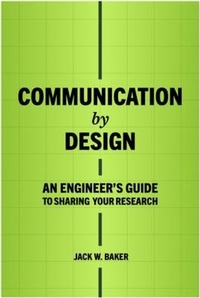
Communication by Design
Description

You don't need to become a charismatic speaker or a gifted writer to be a great communicator. You're already a world-class problem solver. Communication by Design shows you how to apply the systematic design process you already know to your presentations, papers, and proposals - ensuring your best technical work gets the attention it deserves.
Drawing on two decades of experience mentoring researchers at Stanford University, Jack W. Baker introduces a five-stage, audience-focused design process - Empathize, Define, Brainstorm, Prototype, and Test - and applies it to the communication challenges that define academic careers. From structuring a conference talk to navigating peer review, from designing effective graphics to writing a winning grant proposal, each chapter delivers actionable frameworks backed by research and illustrated with real examples.
Whether you're a graduate student preparing your first presentation or an experienced researcher looking to sharpen your impact, this book gives you a repeatable process for communicating complex ideas clearly and persuasively.
More details
Person
Content
- Audience-focused communication - The audience-focused design process; The draft-and-polish trap; Communication capital
- Designing research presentations - Applying the audience-focused design process; The anatomy of a presentation; Designing slides; Designing graphics; Delivering the presentation; Presentation artifacts
- Designing research papers - Applying the audience-focused design process; The anatomy of a paper; Setting up the study; Visual evidence; Writing with clarity; Paper formatting checklist
- The peer review process - Where to publish your work; Reasons journals reject papers; How to review a paper; Responding to review comments; Challenging peer review situations; Logistics
- Beyond presentations and papers - Advisee-advisor communication; Poster presentations; Conferences; Curriculum vitae; Online presence; Sharing papers, data, and code; Designing proposals; Teaching as a design problem
- Systems and tools - Writing productivity; Literature review strategies; Software for research communication; Artificial intelligence as a design partner
